
On this page
Your needs, this model
Does it fit your priorities?
Does the Galaxy 60P meet a 60-pint AHAM minimum but not 70?
The exact listing identifies the 60-pint rating; its separate saturation figure is not a 70-pint AHAM result.
Explore this need in the finder →Does it support an unmeasured pump route, but fail an essential one-foot lift until a limit is confirmed?
The exact shared manual documents pump mode but gives no numeric maximum rise or total hose reach.
Explore this need in the finder →Does the 60P meet the 60-pint requirement, while app control remains an unknown and cannot satisfy an app-essential choice?
The exact Galaxy 60P page and manual do not establish a Wi-Fi/app function.
Explore this need in the finder →The AlorAir Galaxy 60P keeps the 60-pint AHAM capacity and compact cabinet of the Galaxy 60, but adds a built-in condensate pump and a separate pump-discharge option. That matters only when the site’s drain route needs it; the exact manual does not give a numeric pump-lift or total hose-reach limit.
This assessment uses AlorAir’s exact Galaxy 60P listing and its linked Galaxy 60P/85P user manual. The linked model page presents a 60-pint rating; the separately listed saturation figure is not used as the AHAM capacity. No hands-on or laboratory performance is implied.
The suffix changes water handling, not the capacity class
AlorAir lists 60 pints per day at AHAM conditions and 145 pints per day at saturation. The 145 figure is a different, warmer and more humid test condition, not a 145-pint AHAM class. The listed area is up to 1,800 square feet, which is a marketing guide rather than a calculation of moisture load in an unsealed or wet crawl space. For capacity choices, the Galaxy 60 and 60P therefore belong together: both meet a 60-pint minimum but neither meets 70 or 80 pints at the stated AHAM rating. The Galaxy 85P is the capacity step-up if a documented 80-pint threshold is essential.
The 60P is a 47.5-pound unit measuring 21.3 by 11.7 by 14.1 inches. AlorAir lists a 115-volt, 60-hertz supply and 4.5 amps, MERV-1 filtration, 165 CFM and a sound rating below 49 dBA. Those are maker-published specifications, not a measured comparison against another machine. The basic filter is not an advanced air-cleaning system. Exact Wi-Fi/app operation and ENERGY STAR certification were not established in the checked 60P page and manual, so a shopper who requires either should not assume the pump-equipped suffix supplies it.
Two drainage modes; no invented lift limit
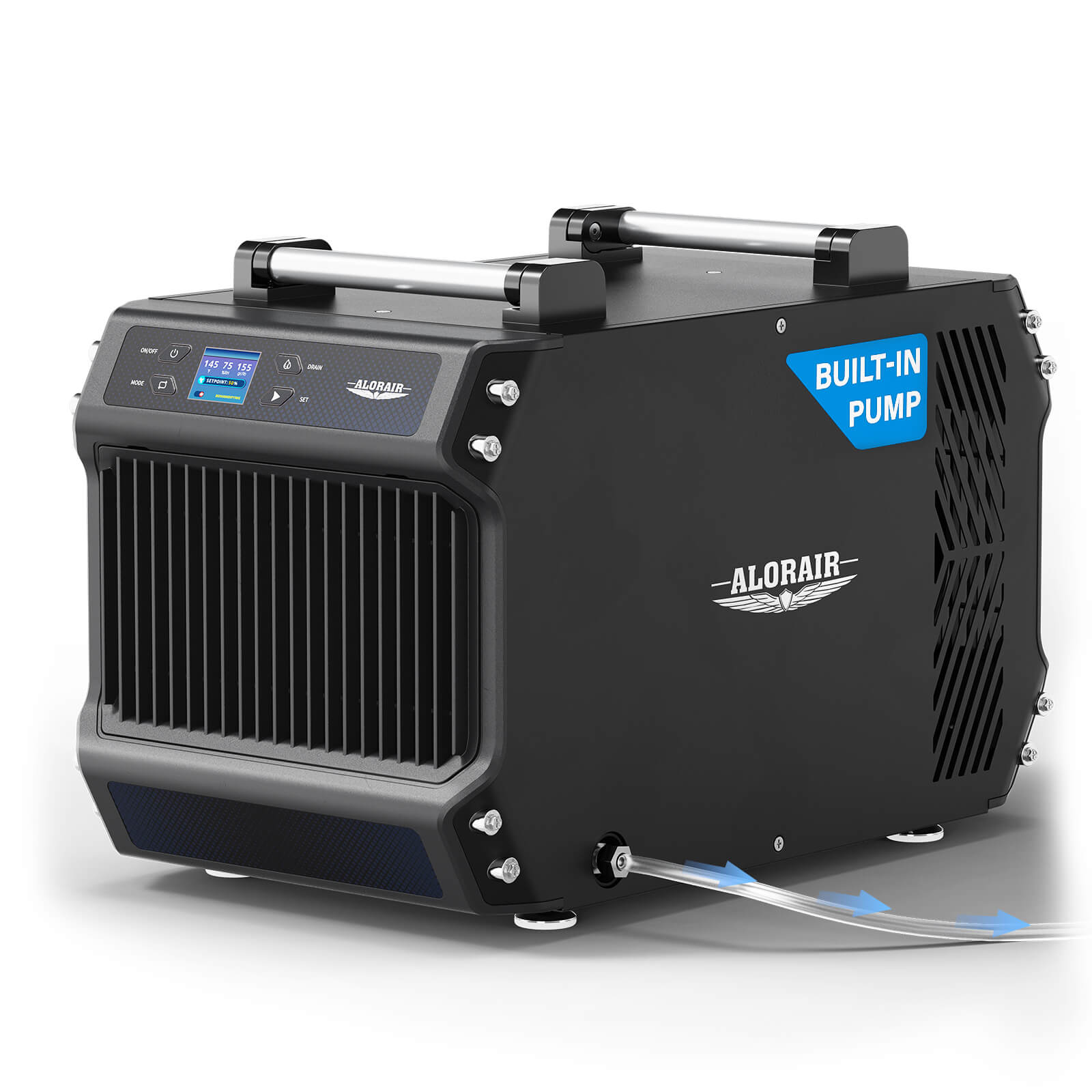
The product page names a pump and drain hose. The shared manual is explicitly labeled for Galaxy 60P and 85P and shows separate gravity and pump drainage connections. On its operation page, a three-second hold of Drain switches between pump and gravity modes, with gravity the default; a short press starts a manual water-drain action. In pump operation, the manual describes a water-level-controlled cycle lasting 28 seconds. This provides a more useful distinction than simply labeling the unit “pump equipped”: the installation can select gravity when a lower drain is available, or use the built-in pump when the route requires discharge above the appliance.
The documentation does not state how many feet the pump can lift or the total distance its hose can travel. A built-in pump therefore supports a general pump-route preference, but it does not satisfy an essential measured-rise or hose-length requirement. Measure the vertical rise from the outlet and the complete route, then ask AlorAir to confirm both against the exact current instructions. The product image itself includes a pump label; it is not a source for a safe operating limit. For a gravity setup, place the outlet above the drain and preserve a continuous downhill route. The manual is the authority for the selected mode and line routing.
Choose it for the site, not the word “pump”
Compared with the plain Galaxy 60, the 60P is the more relevant configuration when a pump might be needed, while its capacity, cabinet dimensions and dry weight stay in the same class. Compared with the Galaxy 85P, it gives up 25 AHAM pints per day but is listed about 9.8 pounds lighter. The right question is whether your building needs a higher capacity rating or a different water route, not whether the larger number looks safer. The manual also calls for a level installation and a suitable electrical supply; do not use an extension cord or plug adapter as a workaround.
Who should shortlist it?
Shortlist the Galaxy 60P for a crawl space or basement needing a 60-pint AHAM class and where the pump can simplify a verified discharge route. It is not a fit when the required rise exceeds an unknown maximum, when the outlet must reach a specified distance, or when app control is essential. A known lower drain and no pump need favor the gravity-only Galaxy 60; a supported 80-pint requirement favors the 85P. Do not turn the separate saturation number into an upgraded capacity recommendation, and do not infer the product’s operating cost or real-room moisture removal from its COP or square-foot claim alone.
Key details at a glance
| Published daily removal rating | 60 pt/day |
|---|---|
| Built-in lift pump | Yes |
| Bucketless operating mode | Yes |
| Published product weight | 47.5 lb |
| Capacity rating test conditions | 60 pints/day at 80°F/60% RH AHAM; the separate 145-pint saturation result is not the AHAM rating. |
| Manufacturer marketed area claim | 1800 sq ft |
More specifications and setup details
| Filter type/choice listed | MERV-1 |
|---|
Use the exact model’s instructions for operating limits, supplied equipment and version differences.
Sources for this assessment

Check the route before the room-size claim.
Match the rated capacity and drainage setup to a real place for the water to go.