
On this page
Your needs, this model
Does it fit your priorities?
Does Galaxy 85P meet an 80-pint AHAM floor but not 100?
The exact sheet lists 85 pints/day at AHAM conditions and 180 pints/day at saturation; only the former is the ordinary capacity rating.
Explore this need in the finder →Does it support a pump route without proving a required one-foot lift?
The linked manual documents pump mode, but the exact source set gives no numeric vertical lift or pump-hose reach.
Explore this need in the finder →Does its 57.3-pound dry weight fit a 58-pound cap but exceed a 55-pound cap?
The exact specification lists 57.3 pounds before any accessories or water.
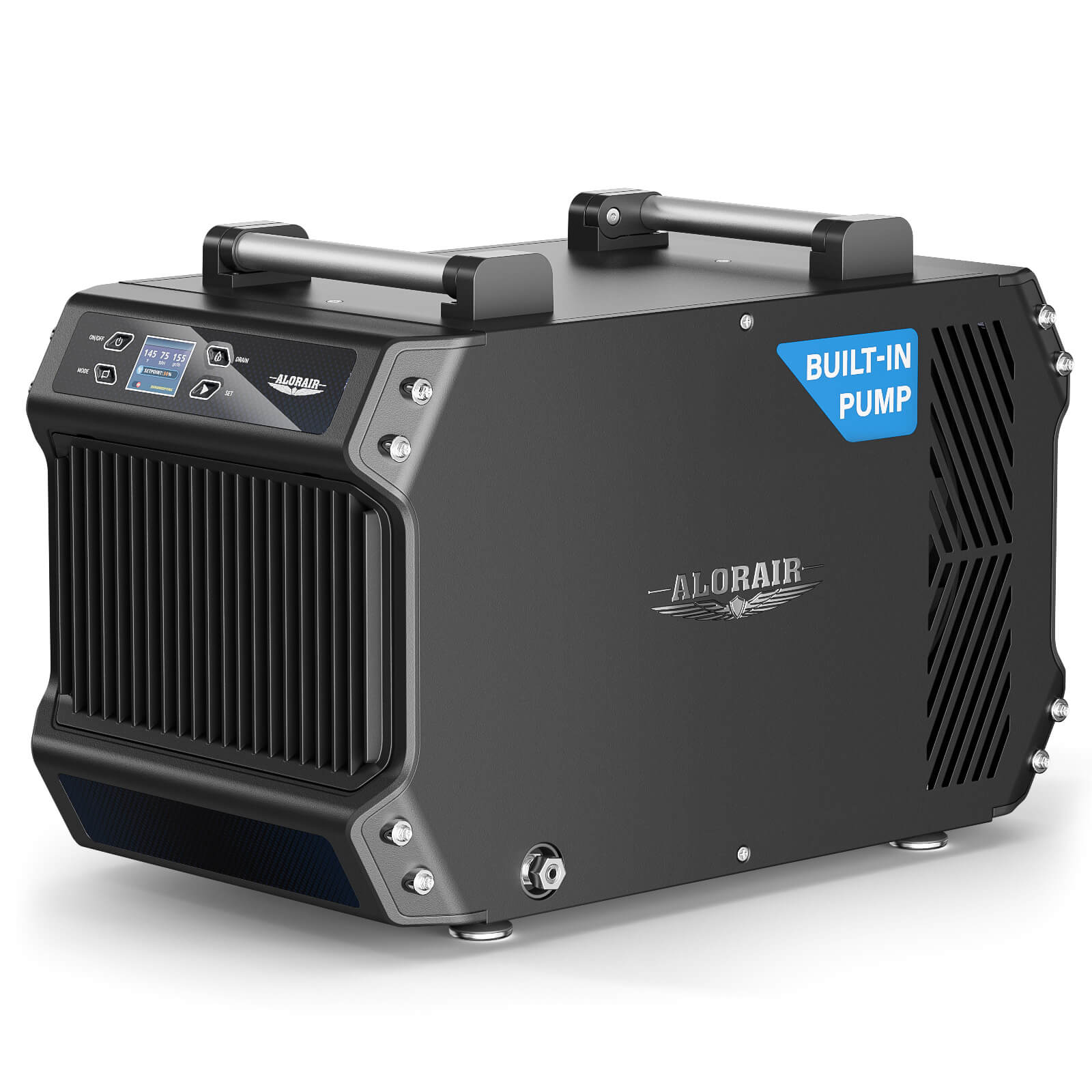
Explore this need in the finder →The AlorAir Galaxy 85P is the higher-capacity pump-equipped option in the Galaxy family: 85 pints per day at the AHAM condition, a listed pump-and-gravity manual, and a 57.3-pound cabinet. It suits a verified 80-pint need better than the 60-pint siblings, but its maximum pump lift and hose reach remain unstated.
I checked AlorAir’s Galaxy 85P product page, its linked 85P specification sheet, and its 85P manual. The 60P/85P operating manual is also linked in the 60P listing. This is an assessment of those manufacturer sources, not a hands-on test.
85 AHAM pints, not 180
The specification gives 85 pints per day at AHAM conditions and a separate 180-pint saturation figure. The hotter, wetter saturation result is not interchangeable with the normal rating used for a 60-, 70- or 80-pint minimum. AlorAir markets the 85P for up to 2,300 square feet; that is not a moisture-load calculation, and a damp crawl space can need a different capacity than its floor area suggests. Correct water entry and ground moisture before relying on a larger compressor to compensate for building problems.
The exact sheet lists a 115-volt supply, 5.3 amps, COP 2.7, 194 CFM and sound below 55 dBA. It uses a MERV-1 pre-filter. A low-grade pre-filter can catch larger debris but does not make this a high-efficiency air cleaner. The 37.4°F low end and automatic defrost support lower-temperature operation within the published range; they are not a guarantee against freezing conditions. The exact sources reviewed here do not establish Wi-Fi/app control or ENERGY STAR certification, so neither should be assumed from a product image or a neighboring AlorAir model.
Pump flexibility with an important unknown
The 85P product listing identifies a built-in pump and drain hose. Its model-specific documentation supports both pump and gravity discharge. In the shared Galaxy 60P/85P manual, the Drain control switches modes when held for three seconds; gravity is the default, while a short press initiates manual draining. The manual also describes an automatic pump cycle after the internal water level reaches its trigger. This gives the installer two different plans: route a gravity line continuously downhill to an acceptable outlet, or use the pump for a higher discharge.
The available materials do not state a maximum pump rise or total hose length. The exact 85P specification sheet also contains a confusing graphic caption that associates a 19.6-foot line with gravity drainage while the configuration has an internal pump. Because that image does not clearly establish a pump maximum, I leave both the numeric lift and pump-hose reach unknown rather than presenting 19.6 feet as a safe limit. If your drain route depends on a particular rise or distance, obtain written confirmation for the exact 85P, then compare the proposed layout with its manual. A pump label alone cannot answer that installation question.
Capacity costs weight, not floor space
At 57.3 pounds, the 85P is about 9.8 pounds heavier than the manufacturer’s 47.5-pound Galaxy 60 and 60P. Yet the three are listed with the same 21.3-by-11.7-by-14.1-inch footprint. That can be useful where a narrow installation location remains fixed, but plan for access and service clearance; matching cabinet width does not prove a unit can be carried safely through a hatch or handled by one person. The product page’s in-stock state can change, and the archived listing displayed a notification option rather than confirming immediate availability.
In the questionnaire, an 80-pint minimum admits the 85P while the 60-pint models do not; a 100-pint minimum admits none of this trio. A pump preference admits the 85P and 60P, but a measured pump-height requirement cannot be verified from the exact source set. A gravity-only plan can make the 85P usable without pump mode when the drain is lower, so the pump feature does not force an uphill installation.
Who should shortlist it?
Consider the Galaxy 85P when the required published capacity is at least 80 pints per day, a crawl-space or basement location suits its operating range, and either its lower gravity route or a manufacturer-confirmed pump layout fits. Consider the 60P if 60 pints is sufficient and a pump route matters; choose the Galaxy 60 if a lower gravity drain is available and the pump is unnecessary. Do not select the 85P merely for its 180-pint saturation label or 2,300-square-foot marketing range. Its meaningful advantages are the higher AHAM rating and dual documented drain modes; its practical limits are weight and missing numerical pump-routing specifications.
Key details at a glance
| Published daily removal rating | 85 pt/day |
|---|---|
| Built-in lift pump | Yes |
| Bucketless operating mode | Yes |
| Published product weight | 57.3 lb |
| Capacity rating test conditions | 85 pints/day at 80°F/60% RH AHAM; the separate 180-pint saturation result is not the AHAM rating. |
| Manufacturer marketed area claim | 2300 sq ft |
More specifications and setup details
| Filter type/choice listed | MERV-1 |
|---|
Use the exact model’s instructions for operating limits, supplied equipment and version differences.
Sources for this assessment

Check the route before the room-size claim.
Match the rated capacity and drainage setup to a real place for the water to go.