
On this page
Your needs, this model
Does it fit your priorities?
Does the Helios MP35 meet a 35-pint AHAM minimum but fail a 36-pint minimum?
The exact MP35 product page states 35 PPD AHAM and 70 PPD saturation.
Explore this need in the finder →Can it support a 15-foot vertical pump rise but not a 20-foot requirement?
AlorAir lists up to 19.6 ft of vertical lift; total route length remains a different, unreported figure.
Explore this need in the finder →Can the MP35 stay eligible when app control is optional, but not when app control is required?
The MP35 page does not identify the Wi-Fi panel variant; family illustrations alone do not establish app control for this exact product.
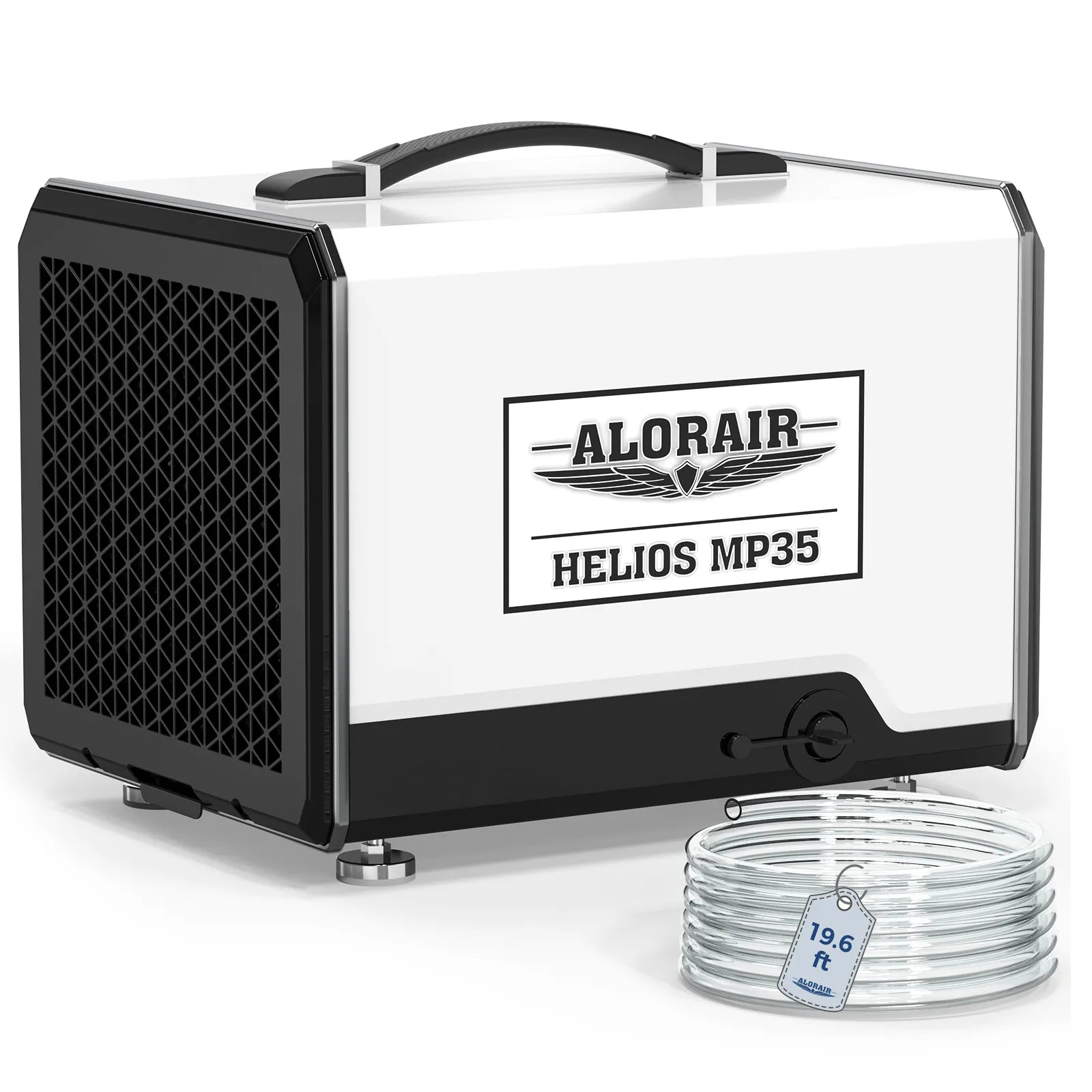
Explore this need in the finder →The AlorAir Helios MP35 is a 35-pint-AHAM crawl-space dehumidifier with a built-in pump and gravity alternative. It shares a capacity class with the Helios D35, but the MP35 is the model to consider when the discharge point sits higher than the appliance.
This review uses the exact Helios MP35 U.S. product page and the linked shared MP35/MP55 manual. The manual is one family document; the product-specific identity and listed ratings come from the MP35 page.
Same AHAM class as the D35, different installation
AlorAir lists 35 pints per day at AHAM conditions and 70 pints at saturation. The saturation figure should not be substituted for the standard rating. Its up-to-1,000-square-foot area claim is a broad manufacturer estimate, not a load calculation. Temperature, soil contact, ventilation and water intrusion can change what is needed in a real crawl space.
The MP35 page lists 126 CFM, a COP of 2.12, 55 dBA, R32 refrigerant, a MERV-1 filter, a 33–105°F operating range and a body measuring 20.5 by 15.4 by 14.7 inches at 35.94 pounds. These details provide a more useful installation comparison than the area headline alone. The page does not establish ENERGY STAR certification for this exact model.
Its pump has a published lift ceiling
The exact page describes the built-in pump and up to 19.6 feet of vertical discharge, and the shared MP manual covers pump and gravity operation. That numeric height is useful when the outlet is uphill. It is not the same as total hose distance: the route may include horizontal segments, bends and the final discharge location. The manufacturer’s sources do not establish total pump-line reach or the precise length of the supplied pump hose, so measure the route and confirm it against current model instructions.
If a lower floor drain is available, the manual also documents gravity drainage. Keep the hose end below the drain port, with a continuous downward slope. Do not combine the pump and gravity arrangements into one imaginary route; choose the one your space actually supports. If your only outlet is above 19.6 feet, this model does not meet that stated lift requirement.
Controls and the setpoint discrepancy
The manual documents grounded/GFCI supply requirements, GPP and humidity-control functions, memory restart and filter care. The exact page advertises a 25–80% RH range, while the linked manual’s family control instructions describe 20–80% in five-point steps. Because the lower endpoints conflict, the profile keeps the exact range unknown instead of choosing whichever is more attractive. The upper endpoint is consistently 80% in those sources, but this is not an argument for buying it to reach a particular low setpoint.
The manual includes drawings of both Wi-Fi and non-Wi-Fi control panels for the broader MP35/MP55 family. The MP35 product page does not identify which wireless configuration is being sold, so Wi-Fi and app control remain unconfirmed for this exact suffix. Optional remote accessories are not proof of phone control. If remote app operation or ENERGY STAR status is essential, ask the seller or manufacturer for exact model-specific evidence before ordering.
Who should shortlist the MP35?
It fits a modest crawl-space or basement job where a 35-pint AHAM class is adequate and an uphill drain route needs a pump with a stated vertical limit. It is a better practical match than the Helios D35 when gravity cannot work, but the D35 is lighter, smaller and has an exact ENERGY STAR 6.0 claim. The Sentinel HD35P WiFi has the same 35-pint rating and confirmed app control, although its conflicting humidity settings require a separate check. These alternatives illustrate why a feature from a similarly sized model should never be transferred to the MP35.
The MP35 is not ideal if quiet operation is the main priority: its listed 55 dBA figure is a published specification, not a measurement in your location. Nor should the up-to-1,000-square-foot claim determine sizing by itself. The filter is listed as MERV-1; that is not an advanced filtration or medical result. A dehumidifier also cannot repair an active leak or replace crawl-space moisture control.
Plan access and drainage before installation
Check that the unit can pass through the access hatch, sit level and remain reachable for filter cleaning. The manual calls for a grounded outlet and gives specific drain setup guidance; do not use an extension lead as a workaround where the maker prohibits it. Before relying on the pump, confirm the outlet elevation and full line route, including horizontal distance, and determine how the line will be secured and inspected. The MP35’s defining advantage is a documented 19.6-foot vertical pump route in a 35-pint class, not a guarantee that every longer run will work.
Key details at a glance
| Published daily removal rating | 35 pt/day |
|---|---|
| Built-in lift pump | Yes |
| Stated maximum vertical pump height | 19.6 ft |
| Published product weight | 35.94 lb |
| Capacity rating test conditions | 35 PPD at AHAM conditions; the separate 70 PPD saturation number uses a different, wetter test condition. |
| Manufacturer marketed area claim | 1000 sq ft |
More specifications and setup details
| Published sound rating | 55 dBA |
|---|---|
| Filter type/choice listed | MERV-1 |
Use the exact model’s instructions for operating limits, supplied equipment and version differences.
Sources for this assessment

Check the route before the room-size claim.
Match the rated capacity and drainage setup to a real place for the water to go.