
On this page
Your needs, this model
Does it fit your priorities?
Can the HD55S Wi-Fi meet a 50-pint AHAM minimum with app control, and does it meet 60?
It meets 50 at its 55-pint AHAM rating, but not a 60-pint minimum. The separate 120-pint saturation figure is not used as AHAM capacity.
Explore this need in the finder →Can the HD55S Wi-Fi serve a bucketless gravity-and-short-duct setup but not an upward pump route?
Yes for the documented gravity route with up to six feet of six-inch supply duct; no built-in pump lift is documented.
Explore this need in the finder →Does Wi-Fi app control mean the HD55S can start or stop a built-in lift pump?
No. The Wi-Fi page documents app control of the dehumidifier, while the linked manual says the HD55S drains by gravity and recommends a separate pump or HDi65S if gravity fall is impossible.
Explore this need in the finder →Can a user require both exact app control and a 60-pint AHAM rating from this model?
No. App control is documented but the exact AHAM rating is 55 PPD.
Explore this need in the finder →The AlorAir Sentinel HD55S with Wi-Fi combines a 55-pint-per-day AHAM rating with app-based monitoring and a compact crawl-space/basement format. It is the more interesting choice when the machine will be installed out of sight and you want to adjust it remotely—but it remains a gravity-drain model. Wi-Fi does not remove the need for a dependable lower drain or turn the unit into the pump-equipped HDi65S or HD55P.
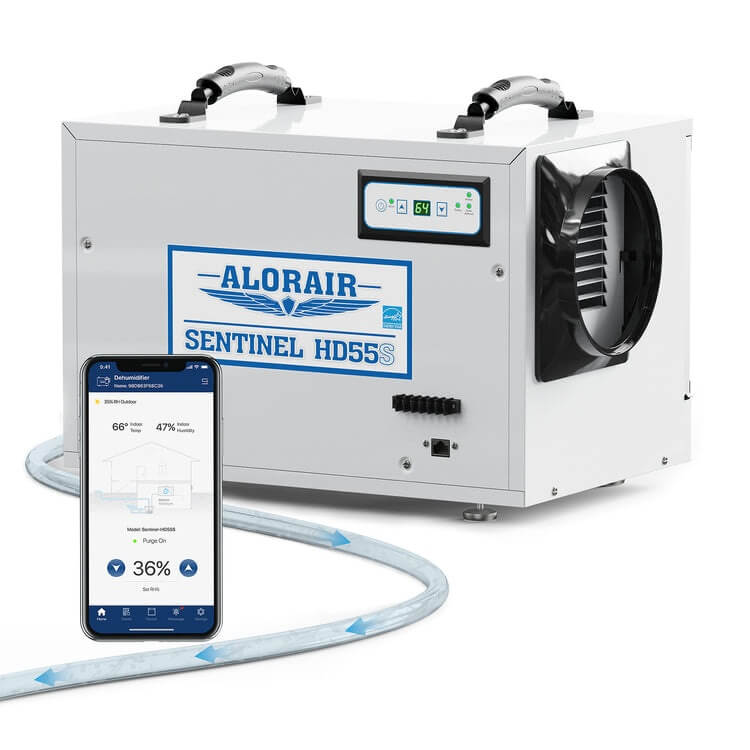
I checked AlorAir’s exact HD55S Wi-Fi product page, its page-linked 2024 Sentinel HD55/HD55S manual, the Wi-Fi specification sheet, and the AlorAir Crawl Space & Basement listing. The page links a Wi-Fi monitoring illustration rather than a close-up unit photograph; the image caption identifies it as a feature illustration, not hands-on photography.
Use the AHAM rating, not the saturation headline
The exact product page states 55 pints per day at 80°F/60% RH (AHAM) and 120 pints at 90°F/90% RH saturation. The second number is not a substitute for a 120-pint AHAM capacity. AlorAir markets the unit for spaces up to 1,300 square feet, but that is not a moisture-load calculation. A crawl space’s ground moisture, air leakage, vapor barrier, temperature and door/vent conditions can change the required capacity. Compare the 55-pint AHAM number with other AHAM ratings and consider the actual enclosure before treating the coverage estimate as a fit guarantee.
Remote control is useful only if the network reaches it
The Wi-Fi version connects to AlorAir-C. Its product page describes app control, and the linked manual’s Wi-Fi section explains pairing from the machine’s control panel. AlorAir recommends placing the router nearby for a stable signal. That is a practical caveat for a metal-bodied unit under a floor or behind a basement wall: verify your signal where the dehumidifier will sit rather than assuming a phone app can overcome a weak connection. The manual also describes ordinary local controls, so app access is an additional convenience rather than the only way to operate the unit.
The page and specification sheet both identify the 55-pint model as ENERGY STAR/cETL certified, with 115 V/60 Hz power, 4.1 A, 130 CFM airflow, MERV-1 filtration and a 2.4 L/kWh COP figure. The manufacturer’s temperature range is 33.8–104°F. These are published specifications, not independently measured results. AlorAir’s current product-page table and linked specification sheet disagree on several other details: refrigerant is listed as R32 on the page and R410A on the sheet; weight is listed as 41.7 versus 44 pounds; noise is shown as below 50 versus below 52 dBA. The humidity lower endpoint also differs between the current page (36%) and family manual (35%). I leave those fields unresolved instead of selecting the more convenient value. The dimension values are the same set, but the category card’s depth/width labels and product page’s L×W×H notation are not fully aligned; check the manufacturer drawing if clearance orientation is critical.
Plan the water route before choosing Wi-Fi
The user manual documents gravity drainage. It calls for a smooth downward route with no loops, dips or valleys and a minimum downward slope of one inch per ten feet. The manual describes a 12-inch drain tube, but the product-page box list does not enumerate that part, so confirm the supplied package rather than assuming that short tube is enough for a long installation. There is no built-in condensate pump on this exact HD55S configuration. The manual recommends the pump-equipped Sentinel HDi65S or a separate external pump when gravity fall is not possible; an external pump is a separate installation, not a built-in pump match.
The HD55S also supports a limited ducted setup: the manual describes a standard supply adapter for six-inch flex duct and a maximum six-foot duct length. That can help send treated air into an adjacent area, but it is not a promise that the dehumidifier can supply a long central HVAC duct network. The planned drainage and duct arrangement need to coexist; use the gravity-and-duct setup only when the drain still falls correctly.
How the questionnaire should treat it
A 50-pint AHAM minimum can include the HD55S; a 60-pint minimum should not count the saturation rating. Essential app control and ENERGY STAR choices are supported by the exact page and specification sheet. Gravity drainage, a bucketless operating plan and the short duct option can fit together in one documented installation, but an essential lift-pump requirement should exclude this configuration. The page’s Wi-Fi tag also must not be transferred to the non-Wi-Fi HD55S White or Gold cards, the HD55P, or the HDi65S family just because their names look similar.
Who should choose it—and who should not
This is a sensible shortlist candidate for an out-of-the-way space with a suitable gravity drain, an AHAM load within the 55-pint class, and a real need to check or change settings from a phone. It is a weaker fit if your drain is uphill, the router signal is poor, or a dimension, noise, refrigerant or humidity-range limit is essential—the manufacturer’s own exact-source set does not agree on each of those fields. If drainage lift matters more than app control, compare the exact pump-equipped HD55P. If capacity and app access are both essential, verify the pump and connectivity on the particular model page rather than reading features across the Sentinel range. No hands-on test, price, stock promise or consumer-review summary is being claimed here.
Key details at a glance
| Published daily removal rating | 55 pt/day |
|---|---|
| Built-in lift pump | No |
| Wi-Fi enabled | Yes |
| ENERGY STAR certified | Yes |
| Published dimensions | The current category card explicitly labels 12.2-in depth ×19.2-in width ×13.3-in height; the PDP labels the same values L×W×H. Confirm orientation with AlorAir drawing if clearance is critical. |
| Bucketless operating mode | Yes |
More specifications and setup details
| Advanced filter included | No |
|---|---|
| Pump activation through app | No |
| Capacity rating test conditions | 55 pints/day at AHAM conditions (80°F/60% RH); 120 pints/day is the separate saturation-condition figure. |
| Manufacturer marketed area claim | 1300 sq ft |
| Documented HVAC duct integration | Yes |
| Filter type/choice listed | MERV-1 |
Use the exact model’s instructions for operating limits, supplied equipment and version differences.
Sources for this assessment

Check the route before the room-size claim.
Match the rated capacity and drainage setup to a real place for the water to go.