
On this page
Your needs, this model
Does it fit your priorities?
Does the HD90 meet an 80-pint AHAM minimum while remaining below 100 pints?
Yes at its exact 90-pint AHAM rating; the 198-pint saturation number does not meet a 100-pint AHAM threshold.
Explore this need in the finder →Can the HD90 use a documented bucketless downhill drain, but not an upward pump route?
The exact HD90 manual documents gravity drainage with a continuous fall; no built-in lift pump is specified.
Explore this need in the finder →Does this no-Wi-Fi HD90 support HVAC ducting without satisfying an app-control requirement?
Its manual describes ducted applications; the no-Wi-Fi guide and optional wired-remote listing do not establish phone-app control.
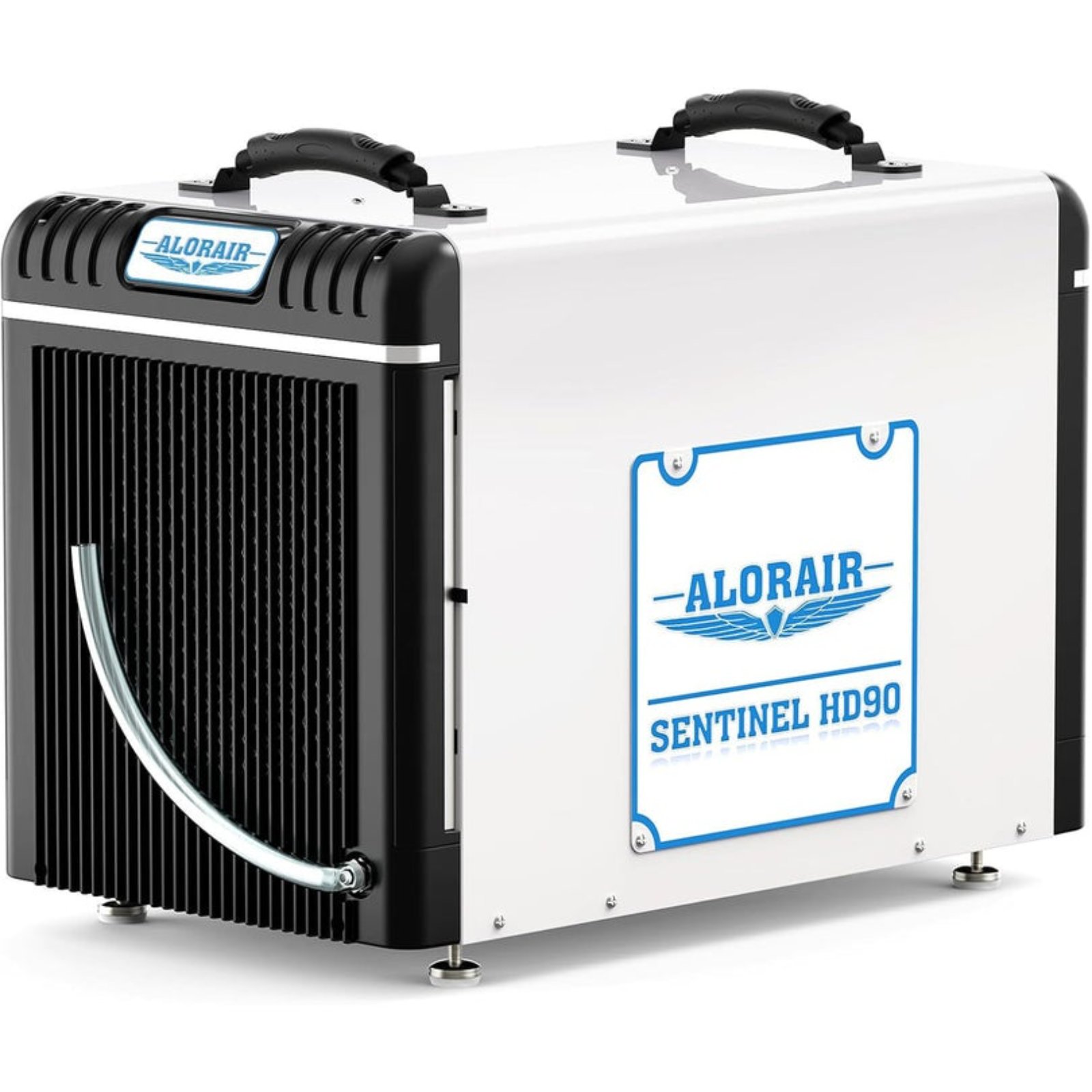
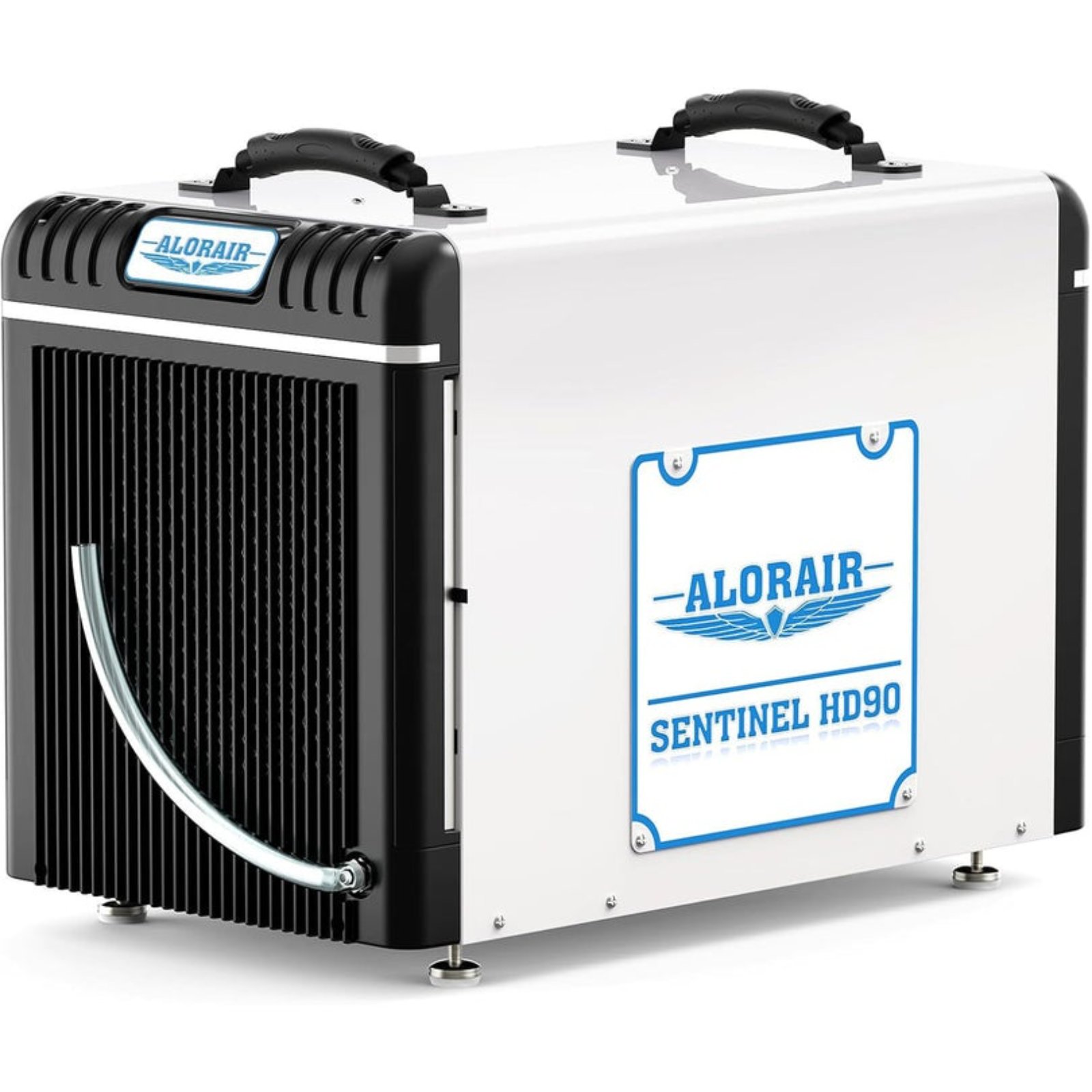
Explore this need in the finder →The AlorAir Sentinel HD90 is a 90-pint-per-day crawl-space and basement dehumidifier with a gravity-only drain. It suits an installation where condensate can travel continuously downhill to a drain; there is no built-in lift pump to overcome a raised outlet.
This assessment uses AlorAir’s exact Sentinel HD90 page, its HD90 specification sheet, and the page-linked HD90 installation and operations manual.
Keep AHAM, DOE and saturation ratings separate
AlorAir’s current page and spec sheet list 90 pints per day at AHAM conditions (80°F and 60% relative humidity). The sheet separately gives a 47.71-pint DOE figure at 60°F/60% RH and 198 pints at saturation. Those are different test conditions, not three interchangeable promises. A shopper asking for a 90-pint AHAM model can consider the HD90; the high saturation number is not the right threshold for a normal basement comparison. The manufacturer markets the unit for areas up to 2,600 square feet, but that area figure cannot account for outside air leakage, wet soil, standing water, temperature, room partitions or a missing vapor barrier. Repair bulk-water entry and estimate the actual moisture load before treating a large advertised area as a guarantee.
Gravity drainage is a hard installation constraint
The HD90’s published drainage method is gravity. Its manual says the drain line must descend to an appropriate outlet without loops, dips or valleys; it gives a minimum downward slope of one inch for each ten feet of line. This makes the model a sensible candidate when the unit can sit above a nearby floor drain or a properly routed exterior discharge. It is not the right fit for a crawl space whose only outlet is higher than the appliance. The HD90 has no documented built-in pump, so selecting a pump-lift answer in the finder excludes it for the right reason. The manual does not give a maximum gravity-hose length or confirm a hose is in the retail box; plan the route and confirm any needed tubing before installation.
Duct support is not the same as a duct kit
The exact manual includes a ducted-application section. It says a supply duct adapter is standard on this series and describes connecting a 12-inch return duct; the return collar is optional. That is useful for a basement where the equipment can stay in one location while conditioned air is routed elsewhere, but the evidence does not make every collar, flex duct or installation accessory part of the purchase. The sheet also lists an optional remote controller. That is a wired remote-control option, not proof of phone-app control. Wi-Fi, app operation, remote pump activation and exact-model ENERGY STAR status are not established for the HD90 in these sources, so those answers should not be treated as yes.
Plan access, power and routine care
The spec sheet gives a 115-volt, 60-Hz supply, 5.56-amp current, 210-CFM airflow, 2.69 L/kWh COP, R32 refrigerant, 33.8–104°F operating-temperature range and 36–90% humidity-setting range. It lists a 23.2 × 15.2 × 17.7-inch cabinet and 67.2-pound weight. That is compact relative to many restoration units but still heavy enough that a tight access hatch, joist opening or stair turn needs measurement before delivery. The manual calls for a grounded 15-amp circuit, a level installation surface and clear air inlets and outlets. It describes automatic defrost, a washable pre-filter and an optional MERV-8 filter. Clean the filter and inspect the drain route regularly; a gravity appliance depends on that path staying open and sloped.
Who should choose the HD90?
Choose it when the priority is a high-capacity, duct-capable crawl-space or basement unit and you already have a dependable lower drain. Its 90-pint AHAM rating clears a 50-, 60- or 80-pint minimum but not a 100-pint minimum. Choose an HDi90 pump configuration instead if the outlet must rise, but verify the required vertical lift with the manufacturer: the available HDi90 materials reviewed here do not publish a numerical pump-rise limit. If app control is essential, the exact HD90 record does not establish it; compare the distinct HDi90 Wi-Fi listing rather than assuming an optional remote accessory adds Wi-Fi. For a small room with a collection-bucket preference, a portable household model may be easier to install and maintain. The HD90’s advertised floor area should not override drainage, access or moisture-load planning.
Key details at a glance
| Published daily removal rating | 90 pt/day |
|---|---|
| Built-in lift pump | No |
| Wi-Fi enabled | No |
| Bucketless operating mode | Yes |
| Published product weight | 67.2 lb |
| Compatible with optional advanced filter | Yes |
More specifications and setup details
| Advanced filter included | No |
|---|---|
| Pump activation through app | No |
| Capacity rating test conditions | 90 PPD at AHAM conditions (80°F/60% RH); the separate 47.71 PPD DOE and 198 PPD saturation figures are not interchangeable. |
| Manufacturer marketed area claim | 2600 sq ft |
| Documented HVAC duct integration | Yes |
| Filter type/choice listed | MERV-1 |
Use the exact model’s instructions for operating limits, supplied equipment and version differences.
Sources for this assessment
Check the route before the room-size claim.
Match the rated capacity and drainage setup to a real place for the water to go.