
On this page
Your needs, this model
Does it fit your priorities?
Does the HDi120 satisfy a 110-pint AHAM minimum but fail a 130-pint minimum?
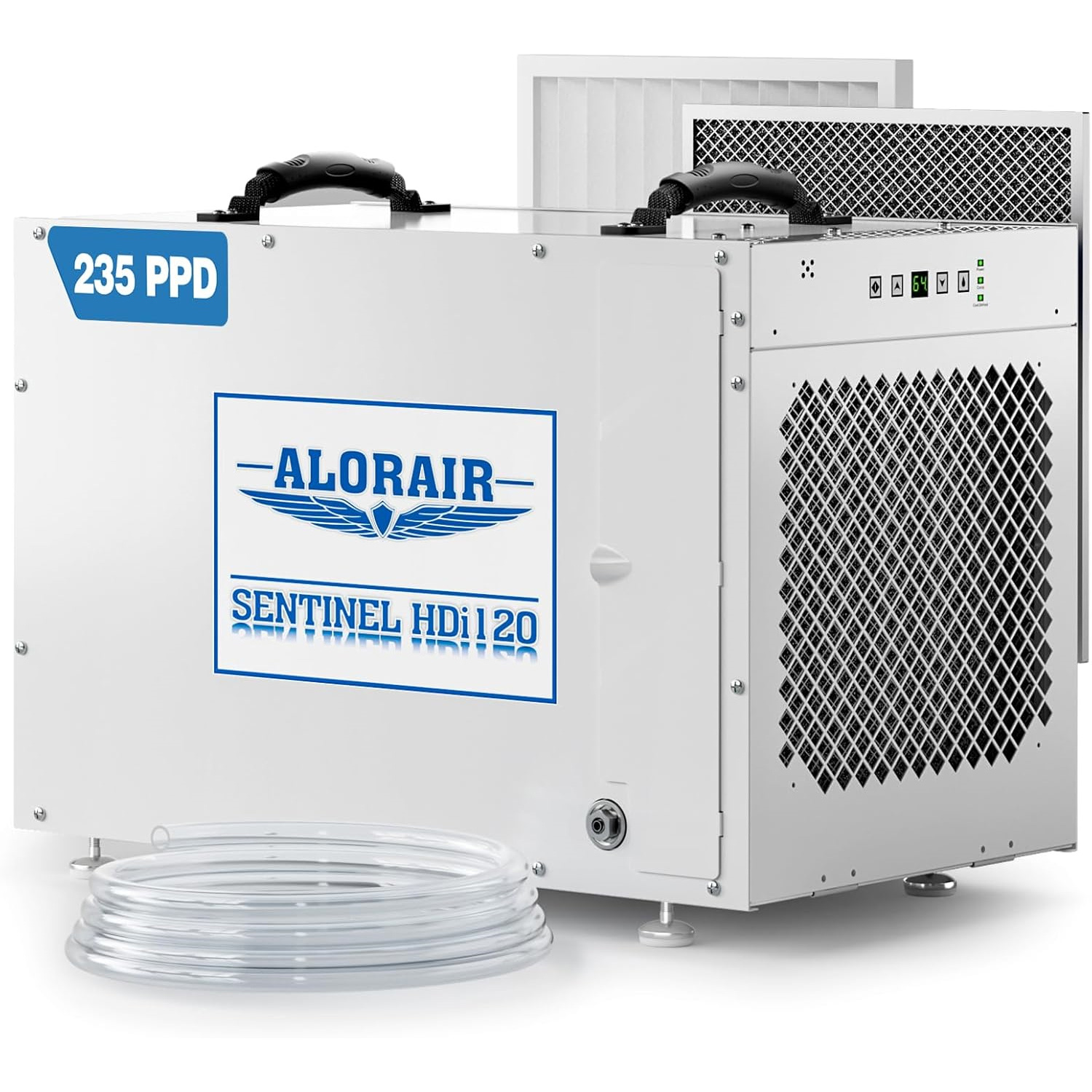
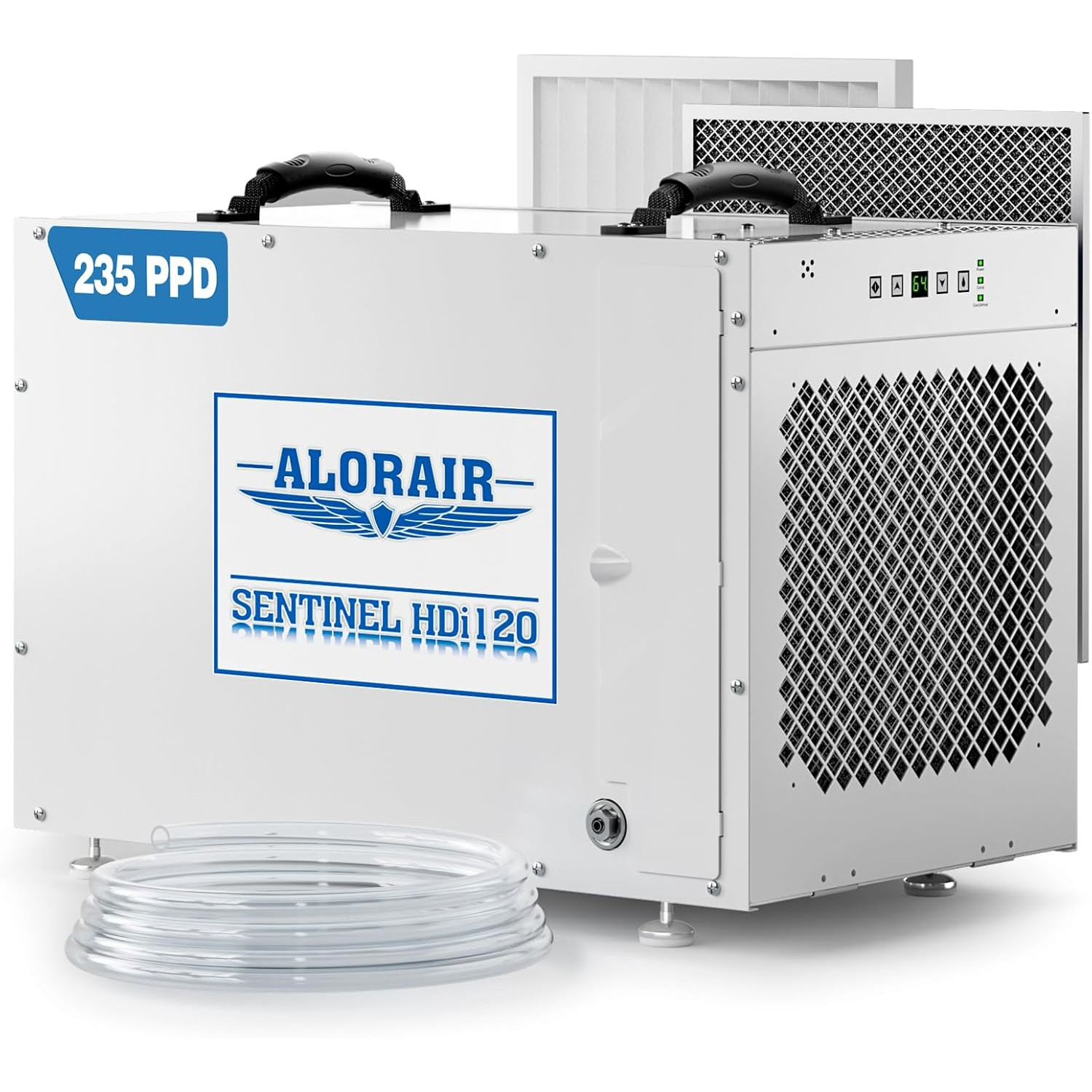
The exact sheet and linked manual list 120 pints/day at AHAM conditions; the 235-pint saturation and 93-pint DOE values are separate conditions.
Explore this need in the finder →Does the HDi120 support a pump-drain route but fail an essential one-foot maximum-lift check?
The exact manual describes the built-in pump and automatic normal drainage but publishes no numeric maximum vertical rise or total hose route. The visible 19.6-foot pipe length is not a vertical-lift specification.
Explore this need in the finder →Can the HDi120 serve a short ducted installation without treating an unverified ENERGY STAR status as positive?
The exact manual documents 10-inch flex duct and a 10-foot maximum total run with optional inlet/outlet adapters. Neither the product page nor its exact sheet/manual establishes ENERGY STAR certification.
Explore this need in the finder →The AlorAir Sentinel HDi120 is the higher-rated member of the compact HDi100/120 crawl-space and basement pair. Its 120-pint AHAM rating and 290 CFM airflow are the material differences; it keeps the same listed cabinet size and still leaves pump lift, total hose reach and remote-app operation unconfirmed.
I checked AlorAir’s Sentinel HDi120 product page, its HDi120 specification sheet, and its installation and operations manual. The performance numbers are manufacturer ratings, not results from an independent test.
What the extra 20 AHAM pints mean
The HDi120 is rated for 120 pints per day at 80°F and 60% RH under the AHAM condition, 93 pints at the separate DOE condition of 73°F and 60% RH, and 235 pints per day at saturation. These figures are not interchangeable. It clears a 110-pint minimum at AHAM conditions, while a 130-pint minimum is not established. The saturation number is not a substitute for the AHAM rating when comparing this machine with another unit.
AlorAir markets coverage up to 3,300 square feet. Treat that as a broad manufacturer claim rather than a design rule: crawl-space leakage, ground moisture, temperature and water entry determine the actual load. The specification lists 290 CFM airflow and 2.7 L/kWh COP, with sound pressure below 60 dBA. The HDi100 is rated at 100 AHAM pints and 250 CFM, so the HDi120’s larger capacity and airflow are the reason to choose it when the need is documented. Its 7.8-amp draw is also higher than the HDi100’s 6.82 amps; confirm the branch circuit and electrical plan rather than treating the two as identical loads.
Pump drainage still needs a site-specific check
This exact configuration includes an integrated condensate pump. Its manual describes automatic pump drainage during normal use and a button that drains the pump reservoir when the unit is being stored or moved. That makes a pump-lift route a supported general operating plan, but it does not answer the number an installer often needs most: the maximum vertical rise. The reviewed manual and spec do not publish a maximum pump lift or total hose length. The product image identifies a 19.6-foot water pipe, but that is not evidence of an allowable 19.6-foot vertical rise or complete route. Measure both elevation and the hose path; ask AlorAir to confirm before placing a drain above the unit.
Do not assume the HDi120 has a consumer bucket mode just because it has a pump reservoir. The sources describe the reservoir as part of pump operation and a manual emptying procedure for storage, not a fitted removable water bucket. Nor do the exact documents establish a numeric “bucketless” or gravity-only setup. A requirement for a pump is supported; a required one-foot or longer lift is not confirmed until the manufacturer provides a limit for the exact configuration.
Short duct runs can solve a placement problem
The installation manual documents a ducted application that can put the dehumidifier in one room and move conditioned air to an adjacent space. Both inlet/return and supply grilles are designed for 10-inch flex duct, and the total duct run must not exceed 10 feet. Inlet and outlet adapters are optional accessories. This can make the HDi120 more workable where a crawl-space access or service location prevents placing the cabinet directly in the target area, but it is not an endorsement of a long duct network. Plan the adapter purchase, route and service access before choosing the larger chassis.
The sheet lists the same dimensions as the HDi100: 23.8 inches long, 14.7 inches wide and 17.9 inches high. At 88 pounds, it is not a lightweight appliance even though the manufacturer describes its cabinet as compact. The manual calls for an upright, level installation with at least six inches of clearance and a grounded 15-amp, 115-volt circuit; the sheet lists 7.8 amps. Check the full opening and service space, not just the published width.
Controls and source conflicts matter
The product page lists MERV-1 and MERV-10 filters in the box, and the exact manual describes local humidity controls, automatic defrost and an optional wired remote using CAT5. That cable-connected remote is not proof of wireless or app functions. The exact page and manuals reviewed do not establish Wi-Fi/app control or ENERGY STAR certification, so either requirement should exclude it from an essential match. The 2025 specification identifies R32, but the manual and the page’s key-feature copy say R410A. Treat the refrigerant as unresolved for this exact model and check the appliance nameplate before any service decision.
Choose it for the need, not the number alone
The HDi120 is the better fit of this pair when the source-backed 120-pint AHAM rating or higher airflow is needed and a pump route plus short duct layout suit the installation. It will not match a 130-pint minimum, a quantified pump-lift limit, a verified app requirement or an ENERGY STAR-only filter. Choose the HDi100 if 100 pints AHAM is sufficient and its lower published amp draw better fits the circuit; consider the HDi90 when 90 pints is enough. AlorAir’s up-to-3,300-square-foot claim can help identify intended scale, but should not replace a crawl-space moisture assessment or correction of bulk-water problems.
Key details at a glance
| Published daily removal rating | 120 pt/day |
|---|---|
| Built-in lift pump | Yes |
| Bucketless operating mode | No |
| Published product weight | 88 lb |
| Capacity rating test conditions | 120 PPD at AHAM conditions (80°F/60% RH); 93 PPD at the separate DOE condition (73°F/60% RH); 235 PPD at saturation. These conditions are not interchangeable. |
| Manufacturer marketed area claim | 3300 sq ft |
More specifications and setup details
| Documented HVAC duct integration | Yes |
|---|---|
| Filter type/choice listed | MERV-1 and MERV-10 |
Use the exact model’s instructions for operating limits, supplied equipment and version differences.
Sources for this assessment
Check the route before the room-size claim.
Match the rated capacity and drainage setup to a real place for the water to go.