
On this page
Your needs, this model
Does it fit your priorities?
Does the HDi55 Blue meet a 50-pint AHAM minimum but fail a 60-pint minimum?
The exact page rates it at 55 PPD AHAM; its separate 120-PPD saturation figure is not substituted.
Explore this need in the finder →Can its built-in pump support a 15-foot vertical rise, but not a 20-foot rise?
The exact manual marks 19.6 feet of pump lift; hose length and vertical rise must still be measured separately.
Explore this need in the finder →Should it be returned when app control is essential, even though its capacity and drain route fit?
The exact HDi55 Blue page and manual do not document Wi-Fi/app control, so that unknown does not satisfy an essential app requirement.
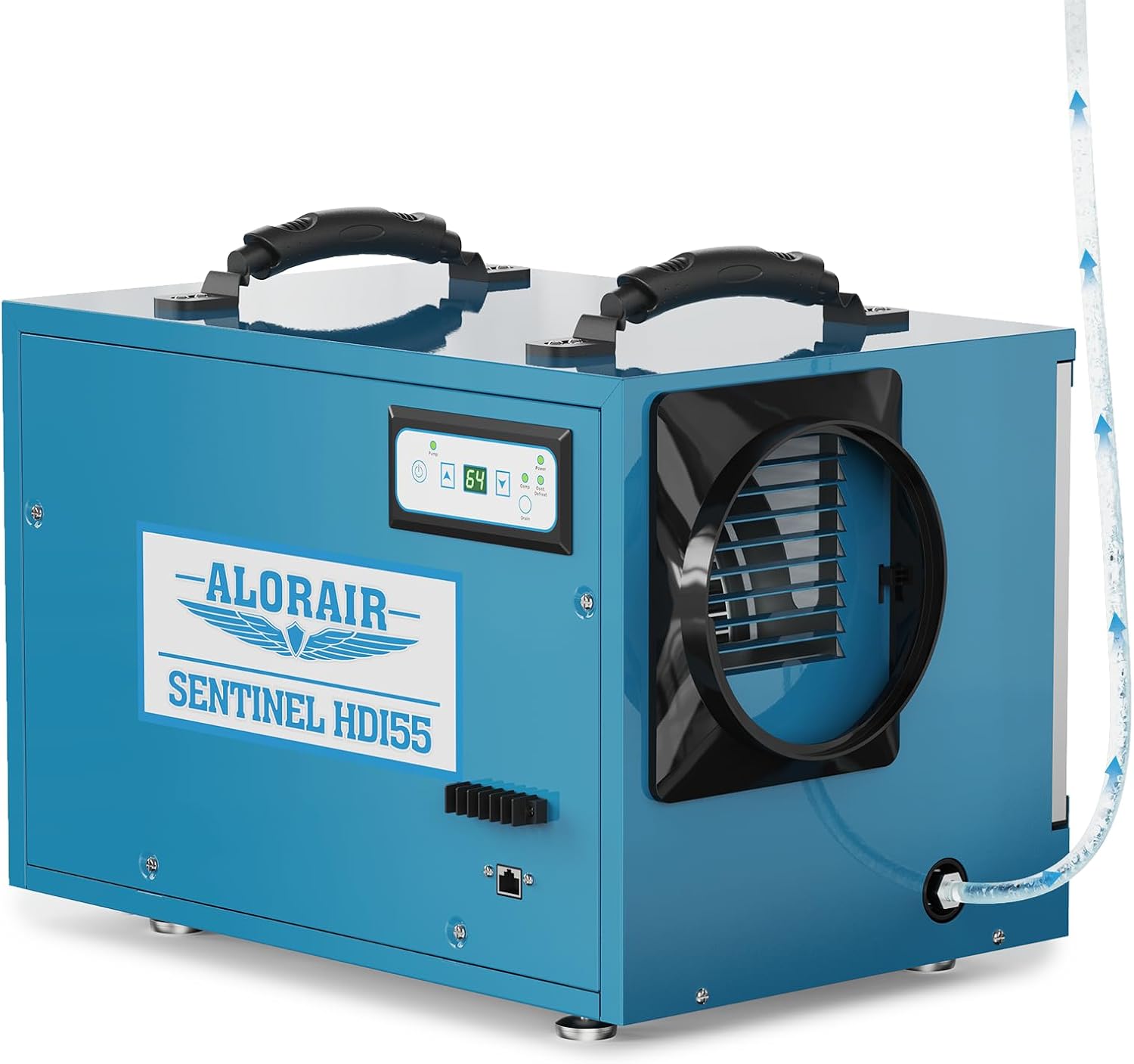
Explore this need in the finder →The AlorAir Sentinel HDi55 Blue is a crawl-space and basement compressor dehumidifier rated at 55 pints per day under AHAM conditions. AlorAir separately advertises 120 pints at saturation, a 1,300-square-foot application, and both pump and gravity drainage. Its useful distinction is the combination of a larger 55-pint class with a built-in lift pump—not a claim that every crawl space of the advertised size has the same moisture load.
This assessment uses AlorAir's exact Sentinel HDi55 Blue page, its page-linked HDi55 installation and operations manual, and the maker's Basement & Crawl Space category listing. The product page identifies SKU RF02ALOS-Sentinel-HDi55-0YDML00. Published specs are manufacturer statements, not independent measurements; photo-versus-render status is not stated.
Compare the 55-pint rating, not the saturation headline
The exact listing gives 55 pints per day at AHAM conditions and 120 pints at saturation. Those are different test environments; the higher number is not a 120-pint AHAM rating. AlorAir markets the unit for spaces up to 1,300 square feet, but that ceiling is not a load calculation. Soil moisture, air leakage, standing water, outside-air exchange and the state of the vapor barrier can make two same-size crawl spaces very different jobs. Fix bulk-water entry and major air pathways before expecting one appliance to hold a target on its own.
The maker lists 130 CFM airflow, a 2.53 L/kWh COP, a MERV-1 filter, R32 refrigerant and a metal cabinet measuring 19.2 by 12.2 by 13.3 inches at 41.7 pounds. These figures help with planning the opening, access and circuit, but they do not establish room-level sound, real energy cost or the unit's delivered capacity in a particular crawl space. The manual specifies 115V, 60Hz single-phase power, a grounded three-prong connection and a 15-amp circuit protector. It also warns against extension cords. Verify the actual outlet and installation before placing a heavy appliance in a tight access area.
The pump and gravity routes are both documented
The product title and feature text advertise a built-in condensate pump and a 19.6-foot vertical discharge limit. The exact manual has a pump mode and a separate gravity-drain mode. AlorAir's product-page specification table, however, labels the drainage row “Gravity Draining.” Read in isolation, that row conflicts with the same page's pump description, included drain hose and the manual's pump controls. The useful interpretation is that the unit can use either route; follow the model-specific manual when setting the drain mode rather than treating the table's single label as proof that a pump is absent.
Measure vertical rise and hose path separately. The published pump height is a vertical limit, not permission to add arbitrary tubing or sharp bends. The page says the included hose extends up to 19.6 feet, but the safe installation still depends on the complete route and outlet. With gravity mode, water needs an uninterrupted downhill path to a lower drain. Either continuous-drain setup avoids routine bucket emptying, but the manual's internal water-tray and drain-maintenance steps still matter. The manual explains pump/drain error E4 and periodic cleaning, so keep the unit reachable enough to inspect the line and pump.
Do not assume app control or a certification from the name
The exact HDi55 Blue page and manual establish local humidity controls and the two drainage methods; they do not establish Wi-Fi/app control. AlorAir has separately named Wi-Fi products, so a nearby connected listing is not evidence for this suffix. If app control is essential, compare the exact HD35PS WiFi or another individually documented Wi-Fi model. Likewise, the page says ETL listed, but it does not establish exact-model ENERGY STAR certification. The humidity lower endpoint is not cleanly consistent: the page's table says 36% RH while the manual setpoint runs from 35% to 90%, with below-35% used for continuous mode. Treat the lower endpoint as unknown for a hard limit. The published operating-temperature statements also vary enough that they should not be used as a close-boundary match without current manufacturer confirmation.
When this configuration makes sense
This model belongs on a shortlist when an assessed crawl-space or basement load is near the 55-pint AHAM class and the drain layout benefits from an integrated pump, or when a lower outlet makes gravity operation simpler. A 50-pint minimum fits the stated rating; a 60-pint minimum does not. It is not the choice for someone who requires phone control, a fitted water bucket, or confirmed ENERGY STAR status. If 35 AHAM pints are adequate and a compact cabinet matters, compare the distinct Sentinel HD35PS models; the WiFi suffix adds the connected control claim, while the standard HD35PS does not. If the need is specifically app monitoring, check the exact WiFi model's range and pump limitations rather than borrowing features from the broader AlorAir family.
As with any crawl-space machine, confirm the opening, level support, electrical outlet, filter access and drain destination before installation. Follow the manual's service directions and disconnect power before cleaning. The practical decision is straightforward: use the AHAM rating for capacity, treat the square-foot figure as a broad application claim, and select the drain plan only after measuring the real route.
Key details at a glance
| Published daily removal rating | 55 pt/day |
|---|---|
| Built-in lift pump | Yes |
| Stated maximum vertical pump height | 19.6 ft |
| Published dimensions | Exact product page lists 19.2 × 12.2 × 13.3 in as L × W × H. |
| Bucketless operating mode | Yes |
| Published product weight | 41.7 lb |
More specifications and setup details
| Water-removal setup | The exact page description and manual document both pump and gravity modes, although one page-table row says gravity draining. The page describes the included pump hose up to 19.6 ft; vertical lift and hose routing are distinct constraints. Gravity needs a lower outlet. |
|---|---|
| Care and operating limits | The manual calls for periodic filter and coil maintenance, unplugging before service, and inspecting the pump/drain when E4 appears. |
| Exact model detail | 55 pints/day AHAM; 120 at saturation. Pump and gravity drainage are distinct supported plans. |
| Advanced filter included | No |
| Pump-hose reach | 19.6 ft |
| Capacity rating test conditions | 55 PPD at AHAM conditions; 120 PPD is the separate saturation-condition figure. |
| Manufacturer marketed area claim | 1300 sq ft |
| Filter type/choice listed | MERV-1 |
| Manufacturer COP at AHAM condition | 2.53 L/kWh |
Use the exact model’s instructions for operating limits, supplied equipment and version differences.
Sources for this assessment
Check the route before the room-size claim.
Match the rated capacity and drainage setup to a real place for the water to go.