
On this page
Your needs, this model
Does it fit your priorities?
Is the WHD100's 90-pint AHAM rating enough for the planned load?
The exact page lists 90 pints/day at 80°F/60% RH and 70 pints/day under the separate DOE whole-house 73°F/60% RH rating. A 91-pint AHAM minimum exceeds the stated AHAM figure; neither is a home-output guarantee.
Explore this need in the finder →Can it run without a bucket when a lower gravity drain and fixed ducts are available?
Yes. The family manual describes a continuously downhill gravity drain, no collection bucket and fixed HVAC ducting. A required raised drain/pump lift is not met by an integral pump.
Explore this need in the finder →Does the WHD100 support a fixed whole-house system that needs optional outside-air intake?
The manual documents fixed HVAC layouts and an optional 6-inch outdoor-air damper/intake. The accessory and airflow plan must be confirmed; Energy Star status and app/Wi-Fi are unknown, not positive matches.
Explore this need in the finder →The AlorAir Sentinel WHD 100 is a fixed whole-house unit whose manufacturer lists 90 pints per day at AHAM conditions and 70 pints per day under its DOE whole-house rating. AlorAir’s 2,300-square-foot figure is an application claim, not a promise that one cabinet will suit every house. It is the smallest model in the current four-product Sentinel WHD listing, but “smallest” still means an 89-pound ducted appliance, not a portable room unit.
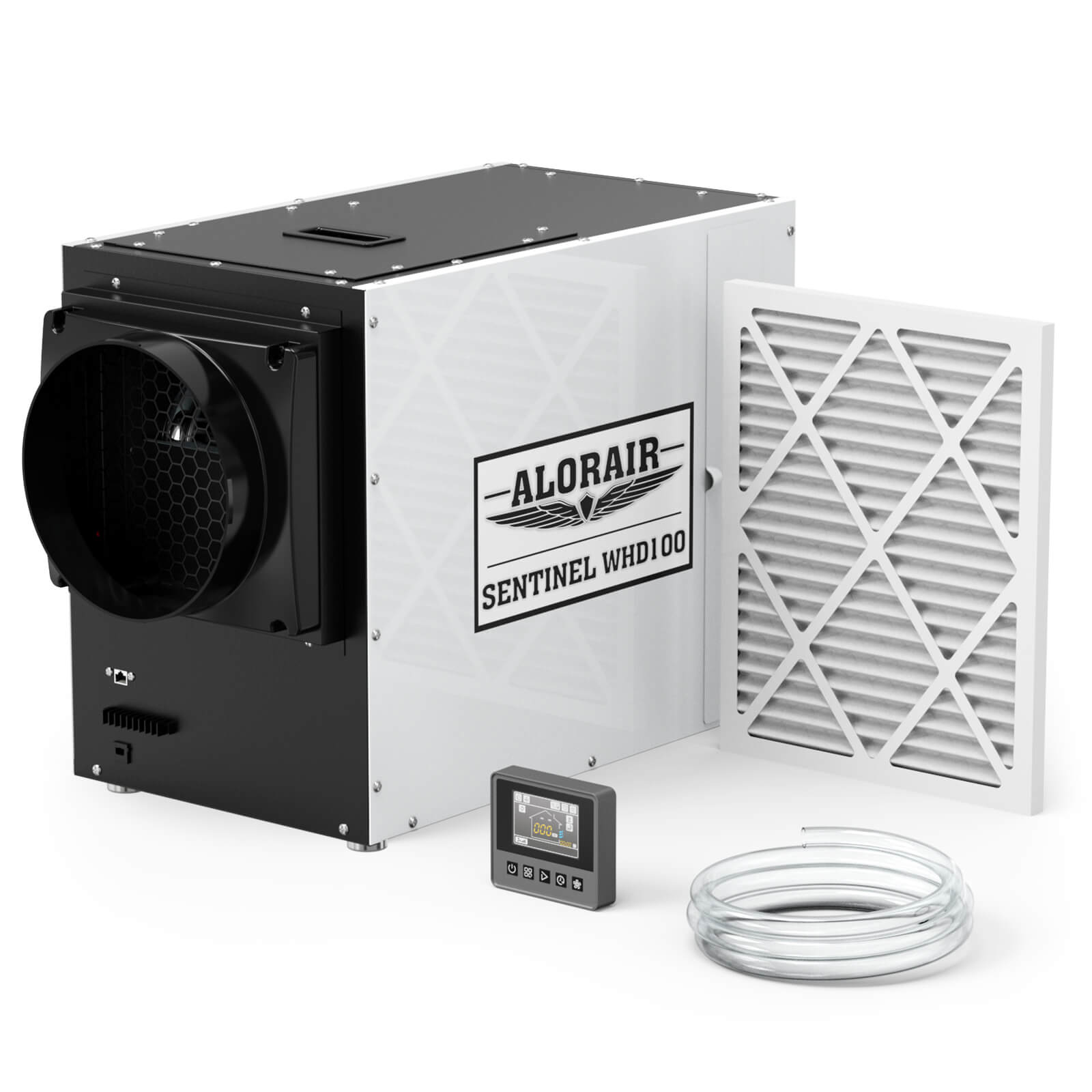
I checked AlorAir’s exact WHD 100 product page, the current Whole House category, and its linked WHD100/120/150/200 manual and WHD100/120 application sheet. The page-linked image identifies the WHD100 cabinet; the manufacturer does not say whether the image is a photograph or rendering, and it does not establish which accessories ship in a box.
Read both capacity numbers before comparing
The headline 90-pint AHAM result and 70-pint DOE whole-house value are different rating conditions, not a contradiction and not a prediction of daily water removal in a particular home. AlorAir lists the former at 80°F and 60% relative humidity and the latter at 73°F and 60%. A shopper comparing the WHD100 with a dehumidifier rated only under one method should compare like with like. The manufacturer’s “up to 2,300 square feet” language is useful as a broad selection clue, but house layout, air exchange, temperature, moisture load, duct design and operating conditions all matter. This listing is not a load calculation.
Among this family, the WHD100 has the least stated capacity. The WHD120 keeps the same smaller cabinet and published airflow figures but is rated at 104 pints AHAM and 85 pints DOE. The jump to the WHD150 is larger in both capacity and physical scale. If a plan requires a 100-pint-or-higher AHAM figure, the WHD100 does not reach that published threshold; the 120, 150 and 200 do. If the 90-pint rating already exceeds the calculated need, paying for a larger model can add cabinet size and electrical demand without solving a different problem.
Plan the ducts, drain and service space first
This is a fixed installation. The shared manual describes a fully enclosed equipment setup with clearance around the intake and outlet, a grounded 115-volt, 60-Hz supply on the specified 15-amp circuit, and a continuously sloped gravity drain. Condensate leaves through the drain; there is no collection bucket and no built-in pump. The drain needs a lower destination and a route that stays downhill, so a basement location with a lift back up to a laundry standpipe is not a match unless a separate external pump is deliberately designed into the installation. That external accessory is not an integral WHD100 feature and its availability does not turn this unit into a pump-equipped model.
The 100’s listed cabinet measures 22.64 inches deep by 14.65 wide by 19.88 high and weighs 89.07 pounds. The orientation and access details matter: leave space for the documented filter, drain, service panels and duct transitions rather than treating those cabinet measurements as a finished closet opening. The manual shows fixed HVAC connections and alternative outlet arrangements. It does not establish two simultaneous discharge outlets. Have the installation planned around the actual return/supply path and static pressure, not around the number of ways a collar can be repositioned.
Fresh air is an optional system choice
AlorAir documents an optional six-inch outdoor-air damper/intake arrangement. That may matter if the home’s ventilation design calls for outdoor air to enter through the dehumidification system. It is a capability that requires the correct damper, controls and airflow plan; the page does not establish that those pieces are included with every purchase. A fresh-air intake also needs to be balanced with the building’s ventilation requirements. Do not treat the six-inch option as a stand-alone ventilation system or as proof that any particular fresh-air volume will be delivered.
The product page lists 229/309 CFM airflow and 55 dBA. Those are published figures, not a measured room-noise prediction after ductwork. The WHD100 uses a MERV-10 filter according to AlorAir’s listing. Filter access and cleaning belong in the maintenance plan. The manufacturer documents a wired control arrangement; I found no exact-model support for Wi-Fi or app operation, so a phone-control requirement should not count as met here. Neither the image nor marketing area claim answers those installation questions.
Who the WHD100 fits
Consider this model when a contractor or experienced building owner has a fixed ducted whole-house plan, confirms that 90 pints at AHAM conditions is sufficient, and can provide a lower gravity-drain outlet. It is the least demanding choice in this family for handling weight and the most compact cabinet among the four. Its 5.9-amp listing is below the WHD120’s 6.8 amps, and its 55-dBA listing is below that model’s 62 dBA; neither difference guarantees a particular bill or perceived sound level, but both are meaningful when comparing the published specifications.
Skip it if you need a portable unit, a bucket, an integrated pump to move water uphill, or a verified app feature. If your design calls for at least 100 AHAM pints/day, compare the WHD120 first; if the calculated demand is higher, the larger WHD150 and WHD200 are the relevant family alternatives. For a strict fresh-air requirement, confirm the damper and controls as part of the installed system. The questionnaire should accept the WHD100 for fixed ducting, gravity drainage, bucketless use and the optional ventilation capability; it should reject it for a required pump lift, bucket collection, app control or an unverified certification condition.
Bottom line
The WHD100 is a sensible low-end member of a large fixed system family, not a universal household recommendation. Its advantage is a smaller 89-pound package with the lowest capacity and electrical draw among these four current WHD models. Its trade is that suitability depends on a real duct plan, a dependable gravity drain, service access and a capacity check made at comparable test conditions. Compare the ratings—not the area headline—with the building’s moisture plan.
Key details at a glance
| Published daily removal rating | 90 pt/day |
|---|---|
| Built-in lift pump | No |
| Published dimensions | Manufacturer lists 22.64 D × 14.65 W × 19.88 H inches; cabinet numbers do not include installation/service clearance or duct transitions. |
| Bucketless operating mode | Yes |
| Published product weight | 89.07 lb |
| Controls and settings | Wired external controller is depicted/documented in family sources; app/Wi-Fi capability was not established. |
More specifications and setup details
| Care and operating limits | Manual covers filter checks/cleaning and yearly coil maintenance. Keep access to filters, drain and service panels. |
|---|---|
| DOE whole-house rating at 73°F/60% RH | 70 pt/day |
| Capacity rating test conditions | AlorAir lists 90 pints/day at AHAM 80°F/60% RH and 70 pints/day under its DOE whole-house 73°F/60% RH rating. These are distinct test conditions, not a household-output guarantee. |
| Manufacturer marketed area claim | 2300 sq ft |
| Documented HVAC duct integration | Yes |
| Optional outdoor-air intake documented | Yes |
| Optional outdoor-air inlet diameter | 6 in |
| Published current | 5.9 A |
| Published sound rating | 55 dBA |
| Published airflow note | The exact product page lists this pair of airflow values; do not assume the number proves performance through an arbitrary duct design. |
| Filter type/choice listed | MERV-10 filter listed; inclusion/package configuration not independently established |
| Manufacturer COP at AHAM condition | 2.6 L/kWh |
| Manufacturer COP at DOE whole-house condition | 2.2 L/kWh |
Use the exact model’s instructions for operating limits, supplied equipment and version differences.
Sources for this assessment
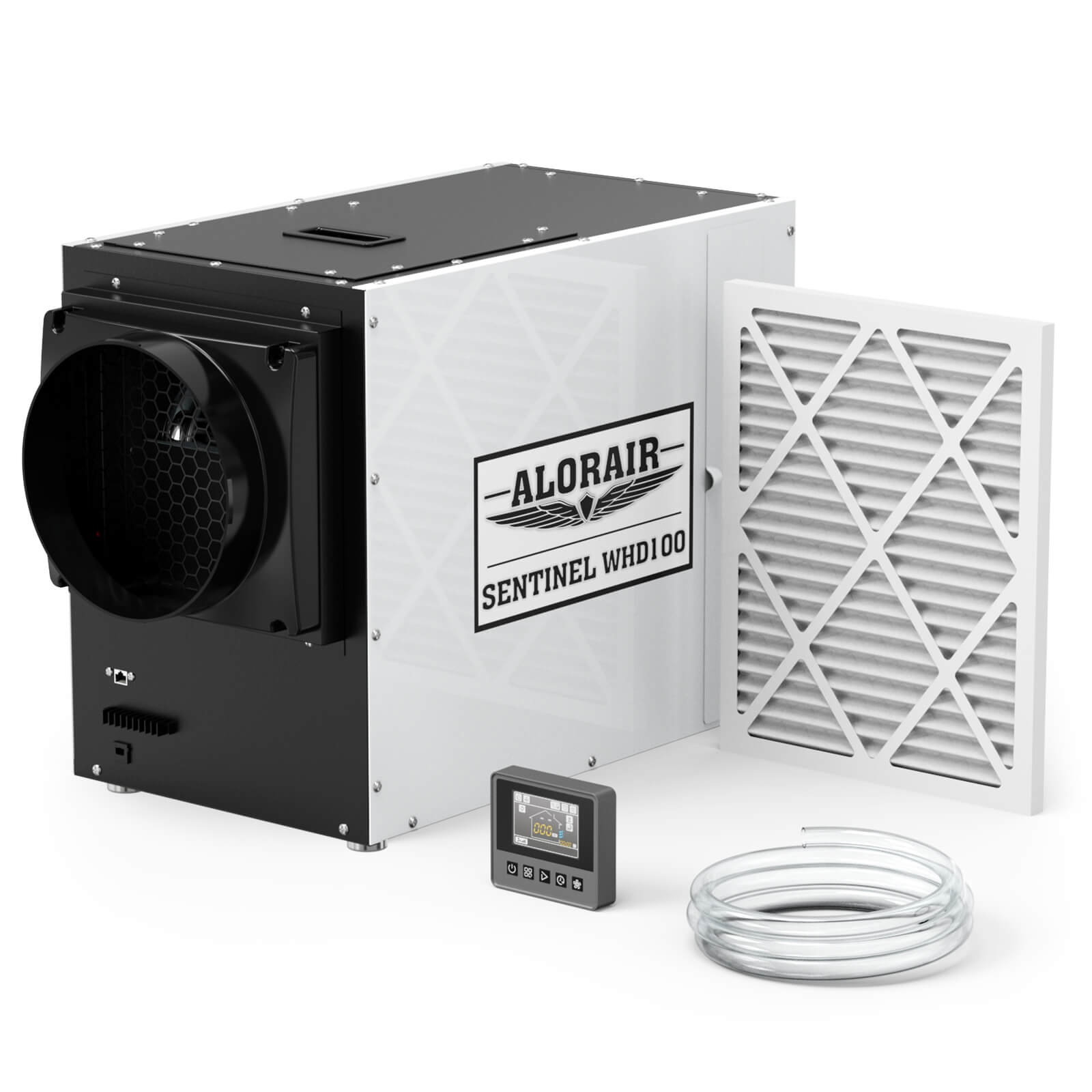
Check the route before the room-size claim.
Match the rated capacity and drainage setup to a real place for the water to go.