
On this page
Your needs, this model
Does it fit your priorities?
Does the WHD120 meet a 104-pint AHAM minimum, and would 105 exceed its published figure?
The exact page lists 104 pints/day at 80°F/60% RH and a separate DOE whole-house value of 85 at 73°F/60% RH. It meets 104 on the AHAM label but not 105; the 3,000-square-foot claim is not guaranteed coverage.
Explore this need in the finder →Can it use bucketless gravity drainage as part of a fixed-duct installation?
Yes, when condensate can flow continuously downhill to a suitable lower outlet. The family manual does not document an integral pump, so a raised outlet is not a WHD120 pump-lift plan.
Explore this need in the finder →Does the WHD120 support an optional outdoor-air path in a fixed HVAC plan?
Yes as a documented capability: the family manual shows fixed supply/return layouts and an optional six-inch outside-air damper. Confirm accessory and control scope; ENERGY STAR/app status remain unknown.
Explore this need in the finder →AlorAir’s Sentinel WHD 120 raises the family’s published capacity to 104 pints/day at AHAM conditions and 85 pints/day under the DOE whole-house rating. Its page describes coverage up to 3,000 square feet, but this remains a ducted building appliance that needs a designed installation, not a portable dehumidifier for a single room. The useful comparison is with the WHD100: the 120 keeps the smaller cabinet and 89.07-pound weight while adding rated capacity, at a higher current draw and a louder published sound level.
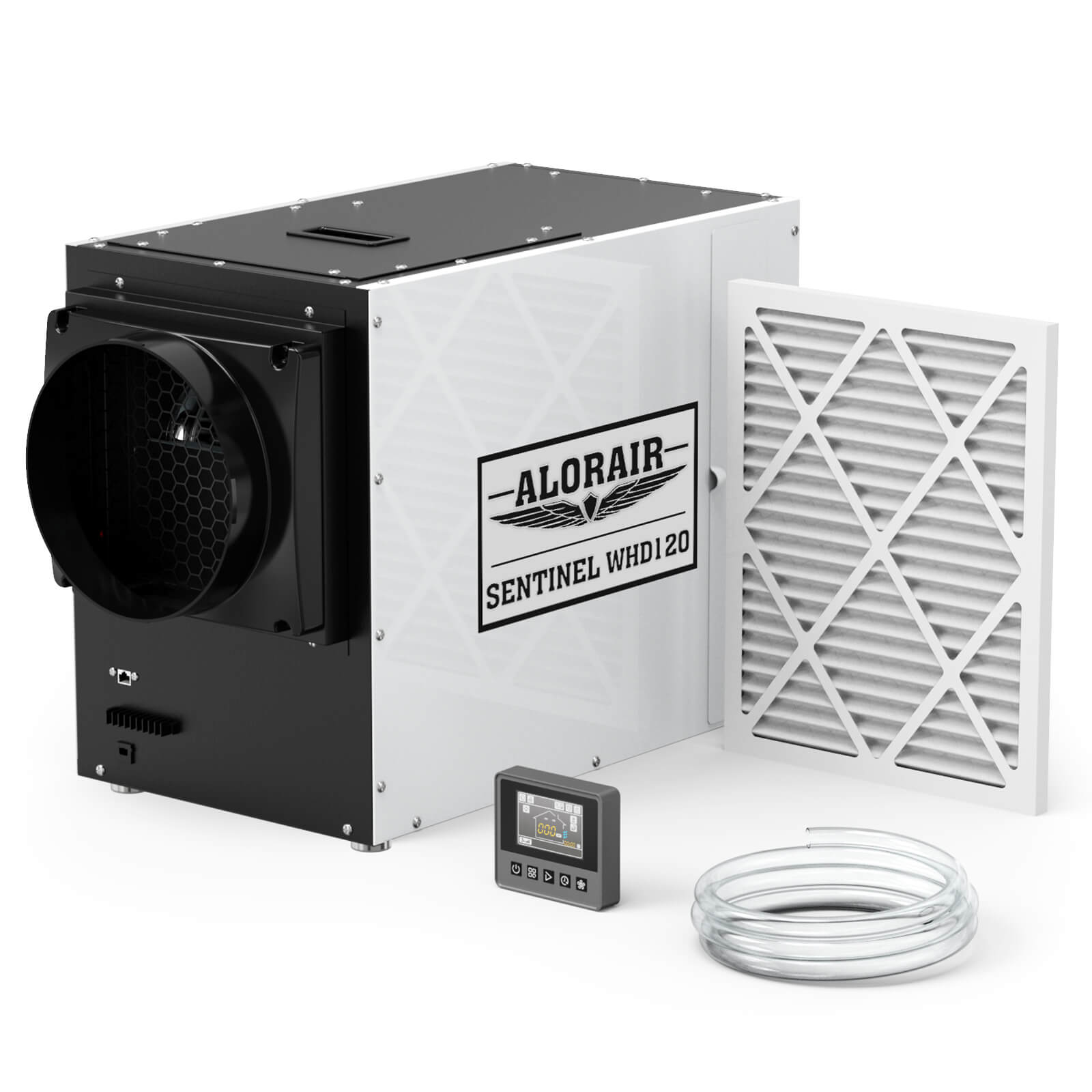
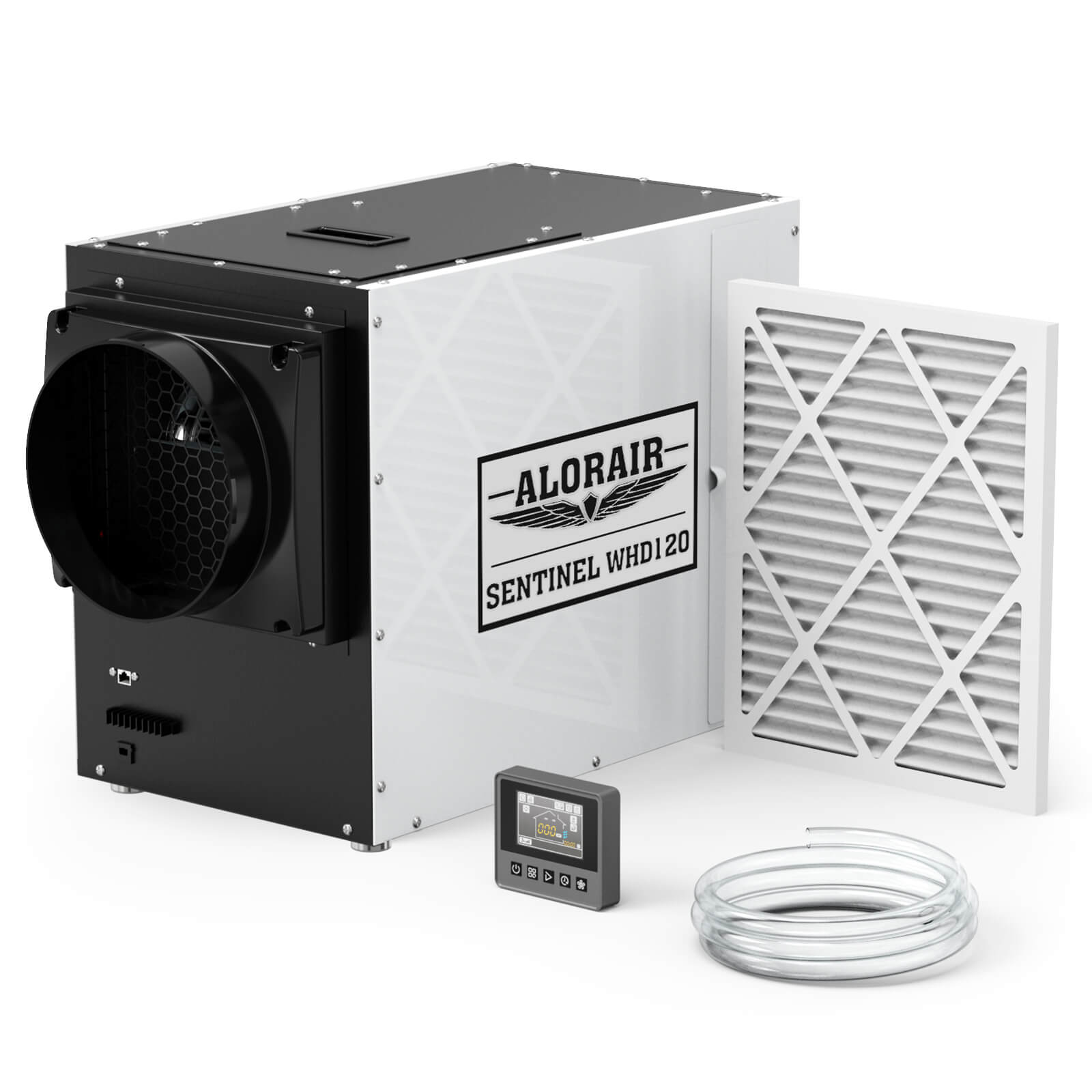
Sources checked: AlorAir’s exact WHD 120 page, current Whole House category, shared WHD family manual, and linked WHD100/120 application sheet. The original page-linked image visibly carries the WHD120 model label; AlorAir does not identify the image as a photo or rendering.
Why the extra capacity may matter
The WHD120’s AHAM rating is 104 pints/day at 80°F and 60% RH; its separate DOE whole-house figure is 85 pints/day at 73°F and 60% RH. Do not compare 104 against another brand’s cooler-condition DOE number as if they were the same test. The 3,000-square-foot marketing claim is not a sizing guarantee: a house with a large moisture load, air leakage or awkward duct layout may not behave like a simple area calculation. Use the rating method appropriate to the competing product, then size the system for the actual building and expected operating conditions.
Compared with the WHD100, the 120 gains 14 AHAM pints/day and 15 DOE pints/day while sharing the same 22.64-by-14.65-by-19.88-inch cabinet and the same 89.07-pound listed weight. AlorAir lists the two models at 229/309 CFM. The WHD120 is rated 62 dBA and 6.8 amps, versus 55 dBA and 5.9 amps for the 100. Their AHAM COP is listed as 2.6 for both; at the DOE whole-house condition, the page gives 2.4 for the 120 and 2.2 for the 100. Those are manufacturer ratings, not a guarantee of household energy use. The 120 is a capacity step-up within the compact frame, not a physically larger installation.
It still requires whole-house infrastructure
The manual’s installation guidance is the decisive filter. This is not a bucket-carrying appliance. The WHD120 has no collection tank and no integral condensate pump; its supported base plan uses a downward-sloped gravity drain to a lower outlet. If the planned drain is above the appliance, the manual’s optional external pump arrangement is separate equipment with its own power and installation requirements. It should not be counted as a built-in pump match, and the page does not establish that the pump is bundled with the WHD120.
AlorAir specifies a 115-volt, 60-Hz supply and the manual describes a dedicated grounded 15-amp circuit. It shows clearances for enclosed installation and multiple fixed duct arrangements. The WHD100/120 cabinet has two documented outlet-direction configurations, but that is not the same as two simultaneous exhaust outlets. The manual includes central HVAC ducting arrangements and an optional outdoor-air path; ask the installer to verify the chosen layout, static pressure and return/supply connection dimensions before making a closet or platform. A cabinet measurement alone does not include the duct transitions, filter-door access or drain service space.
Optional outside air does not come for free
The exact WHD120 materials document a six-inch optional fresh-air intake/damper. If outdoor air is a required part of your design, confirm the accessory, control and final airflow with the installer. The manufacturer page does not prove that the damper or all needed controls are in every carton. Outdoor-air flow should be designed for the building rather than assumed from the presence of an intake collar. If you only want a ducted humidity-control cabinet and do not need outside-air integration, this option is not a reason to select the 120 over the 100.
The exact listing reports a MERV-10 filter, 229/309 CFM and 62 dBA. The wired controller and documented local operation are the evidence available here; app and Wi-Fi control remain unconfirmed for this exact model. The product image shows a filter, remote control and hose near the cabinet, but an illustrative photo cannot confirm which parts ship in a particular sales configuration. Ask the seller for the exact package list rather than inferring it from the image.
Who should pick the WHD120?
Choose the 120 over the WHD100 when the design needs more than the 100’s 90-pint AHAM rating but still fits the smaller 89-pound cabinet, and when the 120’s published 6.8-amp draw and 62-dBA figure suit the planned location. It also clears a 100-pint/day threshold on the AHAM basis; the WHD100 does not. If the sizing points to more than 104 AHAM pints/day, the 150 and 200 offer higher ratings, but they use a much larger, roughly 181–187-pound cabinet. The 150 is 140 AHAM pints/day; the 200 is 165.
Do not buy the 120 for a room-level movable setup, a bucket-only requirement, a lift-pump requirement or a phone-app requirement. Questionnaire answers for fixed ducting, gravity drainage, bucketless operation and optional fresh-air capability can fit the documented WHD120 plan; a positive pump-lift or app-control condition should exclude it. A 100-pint minimum should keep it in view, while a 105-pint minimum should remove it. If ENERGY STAR certification is essential, the checked WHD materials did not establish that status, so do not assume a match.
Bottom line
The WHD120’s best argument is efficient use of the family’s smaller physical frame: it adds the capacity many designs may need over the WHD100 without adding listed cabinet weight or dimensions. That gain comes with higher stated current draw and sound level. It is worth comparing when the 100’s rating is too low, but only after a duct-and-drain plan is real. If the job is properly sized for the 100, the extra capacity alone is not a reason to make the system larger than needed.
Key details at a glance
| Published daily removal rating | 104 pt/day |
|---|---|
| Built-in lift pump | No |
| Published dimensions | Manufacturer lists 22.64 D × 14.65 W × 19.88 H inches; cabinet numbers do not include installation/service clearance or duct transitions. |
| Bucketless operating mode | Yes |
| Published product weight | 89.07 lb |
| Controls and settings | Wired external controller is depicted/documented in family sources; app/Wi-Fi capability was not established. |
More specifications and setup details
| Care and operating limits | Manual covers filter checks/cleaning and yearly coil maintenance. Keep access to filters, drain and service panels. |
|---|---|
| DOE whole-house rating at 73°F/60% RH | 85 pt/day |
| Capacity rating test conditions | AlorAir lists 104 pints/day at AHAM 80°F/60% RH and 85 pints/day under its DOE whole-house 73°F/60% RH rating. These are distinct test conditions, not a household-output guarantee. |
| Manufacturer marketed area claim | 3000 sq ft |
| Documented HVAC duct integration | Yes |
| Optional outdoor-air intake documented | Yes |
| Optional outdoor-air inlet diameter | 6 in |
| Published current | 6.8 A |
| Published sound rating | 62 dBA |
| Published airflow note | The exact product page lists this pair of airflow values; do not assume the number proves performance through an arbitrary duct design. |
| Filter type/choice listed | MERV-10 filter listed; inclusion/package configuration not independently established |
| Manufacturer COP at AHAM condition | 2.6 L/kWh |
| Manufacturer COP at DOE whole-house condition | 2.4 L/kWh |
Use the exact model’s instructions for operating limits, supplied equipment and version differences.
Sources for this assessment
Check the route before the room-size claim.
Match the rated capacity and drainage setup to a real place for the water to go.