
On this page
Your needs, this model
Does it fit your priorities?
Can the WHD150 cover a 140-pint AHAM screening threshold, and is 141 above its rating?
Its page lists 140 pints/day at 80°F/60% RH and 115 at the separate 73°F/60% RH DOE whole-house condition. It meets 140 but not 141 on the AHAM value; actual building output depends on conditions and system design.
Explore this need in the finder →Does it support a fixed ducted, bucketless gravity plan?
Yes, if the unit can drain continuously downward to a lower outlet. There is no collection bucket or built-in lift pump; an uphill drain is not a supported integral-pump configuration.
Explore this need in the finder →Can its optional outdoor-air intake coexist with the fixed duct and gravity plan?
The exact family manual shows a six-inch optional outside-air damper in a fixed whole-house design. Confirm the optional damper/control installation; the product image does not prove package contents, and certification/app status remain unknown.
Explore this need in the finder →The AlorAir Sentinel WHD 150 is the step into the larger WHD cabinet. Its exact product page lists 140 pints/day at AHAM conditions and 115 pints/day under the DOE whole-house rating, with a “3,500 square feet” application claim. The rated capacity is meaningfully above the WHD100 and WHD120, but the cabinet jumps to 181.4 pounds and 37.3 by 23.4 by 24.3 inches. It is a candidate for a planned fixed whole-home system—not a unit to choose from a floor-area label alone.
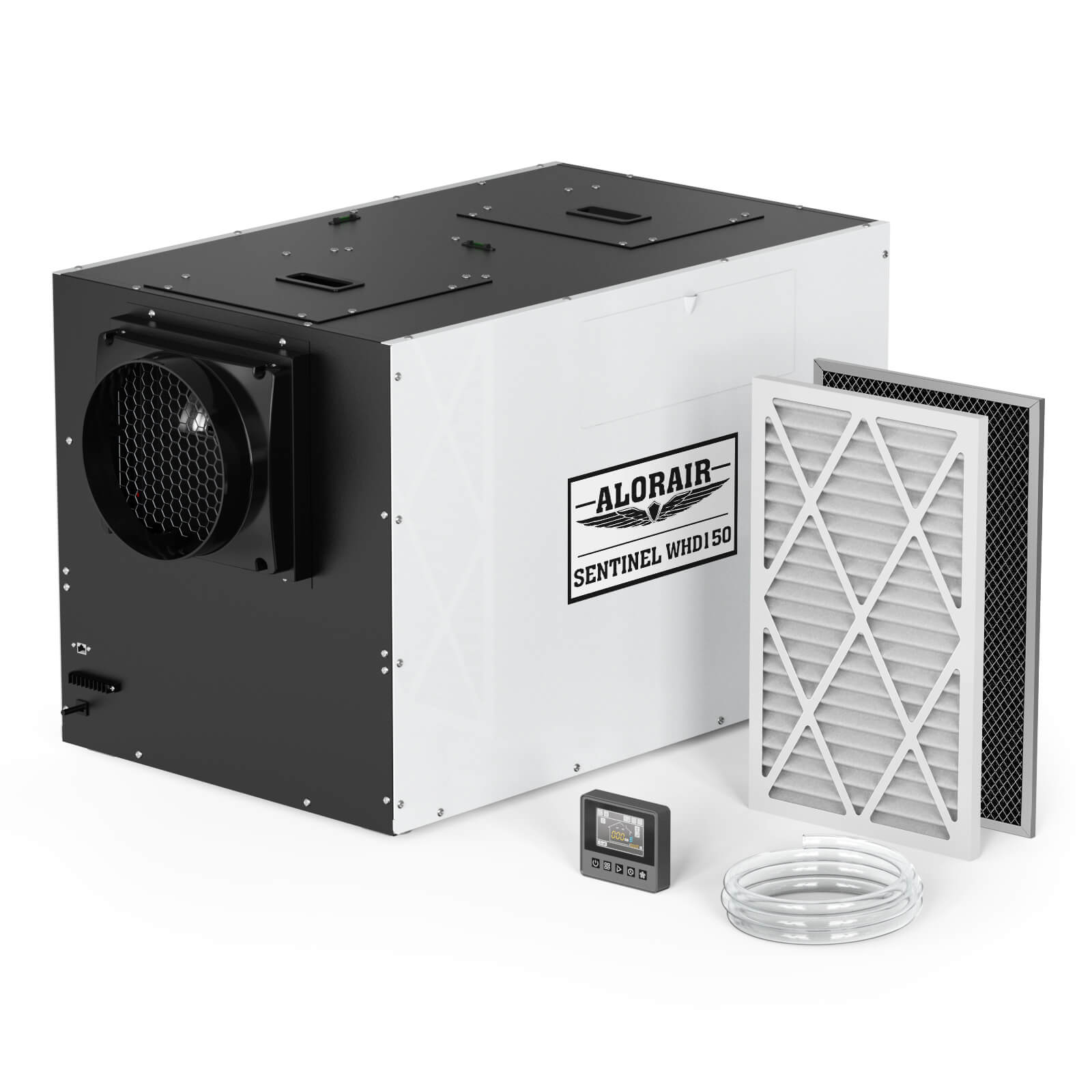
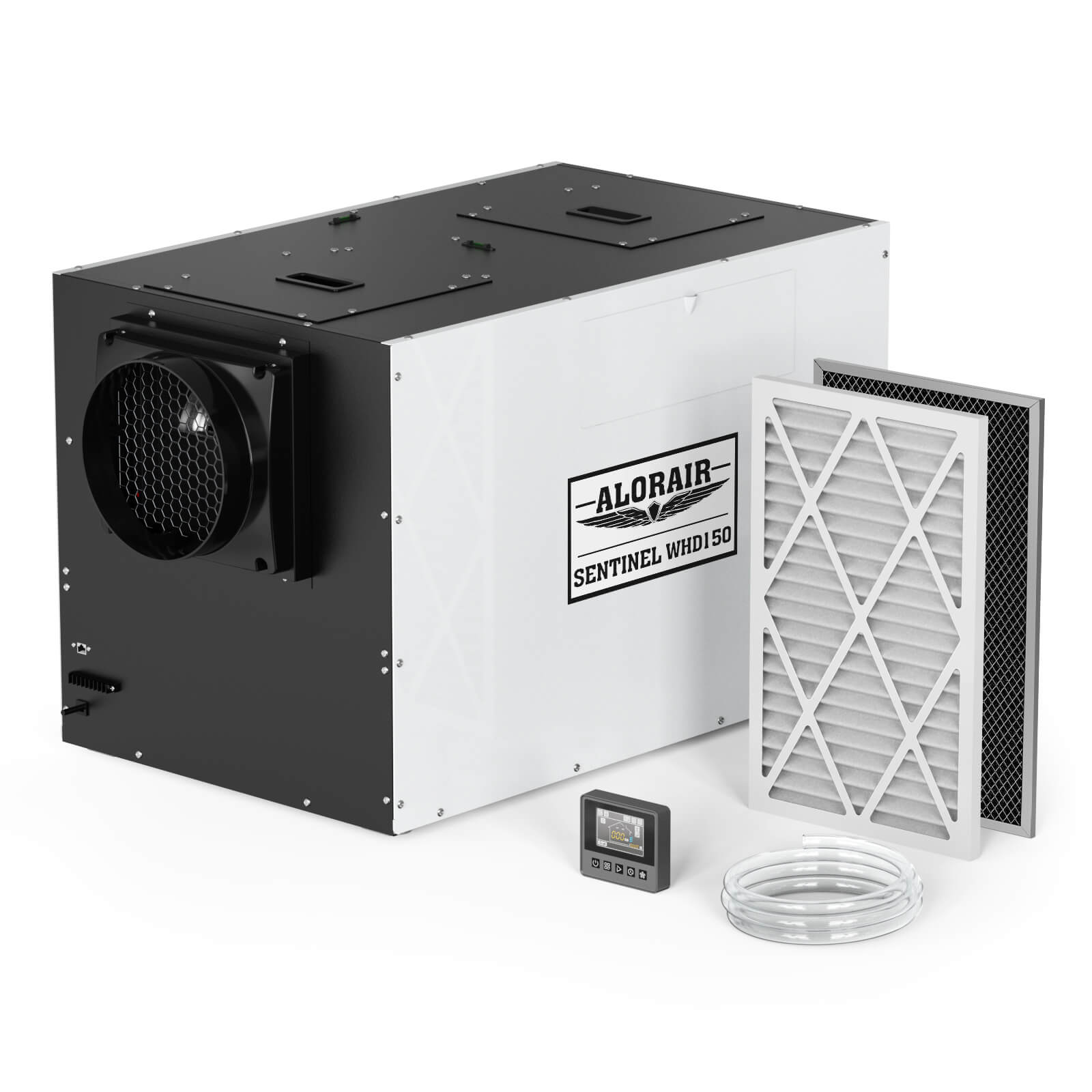
I reviewed AlorAir’s exact WHD 150 page, current Whole House category, shared WHD family manual, and the linked WHD150/200 application sheet. The page-linked image visibly marks the cabinet WHD150; the manufacturer does not state whether the image is a photograph or rendering.
Capacity, conditions and the published comparison
AlorAir’s 140-pint figure is the AHAM-condition number at 80°F/60% RH. The DOE whole-house rating is lower at 115 pints/day at 73°F/60% RH. These two numbers should remain separate in any comparison: a lower rating at the cooler test point does not mean a model has lost a fixed fraction of capacity in every home, and the higher rating is not a promise of daily collection. The manufacturer’s up-to-3,500-square-foot area claim is a starting point, not a substitute for a building load assessment. Duct resistance, airflow, moisture load, temperature and setpoint matter.
The WHD150’s 309/383 CFM published airflow and 64-dBA listing distinguish it from the smaller models. The cabinet is in a different class physically: at 37.3 inches deep, 23.4 wide and 24.3 high, it is substantially larger than the 22.64-by-14.65-by-19.88-inch 100/120 cabinet. It weighs about twice as much as those models. Confirm the access route, structural support, service clearance and filter-door swing before choosing it. The page lists COP 3.7/3.4 at the two conditions; those figures are not a utility-bill prediction.
Installation is part of the model decision
The family manual describes an enclosed fixed installation, clear space around the unit’s air openings, a 115-volt grounded dedicated 15-amp circuit, and gravity drainage. Like the other WHD models, the 150 has no collection bucket and no integral lift pump. Condensate must flow down to a suitable lower destination in its documented gravity plan. If the home only offers a raised drain, the separately powered external-pump approach is an installation decision, not a built-in pump feature and not an included WHD150 capability.
The family’s central supply/return duct layouts are relevant only after a professional confirms that the actual ducts and static pressure can support the installation. The manual also depicts an optional six-inch outside-air damper. That optional fresh-air path may be useful in a building design that needs outdoor air mixed into the system, but the product page does not prove that the damper or all controls are included. The WHD150 has several possible inlet/outlet placements; do not misread alternative positions as dual simultaneous outlets. Duct adapters, filter access, drainage fall and electrical clearance need to be included in the finished layout.
AlorAir lists two filter ratings, MERV-1 and MERV-10, for this larger model family. The source materials do not establish that every possible filter pictured is included in every sale package. Choose filter media based on the specific configuration and the system’s airflow design, and check the manual’s cleaning guidance. The wired controller is documented; I found no exact-model basis for promising Wi-Fi or app operation. If remote app control is essential, look for a model that explicitly supports it rather than extending a capability from another product family.
150 or 200: more capacity is not the only variable
The WHD200 is the higher-capacity option at 165 pints AHAM and 140 DOE. It uses the same listed cabinet size, weighs only six pounds more at 187.4 pounds, and is rated one decibel higher at 65 dBA. It also draws 8.5 amps versus the 150’s 6.5 amps. The 150’s page lists COP 3.7/3.4 while the 200 lists 3.3/3.2 under the respective AHAM/DOE conditions. Those are product-page numbers, not a prediction of lower real-world electricity use or a reason to undersize a system. The practical choice is whether a designed moisture load requires the 200’s extra 25 rated pints at each named condition and whether the electrical plan supports it.
The WHD100/120 cabinets are smaller and about half the weight, but have lower capacity and airflow.
Who should consider the WHD150?
It is worth sizing into a project when a fixed ducted whole-home installation is required, the calculated need clears the WHD120’s 104-pint AHAM rating, and the lower gravity route and site power are available. It meets a 130-pint AHAM minimum; the WHD100 and 120 do not. The WHD200 also clears that threshold and has more capacity, but the 150 may be the better fit when 140 pints is enough and the lower listed current and sound figures are preferred. Weight-sensitive handling is not solved by choosing the 150 over the 200; both use the large cabinet.
Do not select it for a room with no duct plan, a bucket route, an integrated pump-lift need, or an unverified certification/app requirement. The matcher can accept its documented fixed duct, gravity, bucketless and optional ventilation plan together; it should reject a pump-lift route. If the product must fit through a narrow opening, get the full installation dimensions and route checked first, and allow space beyond the cabinet numbers for service.
Bottom line
The WHD150 offers a genuine step up from the small WHD100/120 enclosure, with 140 AHAM pints/day and higher airflow. Its real trade is not just a larger number: installation weight, access, filter service, airflow design, electrical planning and drain slope become more consequential. It belongs on a contractor’s shortlist when the building’s load calls for its rating; the area claim on the page is not enough on its own.
Key details at a glance
| Published daily removal rating | 140 pt/day |
|---|---|
| Built-in lift pump | No |
| Published dimensions | Manufacturer lists 37.3 D × 23.4 W × 24.3 H inches; cabinet numbers do not include installation/service clearance or duct transitions. |
| Bucketless operating mode | Yes |
| Published product weight | 181.4 lb |
| Controls and settings | Wired external controller is depicted/documented in family sources; app/Wi-Fi capability was not established. |
More specifications and setup details
| Care and operating limits | Manual covers filter checks/cleaning and yearly coil maintenance. Keep access to filters, drain and service panels. |
|---|---|
| DOE whole-house rating at 73°F/60% RH | 115 pt/day |
| Capacity rating test conditions | AlorAir lists 140 pints/day at AHAM 80°F/60% RH and 115 pints/day under its DOE whole-house 73°F/60% RH rating. These are distinct test conditions, not a household-output guarantee. |
| Manufacturer marketed area claim | 3500 sq ft |
| Documented HVAC duct integration | Yes |
| Optional outdoor-air intake documented | Yes |
| Optional outdoor-air inlet diameter | 6 in |
| Published current | 6.5 A |
| Published sound rating | 64 dBA |
| Published airflow note | The exact product page lists this pair of airflow values; do not assume the number proves performance through an arbitrary duct design. |
| Filter type/choice listed | MERV-1 and MERV-10 filter choices listed; supplied configuration not independently established |
| Manufacturer COP at AHAM condition | 3.7 L/kWh |
| Manufacturer COP at DOE whole-house condition | 3.4 L/kWh |
Use the exact model’s instructions for operating limits, supplied equipment and version differences.
Sources for this assessment
Check the route before the room-size claim.
Match the rated capacity and drainage setup to a real place for the water to go.