
On this page
Your needs, this model
Does it fit your priorities?
Does the WHD200 clear a 165-pint AHAM threshold, and would 166 exceed its label?
The product page lists 165 pints/day at 80°F/60% RH and a separate DOE whole-house value of 140 at 73°F/60% RH. It meets 165 on the AHAM label but not 166; the 4,500-square-foot claim is not a room-sizing guarantee.
Explore this need in the finder →Can it use the documented gravity drain without a bucket or built-in pump?
Yes, when the fixed installation has a continuously downhill hose to a lower drain. The manual describes no built-in pump; a required uphill route excludes the model absent a separately designed pump system.
Explore this need in the finder →Does the WHD200 offer an optional outdoor-air path in a fixed duct installation?
The family manual documents a six-inch optional outdoor-air damper/intake along with fixed HVAC duct arrangements. Verify accessory/control scope and airflow design; Energy Star and app/Wi-Fi evidence is unknown.
Explore this need in the finder →AlorAir’s Sentinel WHD 200 is the highest-rated model on its current four-unit Whole House category page: 165 pints/day at AHAM conditions and 140 pints/day at the DOE whole-house condition. The manufacturer’s “up to 4,500 square feet” claim is not a guarantee of coverage in any particular home. This is a 187.4-pound, fixed-duct cabinet with a gravity drain—not a portable unit and not a built-in pump solution.
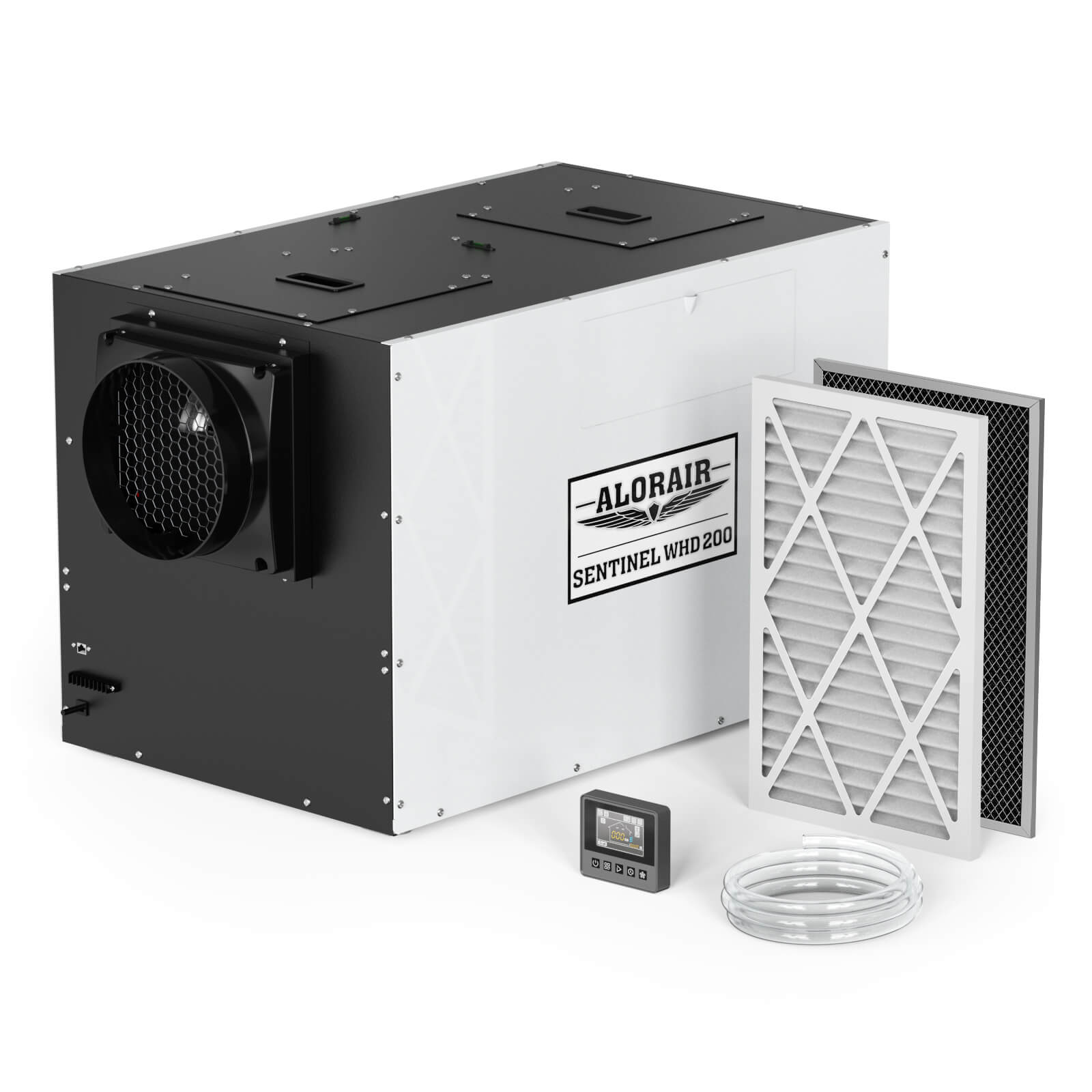
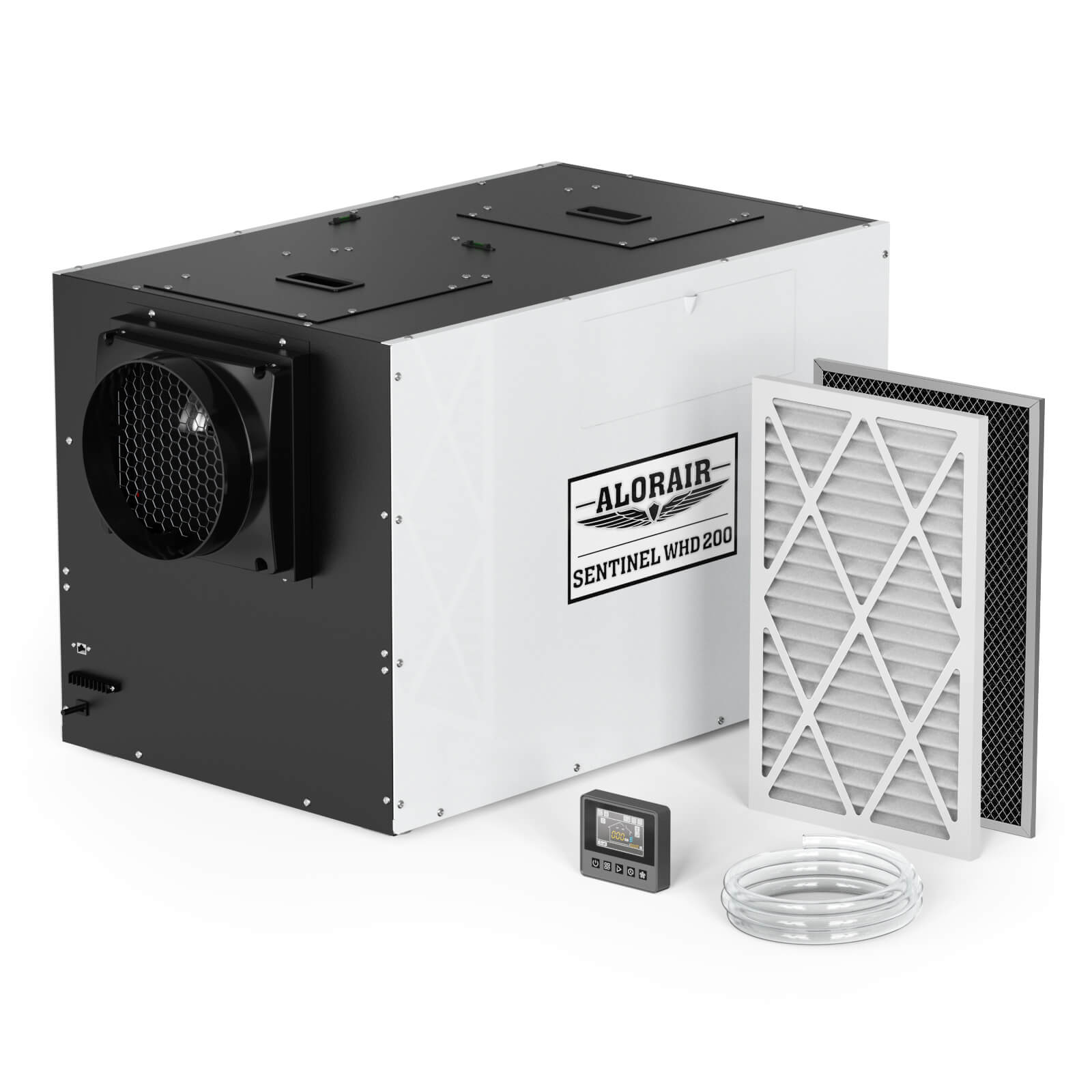
Sources: AlorAir’s exact WHD 200 page, the current Whole House category, shared WHD100/120/150/200 manual, and linked WHD150/200 application sheet. The product page image visibly identifies the WHD200 model; the image’s photo-versus-render status is not stated.
Its edge is the 150’s extra margin
The product page lists 165 pints/day at 80°F/60% RH under AHAM conditions and 140 pints/day at the DOE whole-house condition of 73°F/60% RH. The 4,500-square-foot claim is a manufacturer application guide, not a substitute for checking the house’s moisture load, duct configuration, air movement, temperature and operating schedule. Choose on an appropriate capacity calculation and compare the same rating method across products. Do not assume the published daily output will be reproduced under a different temperature, humidity or duct pressure.
Against the WHD150, the WHD200 adds 25 published pints/day under each stated rating condition. Both use the same listed 37.3-inch-deep, 23.4-inch-wide, 24.3-inch-high cabinet. The 200 weighs 187.4 pounds versus 181.4 for the 150, lists 8.5 amps versus 6.5 amps, and is rated 65 dBA versus 64 dBA. Its COP values are 3.3 AHAM and 3.2 DOE, below the 150’s listed 3.7 and 3.4 under those corresponding conditions. Do not turn this specification comparison into a bill estimate: actual energy use depends on the building and operating conditions. The right question is whether the design needs the WHD200’s extra capacity and has the power and airflow plan to support it.
The WHD150 is already a large and heavy appliance. Moving from 150 to 200 does not require a larger published footprint, but both need handling equipment or enough installers to position them safely. The smaller 100/120 cabinets weigh 89.07 pounds but have substantially lower ratings and airflow. Use one only if its capacity still covers the designed load.
Fix the drainage problem before ordering
All four WHD models share a manual-supported gravity-drain operating plan. The WHD200 has no collection tank and no built-in pump. The drain line needs a continuously downward path to a lower outlet; avoid sags and trapped low points. If the proposed route must rise, the separately powered external pump option requires its own equipment and electrical plan. That does not make the WHD200 a pump-equipped appliance or satisfy a questionnaire answer that specifically requires an integrated lift pump.
The manual describes a fixed, enclosed installation with air clearances around the equipment and a grounded 115-volt, 60-Hz supply on a dedicated 15-amp circuit. The exact product page gives the 8.5-amp current figure. Have an HVAC professional check circuit loading, duct capacity and the location of the lower drain before installation. The product’s dimensions are cabinet dimensions; they do not include duct transitions, pipe bend clearance or the room needed to open the service and filter panels. Confirm the path to the final location and the support surface for a cabinet close to 190 pounds.
Ventilation and filtration are system choices
AlorAir documents an optional six-inch outdoor-air damper arrangement for the WHD family. If the system must draw outdoor air, confirm the accessory and controls, then have its airflow set for the building; the product page does not establish that an optional damper is included with each unit. This is a documented installation capability, not proof of a specified ventilation rate. Several inlet/outlet positions are shown for the larger models, but they are alternative placements rather than two confirmed simultaneous discharge outlets.
The listing identifies MERV-1 and MERV-10 filter options. Ask which is supplied for the exact sales configuration; the image showing separate filter panels does not prove package contents. Regular filter access is part of installing the unit in a way that can be serviced. The page lists 309/413 CFM. Noise in the installed mechanical space may differ from the manufacturer’s 65-dBA figure once duct length, room construction and vibration isolation are considered. The manual’s wired controller is documented, while exact-model Wi-Fi and app control were not established in the reviewed materials.
When the WHD200 belongs on the shortlist
Consider it when a whole-house design truly needs more than the WHD150’s 140 AHAM/115 DOE-pint ratings, and the large cabinet, 8.5-amp current, duct arrangement and gravity outlet all fit the site. It is the only member of this family that clears a 150-pint AHAM minimum. For a 130-pint minimum, the WHD150 also qualifies and may be preferable if the 150 rating is sufficient; the 200’s capacity surplus is not automatically useful. For 100 pints, the WHD120 may handle the design with a smaller cabinet, depending on the actual load.
The WHD200 is not the answer if you need a portable or bucket-based design, an integrated pump to lift condensate, or proven smartphone control. The product matcher should accept fixed ducting, bucketless gravity drainage and the optional outside-air capability in one documented plan; it should reject a required pump lift or a certification/app requirement that the sources leave unknown. Use those choices as practical filters, then verify duct, airflow, electrical and drain details with the installer.
Bottom line
The WHD200 provides the family’s largest published capacity in the same big enclosure as the WHD150. It brings more airflow and a higher rating, but also a higher current draw, slightly more weight and slightly higher listed sound. Buy the 200 only if the house needs the extra rating and the installation can support it; otherwise, the WHD150 or smaller 100/120 may be a more proportionate design. The area claim cannot decide that question.
Key details at a glance
| Published daily removal rating | 165 pt/day |
|---|---|
| Built-in lift pump | No |
| Published dimensions | Manufacturer lists 37.3 D × 23.4 W × 24.3 H inches; cabinet numbers do not include installation/service clearance or duct transitions. |
| Bucketless operating mode | Yes |
| Published product weight | 187.4 lb |
| Controls and settings | Wired external controller is depicted/documented in family sources; app/Wi-Fi capability was not established. |
More specifications and setup details
| Care and operating limits | Manual covers filter checks/cleaning and yearly coil maintenance. Keep access to filters, drain and service panels. |
|---|---|
| DOE whole-house rating at 73°F/60% RH | 140 pt/day |
| Capacity rating test conditions | AlorAir lists 165 pints/day at AHAM 80°F/60% RH and 140 pints/day under its DOE whole-house 73°F/60% RH rating. These are distinct test conditions, not a household-output guarantee. |
| Manufacturer marketed area claim | 4500 sq ft |
| Documented HVAC duct integration | Yes |
| Optional outdoor-air intake documented | Yes |
| Optional outdoor-air inlet diameter | 6 in |
| Published current | 8.5 A |
| Published sound rating | 65 dBA |
| Published airflow note | The exact product page lists this pair of airflow values; do not assume the number proves performance through an arbitrary duct design. |
| Filter type/choice listed | MERV-1 and MERV-10 filter choices listed; supplied configuration not independently established |
| Manufacturer COP at AHAM condition | 3.3 L/kWh |
| Manufacturer COP at DOE whole-house condition | 3.2 L/kWh |
Use the exact model’s instructions for operating limits, supplied equipment and version differences.
Sources for this assessment
Check the route before the room-size claim.
Match the rated capacity and drainage setup to a real place for the water to go.