
On this page
Your needs, this model
Does it fit your priorities?
Does the exact GE AHR50LM meet the questionnaire threshold shown by its own published 51-pint/day figure?
GE lists 51 pints/day, while CPSC groups this recalled model as 50 pints. It can only clear a rating threshold no higher than GE’s published value; because the model is retired and recall-listed, the profile is still excluded from buying results.
Explore this need in the finder →Can AHR50LM satisfy a route that must lift water above the drain connection?
No upward lift is documented. Its manual describes a fitted bucket or a separate downhill gravity hose, and the bucket remains required for operation.
Explore this need in the finder →What must an owner verify before relying on this discontinued AHR50LM?
Check the complete physical model and manufacture date against CPSC’s AHR50LM recall entry. CPSC directs matching units to be turned off and unplugged; this reference never becomes a purchase candidate.
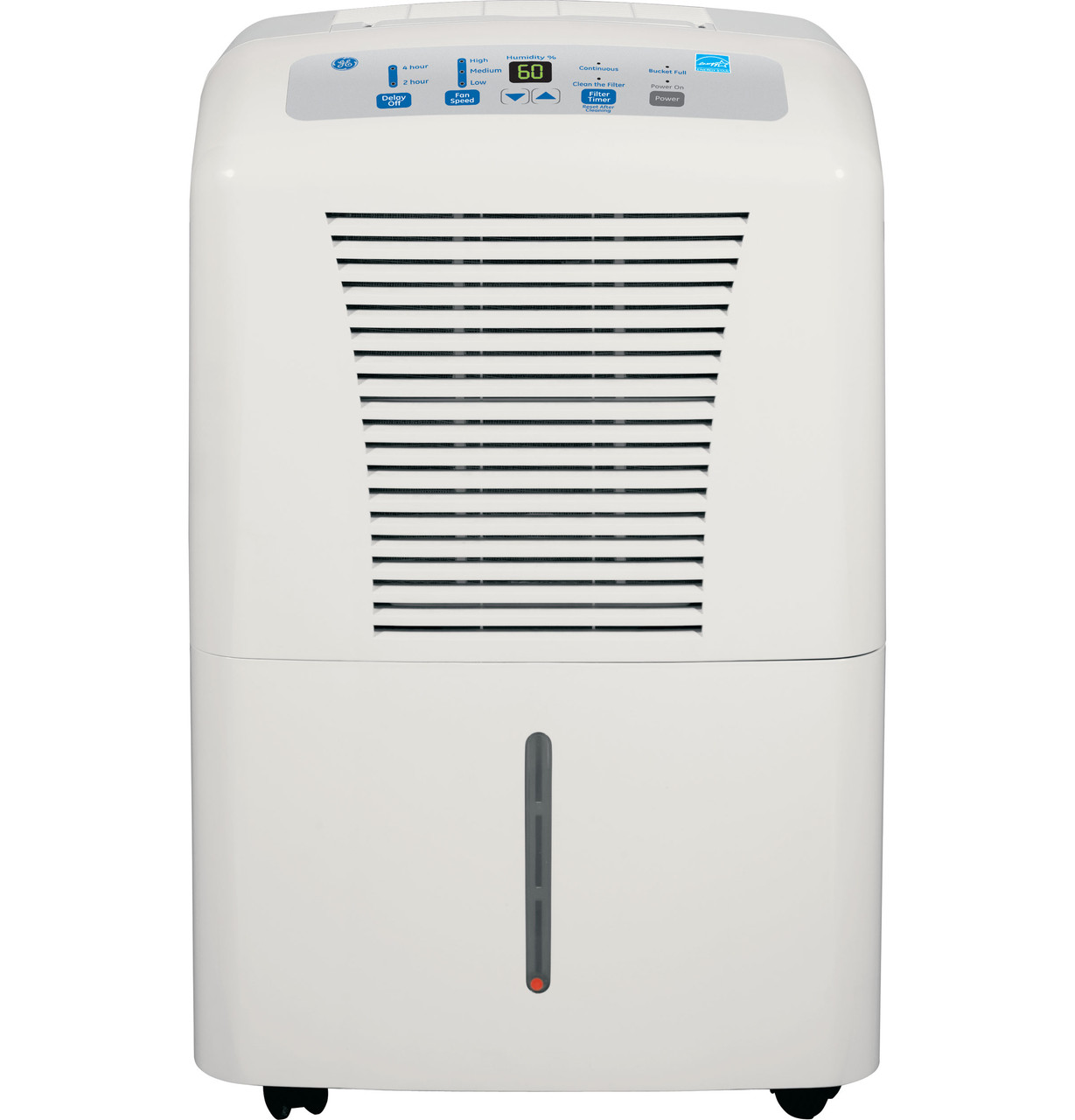
Explore this need in the finder →The GE AHR50LM is a discontinued light-gray 51-pint/day dehumidifier with a 17.5-pint front bucket. Its specification page still helps identify an existing appliance, but the exact model is named in a CPSC recall for units made during a limited date-code period. This is an owner and safety reference, never a new- or used-purchase recommendation.
GE’s AHR50LM product page provides the exact rating, bucket, dimensions and technical table. The matching support entry links owner manual 49-7598-1. CPSC’s 2014 GE dehumidifier recall expansion names AHR50LM among models affected for January 2008–December 2010 manufacture dates.
Safety screening comes before feature comparison
GE’s support page gives a broad AHR50LM manufacture interval from April 2009 through December 2021, while CPSC identifies units with this model number made January 2008 through December 2010 as part of a fire-hazard recall. That does not establish the manufacture date or recall state of an individual machine. Read the full label and date code on the back of the appliance and compare it with CPSC’s official model table. If the unit matches, shut it off, unplug it and use the recall instructions; do not test it by leaving it running or rely on a shortened marketplace model string.
GE states the model is no longer manufactured. A live GE page can preserve owner information without indicating normal new-product support or safe resale. Because the exact code appears in the recall table and the product is retired, this guide keeps it out of purchase matching regardless of the visitor’s capacity or drainage answers. The current GE ADSE50WWT is a separate later 50-pint configuration worth comparing on its own evidence; its current model facts do not retrofit the AHR50LM.
The 51-pint label and larger bucket
GE’s exact product table lists 51 pints per day, a 17.5-pint front-removable bucket, a cabinet 23 5/8 inches tall, 15 3/8 inches wide and 10 1/2 inches deep, and 115 volts, 5.8 amps and 615 watts. CPSC’s recall table classifies AHR50LM in its 50-pint group. The two numbers come from different official records; the specific GE technical table is the detailed rating, while CPSC uses its recall-category capacity. Neither is a guarantee of water removed in a particular basement or a promise that an old unit still performs to specification.
The larger 17.5-pint tank is nearly twice the volume listed for the AHR30LM and AHR40LM, which can make bucket emptying less frequent, but it still fills. GE lists three fan speed selections, an electronic soft-touch panel, automatic humidistat control, automatic defrost, automatic shutoff, casters and a washable filter. Its exact technical table lists high/low dry airflow of 195/155 CFM. The broad airflow and capacity figures describe model specifications, not measured noise, room coverage or energy cost; GE’s table gives no noise rating in the inspected record.
Control and installation facts from the manual
The 49-7598-1 guide covers AHR50 among its model family. It describes 35–80% RH settings in five-point steps or continuous operation, a filter-cleaning reminder after 250 operating hours and use only in an indoor residential setting. It advises at least 12–18 inches of free space around the unit and not to operate below 41°F. Automatic defrost helps manage frost on the coil, but it does not convert a cold, poorly circulated cellar into an ideal installation. Keep the intake and discharge clear and the appliance level on a floor able to support it with a full bucket.
The bucket is the straightforward route: let the machine stop on full-bucket protection, remove the reservoir carefully, empty and reseat it. For a lower floor drain, the manual describes a separate garden hose routed downhill. GE does not list a pump on the exact table or manual; the gravity connection is not an upward lift. The bucket still needs to be seated. Keep the hose’s path descending and inspect the connection for leaks before relying on automatic drainage.
Useful to owners, not buyers
AHR50LM’s 51-pint listed capacity, larger bucket and wider cabinet separate it from the 30- and 40-pint AHR variants. It suits identification of an existing unit and interpretation of its old controls; it does not qualify for the buying list. Its practical limitations are recall/date-code uncertainty, discontinued status, lack of an evidenced pump, no verified app control and a gravity path dependent on a lower drain. Do not infer those features from the generic Wi-Fi blocks still present on the GE website.
If you are determining whether a used unit is safe or worthwhile, start with its label, serial/date information, visible condition and the official CPSC notice, not with the product photo or the page’s historical price. If replacing it, compare a current unit’s rating basis, room placement, drainage plan and service channel independently. This AHR50LM profile preserves a traceable manufacturer specification and recall bridge for owners while keeping the old model out of purchase results.
Key details at a glance
| Published daily removal rating | 51 pt/day |
|---|---|
| Built-in lift pump | No |
| ENERGY STAR certified | Yes |
| Bucketless operating mode | No |
| Capacity rating test conditions | GE's exact technical table lists 51 pints/day. CPSC's recall table groups AHR50LM as 50 pints; preserve that source-specific rounded grouping rather than silently replacing GE's detailed value. Neither listing predicts today's output from an older appliance. |
| Published current | 5.8 A |
Use the exact model’s instructions for operating limits, supplied equipment and version differences.
Sources for this assessment

Check the route before the room-size claim.
Match the rated capacity and drainage setup to a real place for the water to go.