
On this page
Your needs, this model
Does it fit your priorities?
What capacity is documented for CHWA150B at the standard ENERGY STAR test condition?
EPA Appendix X1 lists 49.52 pints/day at the standard rating condition; the separate 150-pint label uses 95°F/90% RH.
Explore this need in the finder →Can the unit drain continuously to a lower floor drain?
Yes, with a gravity hose routed lower than the drain port; the manual calls for a smooth descending path.
Explore this need in the finder →Can the exact offer pump water to a raised drain?
The manual identifies a built-in pump only for CHWA150PB; it does not publish the maximum lift or total hose length.
Explore this need in the finder →Is automatic air swing confirmed?
Yes. The exact CHWA-B family page and manual describe an auto-swing outlet; this changes air direction, not the moisture rating.
Explore this need in the finder →Is app control documented?
No. The exact ENERGY STAR record says Connected Capable: No, so app control cannot satisfy an essential requirement.
Explore this need in the finder →The CHWA150B is the non-pump 150-pint maximum model in Waykar’s auto-swing CHWA-B group. Its current ENERGY STAR record lists 49.52 pints/day under Appendix X1, while the shared manual rounds the 65°F/60% RH capacity to 49.5. The much larger 150-pint figure is measured at 95°F/90% RH. Read the selected model code carefully: CHWA150B and CHWA150PB share a size class, but only the PB model has a built-in pump.
This review uses the exact Waykar CHWA-B selector page, the manual listing the four B models, and the EPA record for CHWA150B. The EPA figures are standardized data, not a measured home result.
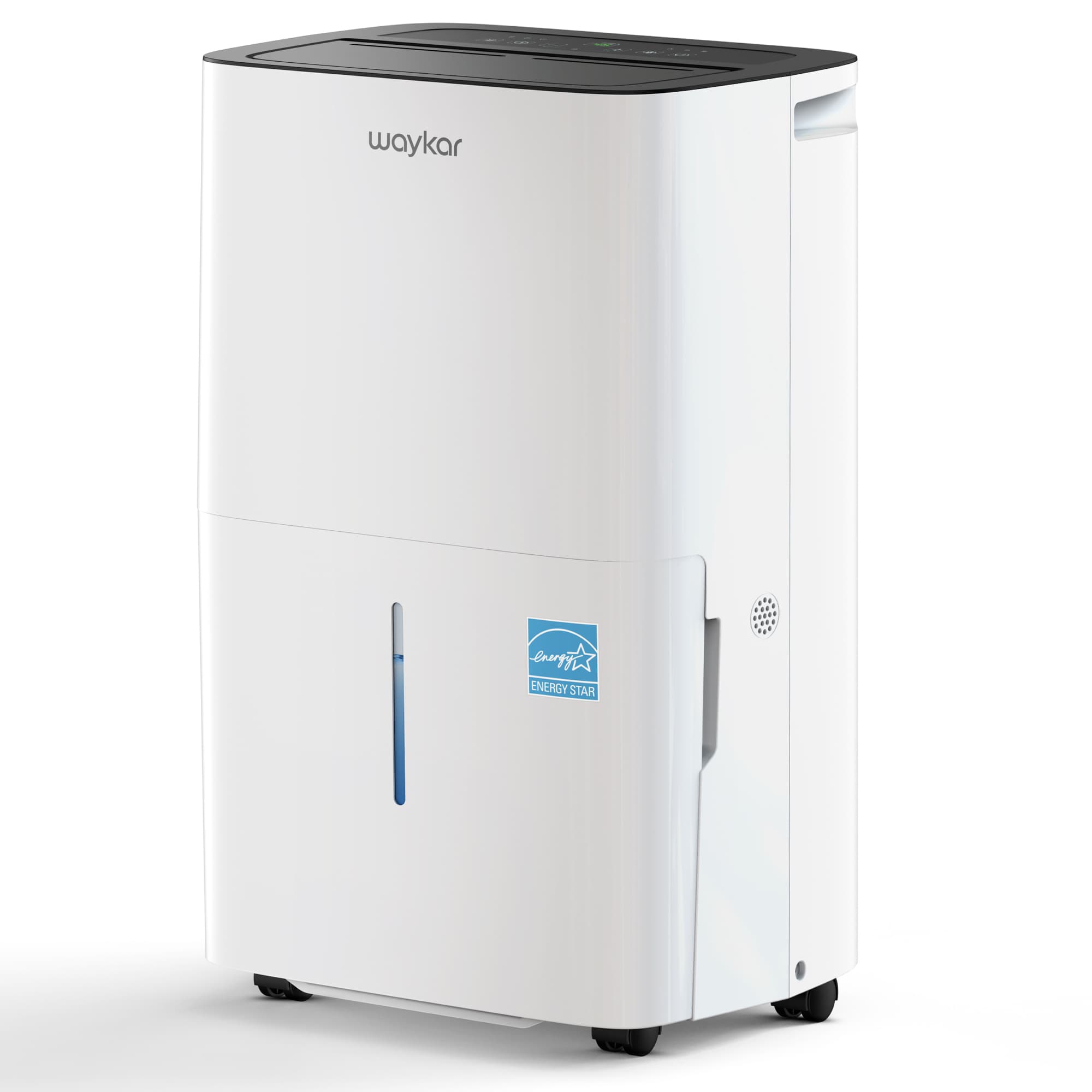
Waykar uses this CHWA-B family image for its size options. The exact model code—not the cabinet view—distinguishes the tank and pump configuration.
A high-condition maximum and a near-50-pint standard rating
The manual’s four test points for the 150-pint models are 49.5 pints/day at 65°F/60% RH, 75.4 at 80°F/60% RH, 116.8 at 86°F/80% RH and 150 at 95°F/90% RH. EPA lists the CHWA150B at 49.52 pints/day, 2.01 L/kWh, and 499 kWh/year. The exact record confirms ENERGY STAR certification but not Most Efficient status; Connected Capable is No. A 50-pint minimum in the finder uses the standardized value, so 49.52 does not satisfy it even though the manufacturer’s rounded manual table says 49.5 and the hot/humid headline says 150.
Waykar’s page estimates coverage up to 7,500 square feet. That figure is not a guarantee that one unit will control every connected basement, open-plan floor, or damp storage area. Doorways, moisture entering from outside, temperature, and operating duration matter. The capacity difference from CHWA120B is real—35.20 to 49.52 standardized pints/day—but it should not be mistaken for an assured room-size result.
Auto-swing and the non-pump drainage choice
The CHWA150B’s auto-swing louver moves the outlet side to side when enabled. The manual says to use the control rather than move the louver by hand. This differs from a fixed-vent model, but it does not add ducting or a second discharge outlet. If you do not need air direction to change, the swing feature is optional; if it is essential, the exact B family is the appropriate variant.
CHWA150B is not the pump model. The manual assigns the built-in pump only to CHWA150PB. For this exact configuration, choose its 2.38-gallon fitted tank or continuous gravity drainage. The supplied gravity hose is listed at 3.3 feet; a standard garden hose is not included. Gravity routing must run smoothly downward, with the outlet at least 3.94 inches below the drain port. A short hose can be awkward if the outlet is far away, and the exact documentation does not say this model can operate without its bucket installed.
The larger 2.38-gallon tank is a useful difference from the 1.45-gallon tanks on CHWA80B and CHWA120B, but it is still a tank that can fill. The manual describes an automatic full-tank stop and requires the tank to be emptied and seated correctly before the unit resumes. If you want fewer manual emptying trips and your drain is above the unit, the pump variant is the relevant alternative—not a change in the CHWA150B’s settings.
Placement and upkeep
The shared manual calls for 18 inches of clearance, a minimum operating area of 43 square feet, and use between 41°F and 95°F. It includes a 24-hour timer, auto-defrost, three fan speeds, and adjustable target humidity from 30% to 80% in five-point steps. A removable rear filter needs regular cleaning. These are practical setup constraints; the manufacturer’s “large space” estimate cannot compensate for blocked airflow, cold conditions below the stated range, or a continuing water source.
Who should choose CHWA150B?
Choose this exact code when you want the larger CHWA-B capacity, auto-swing direction, and can use a tank or lower gravity drain. Its standard rating is close to 50 pints/day, and the model shares its 2.38-gallon tank size with the pump-equipped PB version. If you need upward drainage, look at CHWA150PB; its manual documents pump operation but does not give a maximum vertical lift. If that number is essential, do not assume the pump reaches a particular height until Waykar confirms the route.
Skip CHWA150B if an essential requirement is a pump, a 50-pint/day standardized minimum, a connected app, or known noise and cabinet dimensions. Its rating, energy factor, and efficiency status are distinct from any manufacturer’s room-coverage estimate. Confirm “CHWA150B” on the offer: visually similar CHWA150PB adds a pump, while smaller CHWA80B and CHWA120B use different standard ratings and tank sizes.
Key details at a glance
| Published daily removal rating | 49.52 pt/day |
|---|---|
| Built-in lift pump | No |
| Published bucket capacity | 2.38 gal |
| Wi-Fi enabled | No |
| ENERGY STAR certified | Yes |
| Published dimensions | Exact model-specific dimensions and weight were not verified in the shared selector and manual evidence reviewed. |
More specifications and setup details
| Published integrated energy factor | 2.01 L/kWh |
|---|---|
| Capacity rating test conditions | The exact manual lists 49.52 pints/day at 65°F/60% RH; the separate 150-pint/day maximum is at 95°F/90% RH. Manual printed p.25 also lists 75.4 pints/day at 80°F/60% RH and 116.8 at 86°F/80% RH; these are different test conditions. |
Use the exact model’s instructions for operating limits, supplied equipment and version differences.
Sources for this assessment
- Waykar U.S. home-dehumidifier collection card
- Waykar CHWA-B selector product page
- Waykar CHWA-B four-model user manual
- U.S. ENERGY STAR certified dehumidifier dataset rows for CHWA-B models
- ENERGY STAR exact-model record for CHWA150B
- Waykar CHWA-B exact selector-linked product image shared by CHWA150B variant

Check the route before the room-size claim.
Match the rated capacity and drainage setup to a real place for the water to go.