
On this page
Your needs, this model
Does it fit your priorities?
What is its standard-condition rating versus the headline?
The CTH-A manual lists 50 pints/day at 65°F/60% RH, 73 at 80°F/60% RH and 115 at 86°F/80% RH; the up-to-150-pint number is at 95°F/90% RH.
Explore this need in the finder →Can this exact model pump condensate upward?
No. The shared CTH-A manual reserves the pump button, pump port and pump hose for CTH150PA; CTH150A has tank and lower gravity-drain plans only.
Explore this need in the finder →Can it meet a minimum IEF of 2.0 L/kWh?
The CTH-A manual lists 2.01 L/kWh. Do not convert that label into a household energy-bill forecast.
Explore this need in the finder →Can it run without its tank, or through an app?
Neither bucketless operation nor app control is established by the exact product/manual sources; an unknown essential feature is not a match.
Explore this need in the finder →The Waykar CTH150A is a large portable compressor dehumidifier, but its nameplate “150 pints” is not its standard-condition rating. The Waykar family manual lists 50 pints per day at 65°F/60% RH and 150 only at 95°F/90% RH. Its closest decision is often the CTH150PA: the manual gives the same stated capacity for both, while only the PA adds a documented condensate pump.
I checked Waykar’s exact CTH150A U.S. page and offer and the Waykar CTH-A family manual. The exact offer names SKU AZ-CTH150A; the manual has separate specification tables for CTH150A and CTH150PA.
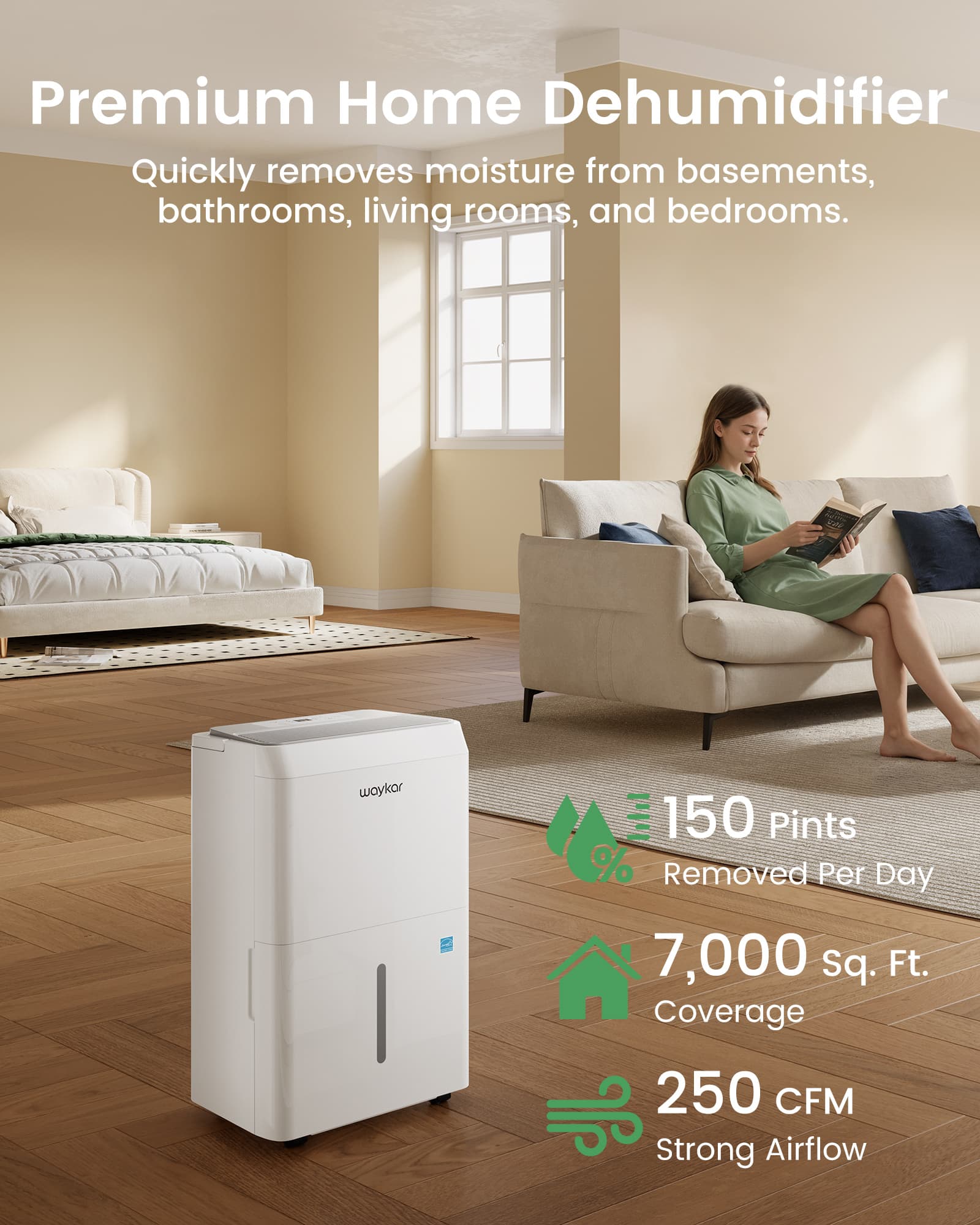
Waykar’s exact CTH150A page links this 150-pint room illustration. The area figure is the manufacturer’s claim, not a guarantee that one portable unit can control 7,000 square feet of divided rooms.
Fifty pints is the fairer comparison
The manual specifies 50 pints/day at 65°F/60% RH, 73 at 80°F/60% RH, 115 at 86°F/80% RH, and a maximum 150 at 95°F/90% RH. A buyer comparing dehumidifiers should keep those test conditions attached to the number. “Up to 7,000 square feet” is also Waykar’s coverage claim, not an engineering calculation for your particular layout. If interior doors separate the basement or room, air circulation and the actual water load still matter.
The manual’s CTH150A table lists 115 V/60 Hz, 783 W rated input, a 7.1 L/1.9-gallon tank and R32 refrigerant. The exact product page separately shows 750 W. Those manufacturer figures conflict, so I do not use either to promise an energy bill or a definitive operating wattage. The manual does list a 2.01 L/kWh IEF, but annual household cost still depends on runtime and local electric rates. Waykar’s page describes ENERGY STAR certification and a 2024 Most Efficient claim; award language can be year-specific, so do not treat that marketing phrase as a current-year ranking without checking the exact model’s current program listing.
Controls work best when the routine is simple
In Auto mode, this family uses room temperature to select 55% RH below 64°F, 50% from 64–77°F and 45% above 77°F. Auto fixes the fan on low and prevents manual fan adjustment. If you want to choose a target yourself, leave Auto and use the manual humidity control: 35–80% RH in five-point increments, with a 30% continuous-run setting. That is useful when you have a clear target, but it is not Wi-Fi control; the model’s public page and manual do not document an app or remote connection.
The three fan speeds, full-tank alarm and automatic stop, auto defrost, power-off memory and one-time 24-hour on/off timer are practical everyday features. The timer does not repeat, and the manual says it must be reset after power is interrupted. Auto defrost is not proof of performance in any temperature: Waykar specifies a 41–90°F operating range. Its manual also recommends a minimum 43-square-foot floor area and warns that the R32 refrigerant is flammable; service work should be left to qualified technicians.
Gravity drainage is the important limitation
The CTH150A has a removable 1.9-gallon tank, full-tank protection and an included 3.3-foot gravity-drain hose. The manual lists a 12.77 mm hose diameter and says the outlet must be at least 3.94 inches lower than the drain port. It also permits a standard garden hose, but does not establish the maximum gravity-drain route length. A nearby floor drain or lower sump opening is the sensible layout; this model has no documented built-in pump for lifting condensate to a higher outlet.
Because its label maximum is so much higher than its tank volume, a tank-only setup may need frequent attention in very damp conditions. Continuous gravity drainage avoids routine emptying only when the route is truly downhill and the tank is installed as instructed. The manual does not confirm bucketless operation, so do not treat continuous drainage as permission to remove the reservoir.
Choose the non-pump model only when the drain allows it
The CTH150A suits a large, damp area where a roughly 50-pint standard rating is useful and a lower gravity drain is available. It is not a compelling step up from a CTH120A if 32.46 standardized pints already cover the need, and it is the wrong CTH choice when an uphill discharge is essential. The CTH150PA is the closer alternative for that need: its manual states the same standard and maximum capacities but adds a pump hose and a 16.4-foot vertical-rise limit. If you do not need that route, the simpler CTH150A avoids a pump that would add no useful capability. I would not choose either model based only on the 7,000-square-foot claim, the hot/wet 150-pint figure, or an unqualified award label.
Key details at a glance
| Published daily removal rating | 50 pt/day |
|---|---|
| Built-in lift pump | No |
| Published bucket capacity | 1.9 gal |
| Published dimensions | No dimensions or dry weight are entered from the reviewed exact sources in this dossier. |
| Published integrated energy factor | 2.01 L/kWh |
| Capacity rating test conditions | The exact CTH-A family manual lists 50 pints/day at 65°F/60% RH, 73 at 80°F/60% RH, 115 at 86°F/80% RH, and the manufacturer page’s 150-pint headline at 95°F/90% RH. No exact current ENERGY STAR program record was found in the reviewed primary archive. |
Use the exact model’s instructions for operating limits, supplied equipment and version differences.
Sources for this assessment
- Waykar exact CTH150A U.S. product page
- Waykar current home collection page 2, CTH150A row
- Waykar current manual-download index (does not list this CTH-A family manual)
- Waykar CTH-A family owner manual (public PDF mirror copy; the archived index does not link this version)
- Image linked by exact Waykar CTH150A page

Check the route before the room-size claim.
Match the rated capacity and drainage setup to a real place for the water to go.