
On this page
Your needs, this model
Does it fit your priorities?
Does this model meet a 20-pint/day minimum on its standard-condition rating?
No. The exact manual and EPA record list 9.2 pints/day at 65°F/60% RH; 30 pints is the separate 95°F/90% RH label condition.
Explore this need in the finder →Can it drain by gravity to a lower outlet?
Yes, when the included 3.3-foot hose reaches and can run smoothly downhill to an outlet at least 3.94 inches below the drain port. A garden hose is an optional alternative, not included.
Explore this need in the finder →Can it pump water upward to a higher drain?
No pump lift is documented in the exact CTH30A manual. Unknown pump ability cannot satisfy an essential lift requirement.
Explore this need in the finder →Is ENERGY STAR certification confirmed, and is app control confirmed?
The EPA record confirms certification but says Connected Capable No. The manufacturer page and manual do not establish app control, so an app-essential need is not a match.
Explore this need in the finder →Can it operate in a documented bucketless configuration?
The manual describes tank collection and gravity drainage but does not establish that the unit runs with the tank removed. Treat bucketless capability as unknown.
Explore this need in the finder →The Waykar CTH30A is a compact portable dehumidifier with a 30-pint headline, four operating modes, a small collection tank, a gravity-drain hose and an ENERGY STAR certification. Those headline pints need context: the manual’s 30-pint figure is measured at 95°F and 90% relative humidity, while the EPA’s exact CTH30A record lists 9.2 pints per day at its standard test condition. It makes more sense for a modest moisture load than for a buyer who needs a verified 20- or 30-pint standard-condition minimum.
This assessment uses Waykar’s exact CTH30A product page, its CTH30A-named manual and the EPA ENERGY STAR record for CTH30A. The manual’s specification table and drainage instructions were checked against this exact code. The EPA record is a separate certification source, not an independent room-performance test.
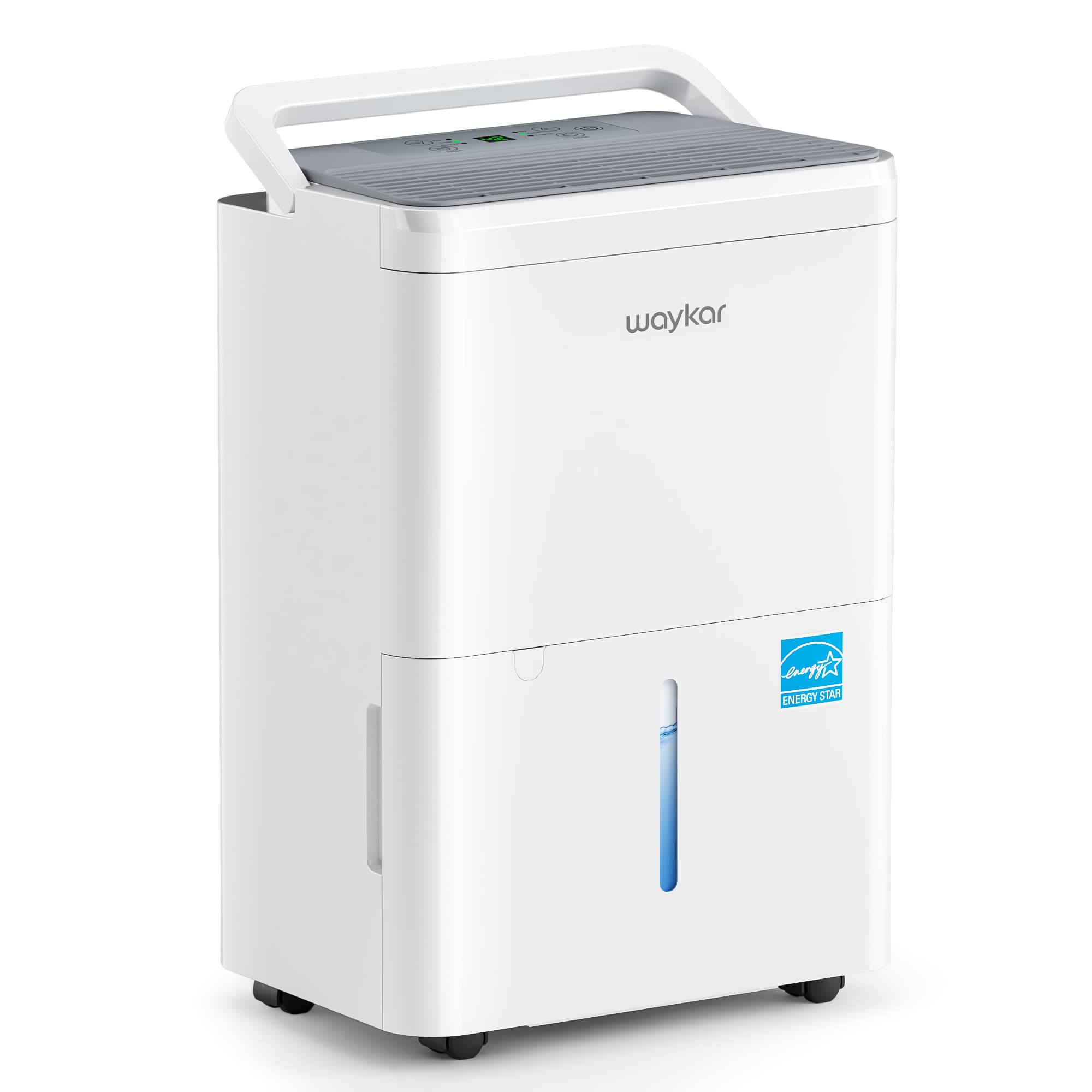
Waykar links this white-cabinet, upper-control-panel and water-window image from the exact CTH30A page. The full unit is visible, but there is no model plate in the image. The manufacturer does not identify the image as a photograph or a rendering.
Use the rated pints that match your conditions
Waykar labels the CTH30A at up to 30 pints per day under 95°F/90% RH. The exact manual shows how much the number changes with the test environment: 23.2 pints at 86°F/80% RH, 13.3 at 80°F/60% RH, and 9.2 at 65°F/60% RH. The last figure is also the capacity in ENERGY STAR’s certified-product record. That record lists an integrated energy factor of 1.7 liters per kilowatt-hour, estimated annual consumption of 117 kWh, and certification under the U.S. market. It is not identified as ENERGY STAR Most Efficient.
For a finder question that asks whether a model meets a hard daily-capacity minimum, use 9.2—not the 30-pint hot-and-wet maximum—as the conservative comparison number. It does not satisfy a 20-pint or higher threshold on that standard basis. The product page’s “up to 2,000 square feet” is a manufacturer coverage claim, not a room-by-room guarantee; closed doors, cool temperatures, ventilation and new moisture sources change the job. A small room that feels damp may be a reasonable starting case, but a wet basement or frequent laundry moisture calls for a better-matched verified capacity.
Pick the water route before the room location
For bucket use, the exact manual describes a removable 1.5-liter tank. It prints a parenthetical 0.33-gallon value, but 1.5 liters converts to about 0.40 U.S. gallons, so I would trust the metric figure and not use that gallon conversion for a strict tank-size requirement. The manual says a full-tank alarm stops the compressor and pauses the fan; the unit cannot restart until the tank is emptied and reinstalled. A small reservoir means more emptying if the appliance is collecting heavily.
Waykar’s page says the package includes a 3.3-foot drain hose. The manual explains the gravity setup: the outlet must be lower than the drain port, with the hose running smoothly downhill and at least 3.94 inches below that port. It also describes a standard garden-hose option with a 12.7 mm inner diameter; that hose is not included. A short downhill run to a floor drain can reduce bucket trips, but this is not an uphill pump. The reviewed instructions document no pump lift or pump-hose reach. If your drain is higher than the appliance, choose a model whose exact manual states a usable lift height rather than treating the CTH30A’s gravity hose as equivalent.
Comfort controls are useful, but not an acoustic test
The CTH30A manual describes four modes. Dry and Turbo allow a humidity setting from 35% to 80%; Turbo defaults to high fan while Dry defaults low. Comfort Mode changes its target automatically with room temperature: 55% RH below 64°F, 50% from 64°F through 77°F, and 45% above 77°F. Continuous Mode runs without an adjustable target and displays a 15% setting. That low number is a control target, not evidence that a room will actually reach 15% RH. Waykar advertises operation as low as 35 dB, but I found no independent acoustic measurement; bedrooms and nurseries should be judged in person if sound sensitivity is a hard requirement.
The unit is intended to operate between 41°F and 90°F according to the manual. Its shutdown sequence runs the fan for about 20 seconds to dry internal parts, and the troubleshooting section describes defrosting at low temperatures before operation resumes. Those details may help with routine use, but they do not make it suitable below the stated operating range. The product page also describes a washable, reusable mesh screen, so routine filter cleaning is part of ownership rather than an optional extra.
Who should choose it—and who should keep looking?
The CTH30A fits a shopper who wants a current, ENERGY STAR-certified portable unit, values a manufacturer-claimed low sound level, and can use a small bucket or a short downhill drain. Its handle and wheels are listed by Waykar as mobility aids, while the simple control panel gives you a choice between a set humidity target and automatic Comfort operation. The EPA says it is not connected-capable, and the reviewed exact sources do not establish app control; do not choose it to satisfy an essential app requirement.
If a standardized capacity matters more than low-noise marketing, compare the Waykar JD025CE-120 review: its exact ENERGY STAR record lists 35.78 pints per day, versus 9.2 for this CTH30A, though that larger model also relies on a tank or gravity drainage rather than a documented pump. If your room needs an uphill drain, focus instead on a unit with a model-specific pump-lift limit. The CTH30A’s appeal is its four-mode control and modest footprint, not the implication that every “30-pint” product removes the same amount of water in a cool room.
Key details at a glance
| Published daily removal rating | 9.2 pt/day |
|---|---|
| ENERGY STAR certified | Yes |
| Published dimensions | No exact dimension or dry-weight figure was established from the archived exact page, model manual or EPA record. |
| Published integrated energy factor | 1.7 L/kWh |
| Capacity rating test conditions | The exact Waykar manual and U.S. ENERGY STAR record give 9.2 pints/day at 65°F/60% RH. The separate 30-pint label is the 95°F/90% RH maximum; do not treat it as the standard rating. |
Use the exact model’s instructions for operating limits, supplied equipment and version differences.
Sources for this assessment


Check the route before the room-size claim.
Match the rated capacity and drainage setup to a real place for the water to go.