
On this page
Your needs, this model
Does it fit your priorities?
Does the CTH30C meet a 20-pint/day standard-condition minimum?
No. Its EPA family-associated record lists 9.2 pints/day under Appendix X1; the page’s 30-pint label is at 95°F/90% RH.
Explore this need in the finder →Can you use a fitted tank or gravity drain to a lower outlet?
The exact product page lists a 0.39-gallon tank and a 3.3-foot gravity hose. A short downward route is documented; an uphill pump route is not.
Explore this need in the finder →Is ENERGY STAR certification confirmed for CTH30C?
The current U.S. EPA record for CTH30A lists CTH30C in its additional model information and reports certified status. It is a family-associated record, not a standalone CTH30C row.
Explore this need in the finder →Can CTH30C satisfy an essential app-control need?
No app or Wi-Fi control is established by the exact page or indexed manual. Unknown connectivity does not pass an app-essential choice.
Explore this need in the finder →Can it satisfy an essential bucketless drain requirement?
The exact page lists a tank and gravity hose but the CTH30C manual is not listed, so bucketless operation is unconfirmed.
Explore this need in the finder →The Waykar CTH30C is a portable 30-pint-labeled dehumidifier with a compact 0.39-gallon tank and a short gravity-drain hose. The 30-pint figure is its maximum at 95°F and 90% relative humidity, not the ordinary-condition rating: the current U.S. ENERGY STAR record associates CTH30C with a 9.2-pint-per-day standard rating. That makes it a better fit for a modest moisture load than for a buyer who needs a confirmed 20-pint standard-condition minimum.
Waykar’s exact product page identifies CTH30C and matches the collection row’s product ID. The collection image alt says “C30CTH”; Waykar does not explain the difference, so I do not treat it as a second model. EPA lists CTH30C as additional model information under its CTH30A record, with a 9.2-pint/day rating and 1.70 L/kWh IEF. The archived manual index has no CTH30C manual, so I do not import operating details from CTH30A.
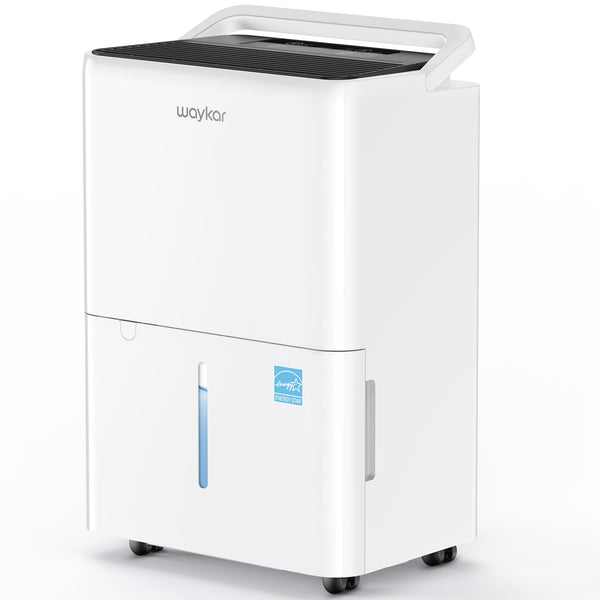
Waykar links this white cabinet view from the CTH30C page. It shows the top vent, carry handle, water window and wheels, but no model plate or internal parts.
Read the 30-pint rating in context
Waykar’s specification table rates CTH30C at 30 pints per day under 95°F/90% RH and advertises coverage up to 2,000 square feet. Those are manufacturer claims at a warm, very humid condition and a broad area estimate, not a promise that a particular basement will dry quickly. Under the standard ENERGY STAR test condition, the associated CTH30A record lists 9.2 pints a day and an integrated energy factor of 1.70 liters per kilowatt-hour. The EPA record identifies CTH30C as an additional model in that certified family; it is not a separate room-performance test for your house.
For a hard capacity filter, use the documented 9.2-pint standard rating rather than the 30-pint hot-and-humid maximum. It does not meet a 20-pint/day standard-condition requirement. A room with only a small recurring humidity problem may be a reasonable use, but persistent seepage, laundry moisture or a damp basement can be a different load. Measure the space and address the moisture source; square-foot claims alone do not size an appliance.
Choose between a small tank and a short gravity route
The product page lists a 0.39-gallon water tank. That is a limited reservoir, so expect to empty it when the full-tank control stops collection; the exact model’s manual was not available in the captured Waykar download index to confirm the alarm sequence or restart behavior. If you can place the unit near a lower drain, Waykar lists a 3.3-foot gravity hose. Gravity drainage needs a continuously descending route to an outlet below the unit; a short hose does not give much flexibility for crossing a room or climbing to a sink.
The collection title calls it garden-hose compatible, but the page’s included-hose statement is for a 3.3-foot hose; it does not say a longer garden hose is in the box. Neither the exact product page nor the manual index confirms a built-in lift pump, the maximum vertical rise, or bucketless operation. Do not choose CTH30C for a drain above the appliance or a bucket-free installation unless Waykar supplies instructions for that exact setup. A model with an explicit pump rating is a safer comparison when water must travel uphill.
Simple controls, limited documentation
Waykar describes four settings and automatic defrost, but does not name the settings on the product page. Its “as low as 35 dB” statement is a manufacturer noise claim, not an independent measurement, and the exact model’s manual was not listed in the archived download index. If bedroom quietness or a specific humidity-control behavior is essential, request the CTH30C instructions before purchase rather than assuming that a sibling CTH30A manual applies. The EPA record says the certified product is not connected-capable; I found no exact CTH30C evidence for Wi-Fi or app control, so it should not pass an app-required choice.
The page’s 2,000-square-foot estimate is useful for comparing the manufacturer’s intended home scale, but it cannot account for a cold cellar, open stairways, air leakage or a continuous water source. The page lists 59/44 CFM airflow and auto defrost, yet the control settings and operating-temperature limits remain unspecified in the exact documentation I found. For a room that regularly gets cool, check the temperature range with Waykar before relying on it.
How it compares with nearby choices
CTH30C and Waykar’s CTH30A share a 30-pint label and EPA record family, but CTH30A has its own manual. Its tank, drainage and control instructions do not establish CTH30C behavior. The PD160B has a larger published tank, but its standard rating is still only about 9.8 pints/day; it is not a substitute for substantially more verified output or a documented pump. For those needs, compare the exact alternate model’s manual and certification record instead of relying on a collection-page family name.
Who should consider it?
CTH30C may suit someone who wants a current, ENERGY STAR-certified portable unit for a modest humidity problem, can tolerate a small tank, and has a nearby lower drain or is willing to empty the tank. It is a poor match for a strict 20-pint standard-rating need, an uphill drain, a required bucketless setup, app control, or a sound threshold that must be independently verified. Waykar advertises a limited warranty extension after registration; read the current terms and obtain the exact CTH30C manual before relying on any setup details. The most useful comparison here is not “30 pints versus 30 pints,” but whether its 9.2-pint standard rating, small reservoir and gravity-only documented route fit your actual room and maintenance routine.
Key details at a glance
| Published daily removal rating | 9.2 pt/day |
|---|---|
| Published bucket capacity | 0.39 gal |
| ENERGY STAR certified | Yes |
| Published dimensions | Exact CTH30C cabinet dimensions and weight were not found in the captured product page or indexed manual. |
| Published integrated energy factor | 1.7 L/kWh |
| Capacity rating test conditions | The current EPA ENERGY STAR row for CTH30A lists CTH30C as additional model information and reports 9.20 pints/day under Appendix X1. The Waykar page separately labels CTH30C 30 pints/day at 95°F/90% RH; do not use that hot-and-humid maximum for standard-condition minimum matching. |
Use the exact model’s instructions for operating limits, supplied equipment and version differences.
Sources for this assessment
- Waykar exact U.S. CTH30C product page
- Waykar U.S. home dehumidifier collection, page 1
- Waykar official manual-download index (reused archive)
- ENERGY STAR current certified-dehumidifier dataset query for CTH30A record containing CTH30C
- ENERGY STAR current dataset exact model-number query for CTH30C
- EPA ENERGY STAR CTH30A certified-product record (same record reused)
- Waykar CTH30C page-linked product image

Check the route before the room-size claim.
Match the rated capacity and drainage setup to a real place for the water to go.