
Your needs, this model
Does it fit your priorities?
What does GE document for gravity drainage on ADEW50LY?
The linked manual describes an unsupplied garden hose leading to a floor drain, with the bucket reinstalled and seated. It does not document a bucketless or elevated-pump route; ADEW50LY itself is a discontinued owner reference.
Explore this need in the finder →Does GE’s exact ADEW50LY page identify SmartHQ Wi-Fi?
The page lists built-in Wi-Fi powered by SmartHQ and describes feedback, optimized performance and alerts. That listing does not guarantee current app/cloud support for an older installed unit; the model remains outside buying results.
Explore this need in the finder →Will the cabinet fit a 22-inch height and 44-pound dry handling limit?
GE lists a 21.875-inch cabinet and 43.2-pound net weight, so it meets those cabinet-only caps. The manual still calls for 18 inches of surrounding clearance and access to remove the 10.6-pint bucket.
Explore this need in the finder →ADEW50LY is a discontinued GE 50-pint/day dehumidifier with a notable split: GE advertises SmartHQ Wi-Fi, while its linked manual documents only a fitted bucket or a hose to a floor drain. The bucket must stay seated during hose use. This is an exact-model owner reference, not a recommendation to buy old stock.
Sources: GE’s exact product page, support page and linked 49-7759-1 manual. GE dates manufacture June 2019–January 2025 and says it is no longer manufactured. The manual cover lists ADEW30/ADEW50/ADEW70, not the LY suffix; the exact support page links it.
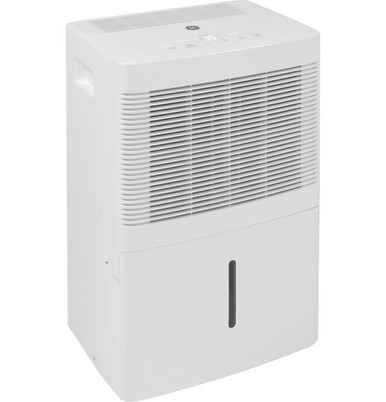
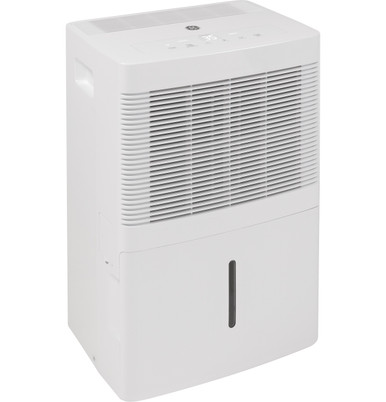
The exact GE page links this white cabinet image. Its grille, top panel and water window are visible, but not the drain hardware. Photo-versus-render status is unknown.
A large daily rating does not mean a large reservoir
GE lists 50 pints/day, a 10.6-pint front bucket and 43.2-pound dry weight. The rating is not a promise of ordinary-room output; temperature, humidity, target setting and runtime matter. The roughly 1.3-gallon reservoir is much smaller than the daily rating, so a wet basement may still need frequent checks and emptying. The full-water light, alarm and automatic shutoff are safeguards, not hands-off water handling.
The cabinet is 21.875 inches high, 13.75 wide and 10.625 deep. Measure side access for the drain and front access for bucket removal, plus the manual’s 18-inch air clearance. Rollers are for smooth, flat floors, not carpet. GE’s manual warns performance can fall below 41°F; the exact page lists 5–32°C. It is for residential indoor use, and a closed adjacent closet will not dry without air circulation.
Gravity hose means the bucket stays installed
The 49-7759-1 manual documents two water arrangements: collect condensate in the bucket, or attach a garden hose (not supplied) to the side drain nozzle and lead it to a floor drain. The setup sequence removes the bucket to open the drain and connect the hose, then puts the bucket back; GE says the unit will not run unless it is securely seated. This is not a bucketless-drain configuration. Nor does the exact page or linked manual describe an internal pump, a maximum lift height or a way to send water to an elevated sink. If the outlet is higher than the appliance, treat this model as an unverified fit rather than assuming a pump from the phrase “external drain connector.”
A floor drain below the unit and an unblocked hose path can reduce emptying chores. An elevated laundry sink or a demand to remove the bucket calls for another documented setup. With the hose connected, water follows it rather than filling the bucket.
SmartHQ is the unusual strength—and an ownership uncertainty
GE’s ADEW50LY page advertises Wi-Fi powered by SmartHQ and describes feedback, optimized performance and alerts; its exact specifications do not establish Wi-Fi for the adjacent ADEW20LY. GE also lists several “Works With” services. That is a connected-feature distinction, not a change to drainage. A product page cannot guarantee that a used unit, home network and GE’s current app service will still pair.
The manual’s local controls include three fan speeds, 35–80% humidity settings in five-point increments or continuous mode, two- and four-hour delayed shutoff, automatic defrost and restart after a power interruption. GE lists 153/135/118 CFM at high/medium/low, 52 dBA maximum sound, 490 watts and a 2.0 L/kWh integrated energy factor. Treat the noise and efficiency entries as manufacturer figures, not lab testing or a prediction of your bill. The Energy Star mark appears on GE’s exact product page, but certification does not settle whether this discontinued model is the best fit for a current purchase.
Care is straightforward, but recurring
Check and wash the slide-out filter at least every 250 operating hours; a reminder light marks that interval. Turn the machine off and unplug it before cleaning, then let the filter dry before reinstalling. GE recommends cleaning the bucket every few weeks. Keep the airflow opening clear and the bucket seated. An app alert cannot correct a dirty filter, a poor hose route or cold-room performance.
Where it sits among GE’s older 50-pint options
APHL50LB is a useful contrast: its separate manual documents a pump with a 16-foot maximum lift, but requires its 15-pint bucket to remain installed. ADEW50LY’s bucket is 10.6 pints and its linked manual gives no pump-lift plan. GE lists 2.0 L/kWh IEF for ADEW50LY and 1.8 for APHL50LB; these are specifications, not measured household energy comparisons. Confirm the full suffix before using an owner’s manual or ordering parts, and never transfer APHL’s pump steps. A new purchase should start with an in-production model whose exact manual fits the intended route.
Reference only, not a shortlist result
Use GE’s exact page to check the 50-pint rating, SmartHQ listing, dimensions and manual if this is your installed unit. It is no longer manufactured, and a secondhand listing does not establish condition, coverage or support. The useful fit questions are whether the bucket can stay seated, gravity can reach a floor drain, and an older connected appliance still meets your needs. GE documentation answers the first two, not the last.
Key details at a glance
| Published daily removal rating | 50 pt/day |
|---|---|
| Published bucket capacity | 1.32 gal |
| Wi-Fi enabled | Yes |
| ENERGY STAR certified | Yes |
| Published high-fan sound rating | 52 dBA |
| Published dimensions | 21.875 in H × 13.75 in W × 10.625 in D |
| Bucketless operating mode | No |
| Nested storage arrangement | No |
| Published product weight | 43.2 lb |
| Controls and settings | The exact product page lists electronic controls, three fan speeds, 35–80% humidity setpoints in 5% increments or continuous operation, two-/four-hour off timer, automatic defrost, auto restart, and built-in Wi-Fi powered by SmartHQ. GE describes feedback, optimized performance and alerts; it does not guarantee ongoing app/cloud support or document every remote control action. |
| Water-removal setup | The exact page lists an external drain connector. Its linked 49-7759-1 family manual documents hand collection in the fitted bucket or an unsupplied garden hose connected to the side nozzle and led to a floor drain. The bucket must be securely seated for operation in either arrangement. The manual does not document a bucketless setup or an upward pump route; built-in-pump presence and any lift limit remain unknown rather than inferred from the page’s omission. |
| Care and operating limits | The linked ADEW30/ADEW50/ADEW70 manual requires a level indoor residential location, advises 18 inches of clearance, and warns against operation below 41°F. Inspect and wash the slide-out filter at least every 250 hours; clean the water bucket every few weeks. The bucket must remain seated, including during gravity-hose use. |
| Exact model detail | GE dates manufacture June 2019–January 2025 and says ADEW50LY is no longer being manufactured. Keep as an owner-identification reference; exclude from current buying matches. |
| Published integrated energy factor | 2 L/kWh |
Use the exact model’s instructions for operating limits, supplied equipment and version differences.
Sources for this assessment
Check the route before the room-size claim.
Match the rated capacity and drainage setup to a real place for the water to go.