
Your needs, this model
Does it fit your priorities?
Is the published 50-pint U.S. class the minimum you need?
The exact retail listing labels this a 50-pint model; ENERGY STAR separately reports 49.64 pints/day under Appendix X1. Neither number promises room-specific daily collection.
Explore this need in the finder →Can you drain by gravity to a lower floor drain?
Yes. GE’s family manual describes a separate garden hose routed downhill while the fitted bucket stays seated; that hose is not supplied.
Explore this need in the finder →Must water be pumped to a higher outlet?
No. The exact ADSE50WWT code uses W for Wi-Fi; GE reserves X for Wi-Fi plus pump. This W model has no pump-lift plan.
Explore this need in the finder →Must the machine run without its bucket installed?
No. The GE family instructions require the bucket to remain seated during operation, including gravity drainage.
Explore this need in the finder →Is remote app control important?
The exact listing advertises Wi-Fi/SmartHQ. Connectivity does not change the gravity-only water route.
Explore this need in the finder →Do you have a strict cabinet-size or dry-weight limit?
Exact WWT dimensions and dry weight are not confirmed here. Treat these as unknown until checked against the rating label or exact model documentation; unknown does not prove a fit.
Explore this need in the finder →The GE ADSE50WWT is GE’s Wi-Fi-enabled 50-pint-class portable dehumidifier in the current compact ADSE cabinet family, but it is not the pump-equipped sibling. Its useful water options are the fitted bucket or a separate downhill gravity hose; there is no documented route for lifting water to a higher drain. That makes the exact model code important: the similar ADSE50XWT adds a built-in pump, while this W-feature version does not.
The exact Home Depot ADSE50WWT listing identifies the retail model, describes a 50-pint, Wi-Fi unit and advertises use up to 5,000 square feet. GE’s 2025 code guide explains that W is built-in Wi-Fi while X is Wi-Fi plus pump. The GE-authored 49-5001142 family manual includes ADSE50 and describes bucket and gravity operation. The official ENERGY STAR ADSE50 family record lists ADSE50W**# as an additional model under its certification.
Water route is the dividing line from the pump version
For this model, collect condensate in the bucket or attach a separate garden hose and let it run downhill to a floor drain. GE’s family instructions say the bucket must remain properly seated while the appliance operates; connecting the gravity hose does not make the unit bucketless. The hose is not supplied, and its path must slope toward a lower drain. If there is no lower outlet and your route requires water to travel upward, select a configuration with a documented pump lift instead. The ADSE50XWT is the closely related GE version with a built-in pump and 16-foot stated vertical lift, but its pump also requires the bucket to remain installed.
The 50-pint label does not tell you how long the bucket will last between checks. The exact listing and family manual do not establish a consistent bucket-volume figure for this SKU, so do not plan an unattended interval around an assumed tank size. A full or removed bucket stops operation. A continuous gravity route can reduce manual emptying only if you have a nearby drain below the unit and can route the hose without a rise or kink.
Published capacity and square footage are different things
Home Depot lists a 50-pint U.S. class and claims use in rooms up to 5,000 square feet. In the official ENERGY STAR record, ADSE50W**# appears among the additional models under ADSE50X**#; that certification gives 49.64 pints per day under Appendix X1, an integrated energy factor of 2.01 L/kWh and 519 kWh per year. The test-basis number and the retail 50-pint class are related but not identical descriptions. Neither one guarantees that this unit will remove 50 pints from your particular home each day. Temperature, air leakage, room configuration and moisture sources all affect real operation, so treat the area statement as a broad marketing guide, not a room-sizing promise.
Wi-Fi does not alter what the hose can do
The exact listing describes Wi-Fi and SmartHQ access, and GE’s nomenclature guide decodes this code’s W feature as built-in Wi-Fi. That can make remote adjustment useful when the appliance sits in a basement or other room you do not visit constantly. It does not add a pump: software control cannot raise water to a drain above the machine. The related X-feature model combines Wi-Fi and a pump, but its manual still requires local pump setup. ENERGY STAR’s separate “Connected Capable: No” field is a program designation and should not be read as a contradiction of GE’s consumer Wi-Fi description.
Leave space and keep up with the filter
GE’s family instructions call for indoor residential use between 41°F and 90°F, at least 18 inches of clearance around the unit, a washable filter check at 250 operating hours, and a properly seated bucket. The control section describes High and Low manual fan settings plus Smart automatic speed adjustment, a 35–80% humidity range in five-point increments, continuous operation, auto defrost and restart after a power interruption. These details are useful when comparing routines, but do not turn the manufacturer’s 5,000-square-foot claim into a guarantee for a closed room, crawl space or damp basement.
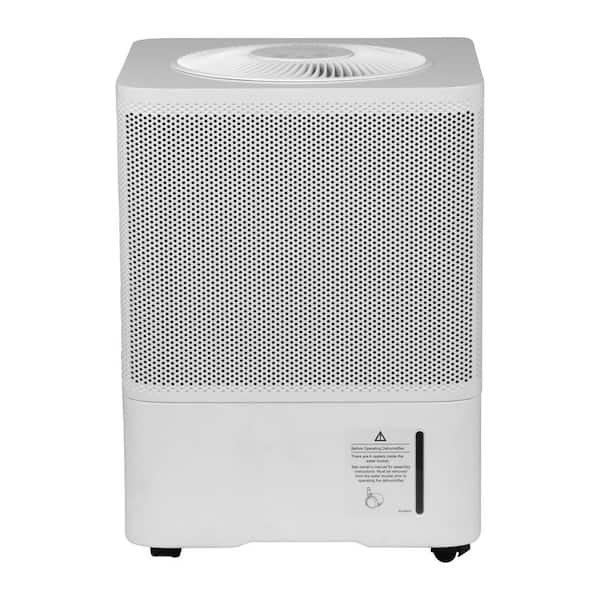
The exact product image shows the outer cabinet, not the water route or internal pump hardware. Physical dimensions, dry weight, bucket capacity and a comparable independent noise measurement are not established here for this exact WWT code. Leave cabinet-size or weight constraints unanswered unless you can confirm them from the rating label or model documentation; unknown dimensions are not proof of a fit.
Who should choose it
Choose the ADSE50WWT if a 50-pint-class portable unit, SmartHQ connection and bucket or lower-drain gravity use meet your actual conditions. It is the wrong GE ADSE code when upward pumping is essential, and a bucketless requirement is not supported. Compare it with the ADSE50XWT when an uphill water route matters, checking that the pump’s documented lift is enough and that keeping the bucket installed is acceptable. If a lower capacity is enough and a shorter cabinet has value, the ADSE35WWT1 shares the Wi-Fi/gravity-only approach but is a 35-pint-class configuration. Pick among them by capacity class and a drainage plan that can coexist in one setup, not simply by comparing their shared brand name or advertised area figures.
Key details at a glance
| Published daily removal rating | 50 pt/day |
|---|---|
| Built-in lift pump | No |
| Wi-Fi enabled | Yes |
| ENERGY STAR certified | Yes |
| Published dimensions | Exact ADSE50WWT dimensions were not verified; do not infer from the pump-equipped sibling. |
| Bucketless operating mode | No |
| Published integrated energy factor | 2.01 L/kWh |
| Pump activation through app | No |
Use the exact model’s instructions for operating limits, supplied equipment and version differences.
Sources for this assessment
- Exact Home Depot GE listing for model ADSE50WWT; rendered browser observation, not original HTML
- GE Appliances 2025 Product Nomenclature Guide, dehumidifier feature codes
- GE Appliances owner manual 49-5001142 Rev. 0 (09-25), ADSE/ADNE 25/35/50 family
- ENERGY STAR GE ADSE50X**# certified dehumidifier record 4515187
- Exact Home Depot item-page-linked image for model ADSE50WWT
- ENERGY STAR Connected Criteria for Partners

Check the route before the room-size claim.
Match the rated capacity and drainage setup to a real place for the water to go.