
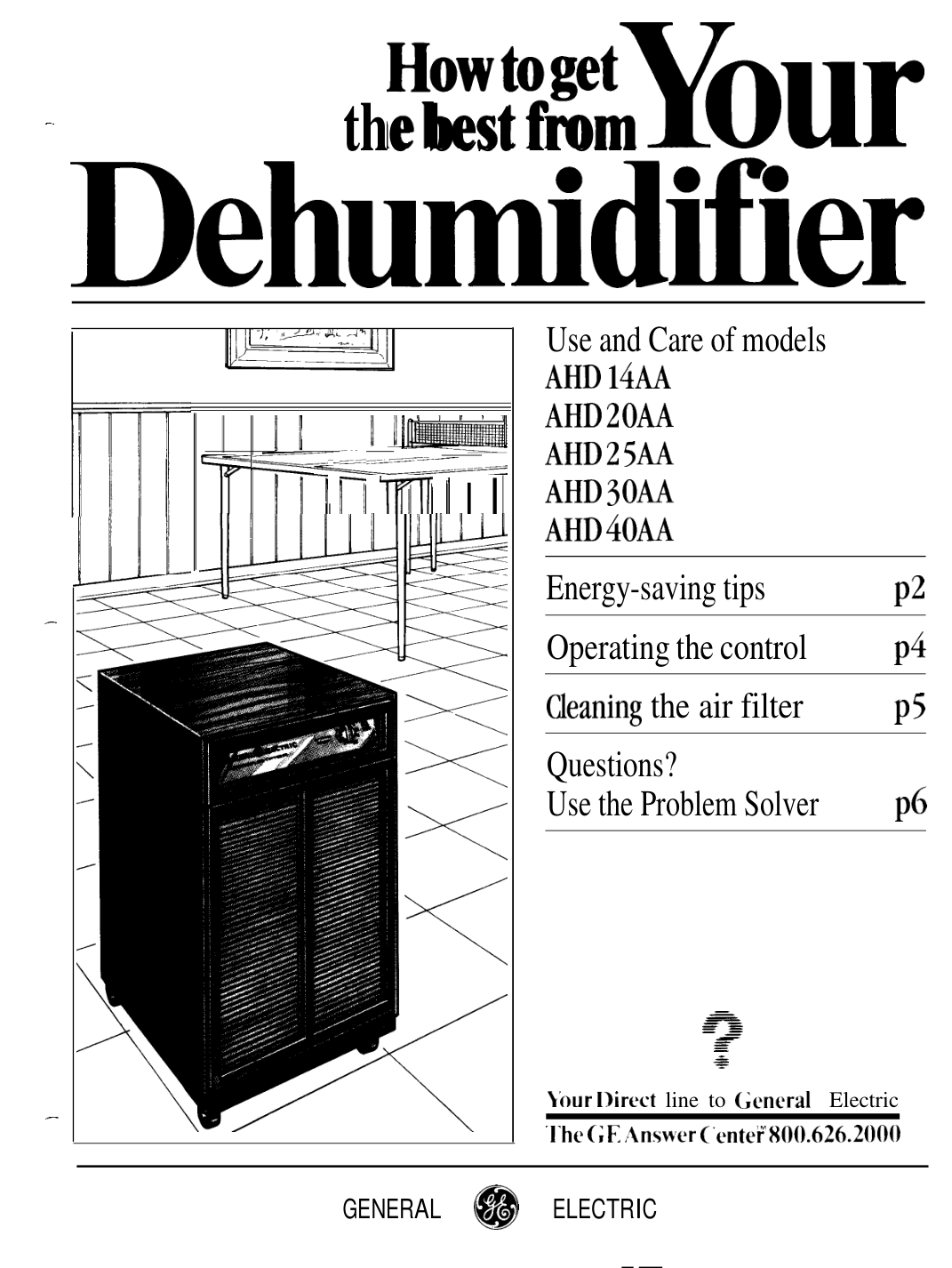
Your needs, this model
Does it fit your priorities?
Does the “14” in AHD14AA establish a 14-pint daily rating?
No. GE’s 49-7300 guide lists exact AHD14AA but supplies no model-by-model pints-per-day table or test conditions. The “14” in its model string is not treated as an extraction rating; a capacity-essential request excludes this reference.
Explore this need in the finder →Can AHD14AA drain downhill without its fitted bucket?
Yes, the GE family manual applies to this exact listed model and describes removing the bucket and fitting a standard garden hose (not supplied) to the threaded drain. This is a gravity route to a lower outlet, not a pump or raised drain.
Explore this need in the finder →Can AHD14AA satisfy an essential app-control requirement?
No confirmed app or Wi-Fi feature is mapped to this exact suffix in the family guide or exact support response. Unknown connectivity cannot meet an app-essential request.
Explore this need in the finder →For identifying an existing GE, not for selecting a new dehumidifier. GE’s 49-7300 Use and Care Guide lists AHD14AA, but does not give this suffix a daily water-removal rating, room-size claim, or complete specification table. The guide is still useful for the shared bucket, dial, airflow, and cleaning instructions. The “14” in the model code is not enough evidence to match a 14-pint rating.
The GE Use and Care Guide 49-7300 lists AHD14AA among the covered models. Its family instructions are not a substitute for the rating plate on the individual appliance.
Start with the actual label
The guide tells owners that the model and serial labels are on the side wall inside the cabinet once the collection bucket is removed. That is the useful first step when a machine is inherited, found in storage, or offered secondhand: check the full model string, including the two-letter suffix, before looking for instructions or parts. AHD14AA is distinct from similarly named AHD14 or other GE AHD models. A family document that lists several codes does not establish that those machines share capacity, fittings, or optional controls.
For AHD14AA specifically, the saved manufacturer records establish its place in the 49-7300 manual family, but not a standardized pints-per-day figure or rating conditions. The number in the code should not be turned into a capacity claim. The guide also gives no model-specific energy figure, dimensions, weight, electrical nameplate values, Wi-Fi or app feature, or present selling status. Those gaps matter: without a comparable rated capacity, you cannot confidently size it against a damp room or assume it can keep up with a high moisture load.
What the family guide does explain about water
For the models covered by this booklet, GE describes an eight-quart collection bucket. That is storage volume, not how much water the machine removes per day. A bucket-based plan means checking and emptying the tank; the manual says its float triggers the PAN FULL indicator and stops dehumidification before overflow. Before pulling out the bucket, the guide says to turn the humidity control down, then push the bucket fully back in and make sure the float can move freely. A full tank or a mis-seated bucket interrupts collection even if the cabinet still powers on.
The booklet also gives a separate continuous-drain procedure: remove the bucket and attach a standard garden hose, which is not supplied, to the threaded drain. That is a downhill gravity route to a lower drain, not a built-in pump. The guide states no supported lift, total hose run, or raised outlet. If the only drain sits above the unit or the hose would have to climb a stair, this is not documentation for that installation. Inspect the actual fitting and the machine’s condition before connecting anything.
A manual dial is not a humidity readout
The control section describes a rotary setting from 1 through 10. GE explains that a higher setting calls for more dehumidification; it does not label these marks as relative-humidity percentages. The booklet recommends initially using a high setting while a room is unusually damp, then lowering the control once the desired dryness is reached. It also warns that drying accumulated moisture can take time. These are operating directions, not a guarantee for a particular room size or a modern automatic sensor reading.
Cold operation deserves special caution. The family guide notes that frost may collect on the coil below 65°F and describes different behavior for models with and without frost control. It does not tell the reader which version is AHD14AA. Do not assume the suffix proves automatic defrost, or expect this record to satisfy a cold-basement requirement. Choose a documented modern unit if an exact low-temperature range and defrost behavior are essential.
Placement and care are part of the plan
The guide says to keep the cabinet at least 10 inches from a wall and leave the rear coil inlet and front grille open. It recommends keeping the filter clean; the family filter is removable and washable. It also cautions against directing a hose at the coil during cleaning. The booklet’s electrical section calls for proper grounding, but the exact AHD14AA nameplate is not reproduced in its model listings. On a used appliance, check the label and cord, inspect the outlet, and stop if there is damage, burning odor, water intrusion, or an uncertain electrical connection. Old wiring or a corroded cabinet is not something to solve by guessing from a family manual.
When AHD14AA is and is not a sensible answer
This entry helps an owner who has already found an AHD14AA label and wants to understand the manual’s shared care and water-handling instructions. It does not establish that the exact machine still works, that replacement parts are available, or that a seller’s capacity claim is correct. For a current purchase, compare products with exact manufacturer ratings and stated conditions, then check the installation: bucket access, a genuinely downhill drain, room temperature, and enough clearance for airflow. AHD14AA remains an identification reference only. Because its precise rating, current lifecycle, model-specific frost option, dimensions, and exact product image are unresolved, it is excluded from purchase matching.
Key details at a glance
| Built-in lift pump | No |
|---|---|
| Bucketless operating mode | Yes |
| Controls and settings | The manual depicts a rotary humidity dial with settings 1–10; these settings are not relative-humidity percentages. The guide mentions frost-control and non-frost-control versions but does not map that option to this exact suffix. |
| Water-removal setup | GE 49-7300 describes a fitted collection bucket and, as a separate family procedure, removing it and attaching an unsupplied standard garden hose to the threaded drain. This is gravity to a lower outlet. No pump, lift or exact hose-run limit is documented. |
| Care and operating limits | The family manual says the rear filter is washable, calls for unobstructed rear intake/front discharge airflow, and warns not to spray a hose at the coil. Verify the actual unit’s rating plate and condition before use. |
Use the exact model’s instructions for operating limits, supplied equipment and version differences.
Sources for this assessment
Check the route before the room-size claim.
Match the rated capacity and drainage setup to a real place for the water to go.