
Your needs, this model
Does it fit your priorities?
What daily capacity does the GE AHD15 record verify?
The exact AHD15 is listed on the GE family-guide cover, but guide 49-7222 gives no pints-per-day rating or test conditions for that suffix. The model number is not an established capacity.
Explore this need in the finder →Can the evidence for GE AHD15 meet an app-control-essential request?
No app or Wi-Fi control is mapped to AHD15 in the exact model-listed booklet; the generic exact support response provides no feature table. Unknown connectivity cannot satisfy an essential app requirement.
Explore this need in the finder →Does GE's family hose paragraph prove a bucketless gravity plan for AHD15?
No. The shared 49-7222 manual describes a hose connection but does not map the exact bucket/drain fitting or a pump to AHD15. Only fitted-bucket collection is represented in this reference profile.
Explore this need in the finder →Owner reference only. GE’s 49-7222 Use & Care guide lists AHD15, but the available records do not give this suffix’s pint-per-day rating, bucket volume, exact drain hardware, image, or present sales status. This is a guide to what the shared booklet does and does not tell an AHD15 owner—not a capacity-based buying recommendation.
The official GE guide 49-7222 names AHD15, AHD24, and AHD38 together. GE’s saved exact AHD15 support response is a generic “Product is Unavailable” page, while the exact product route returned not found; neither archive supplies a model specification table or gallery.
Start with the label, not the “15”
The cover of the shared GE booklet is the evidence connecting AHD15 to this appliance family. It does not show a capacity table, test conditions, dimensions, weight, electrical rating, noise figure, or tank volume. It would be tempting to interpret the final two digits as a daily removal rating, but neither the cover nor the exact support response establishes that. If the amount of water removed per day determines whether an appliance fits a damp room, this record cannot answer the question. Look for a model-specific plate, specification sheet, or verified manual for the exact machine rather than filling the gap with a number inferred from its name.
GE’s general product-support instructions say an owner should identify the complete model and serial number from the appliance label. For this family, the guide says the label is in front of the bucket at the back of the unit. Record the complete characters before seeking parts, service, or a matching manual: an AHD15 label is not interchangeable with the separately listed AHD24 or AHD38 merely because all three appear on one booklet.
What the shared controls can help an owner do
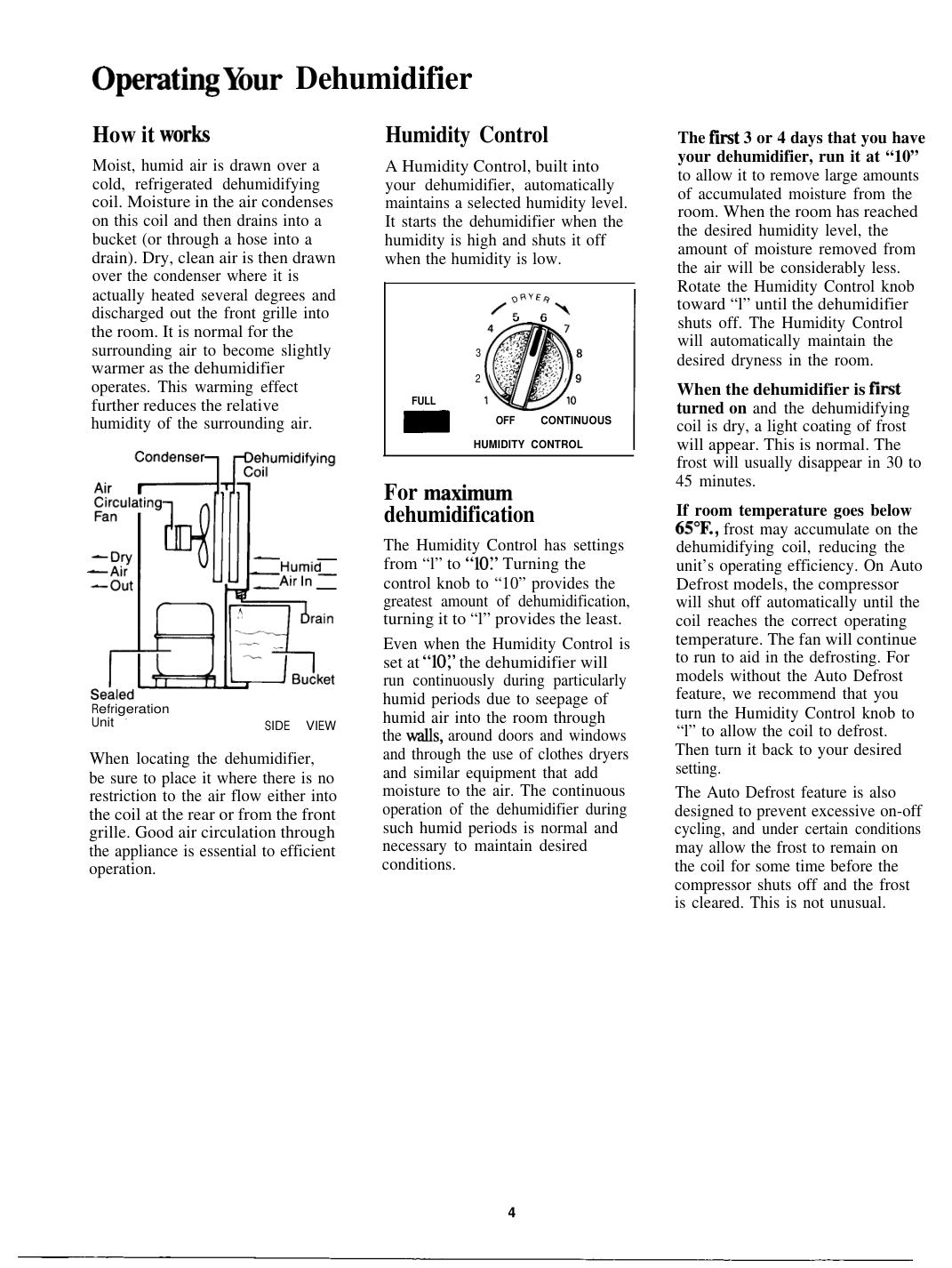
The manual describes a rotary humidity control marked from 1 to 10. Those are dial positions, not a digital relative-humidity readout. GE suggests starting near the high end for several days when a room has accumulated moisture, then reducing the setting until the compressor stops as the chosen dryness is reached. That advice describes a control approach; it does not promise how quickly an AHD15 will dry a space, because the exact capacity and rating conditions are absent. Doors, windows, clothes dryers, and other moisture sources can continue to affect the room.
GE also says not to block the rear coil intake or the front discharge grille. The discharged air may feel slightly warmer because it passes over the condenser. The guide warns that temperatures below 65°F can contribute to frost on the coil and reduce efficiency. Its instructions distinguish automatic-defrost and non-automatic-defrost models, but do not identify which exact control set belongs to AHD15. Do not treat the word “Auto Defrost” in a contents list as proof that this suffix has that feature. In a chilly basement, this unknown is important; a manual that describes several family configurations is not evidence of low-temperature performance for each one.
Plan around the installed bucket
The cautious operating plan represented here is the fitted collection bucket. The booklet explains that a full-water control stops dehumidification and lights a full indicator. It then describes two possible arrangements: on some machines the bucket’s weight actuates a switch; on others, a float and control cord operate the shutoff. GE does not map either bucket mechanism to AHD15. The owner should therefore inspect the actual cabinet and follow the instructions that match it, rather than assuming the generic illustration shows the exact hardware.
The same guide contains a garden-hose procedure, noting an unsupplied standard hose and a male thread on the drain or water bucket. That is useful family-level context but not a verified AHD15 drain-port and bucketless configuration. This assessment does not promise that the bucket can be removed during draining, that a particular hose is included, or that the model has a lift pump. If a room requires unattended drainage, confirm the actual AHD15 port and manual before placing it on that essential need list.
Care guidance is more certain than replacement fit
For a machine already on hand, GE’s booklet gives practical basics: unplug before cleaning; keep the grille and coil clear; use a soft brush on the coil; and prevent excess water from entering the electrical or machine compartment. A filter screen is mentioned only for some family members, so this review does not assign a filter or filter-cleaning interval to AHD15. The guide also says the appliance must be properly grounded and should not be used where standing water is likely to collect.
Those steps can help an owner understand the old family guide, but they do not settle current availability. GE’s exact support response is not a dated discontinuation notice, and a not-found product URL is not proof of the appliance’s sales history. No current-buy status is claimed here. Before replacing an AHD15, compare a currently documented machine on its exact rated capacity, temperature limits, bucket arrangement, drain route, and footprint. For example, the site’s separate Midea MAD35S1QWT record publishes a 35-pint/day rating; that is a transparent comparison point, not evidence that the AHD15 is equivalent or that it was a 15-pint model.
Who this reference can—and cannot—serve
This page is useful when an owner has verified the full AHD15 label and wants to interpret the family booklet’s dial, bucket-full behavior, placement, frost warning, and cleaning instructions. It is not enough to select a new appliance by room size or to satisfy an essential minimum-capacity, pump-lift, bucketless-drain, app-control, or cold-room requirement. Unknown values are not “probably yes.” If those specifications matter, choose a model whose own U.S. product page and manual establish them, and treat AHD15 only as an identification and operating-guide reference.
Key details at a glance
| Controls and settings | GE guide 49-7222 describes a built-in 1–10 humidity dial; these dial positions are not relative-humidity percentages. It describes automatic defrost for some covered configurations and a different manual defrost instruction for others, without identifying which applies to this exact suffix. |
|---|---|
| Water-removal setup | The model-listed family guide documents an installed plastic collection bucket and full-water signal/shutoff; its bucket-weight switch and float/control-cord arrangements are alternatives without exact suffix mapping. The guide also describes an unsupplied standard garden hose on a threaded drain or bucket, but does not establish this suffix's adapter, bucketless arrangement, or pump. |
| Care and operating limits | The model-listed family guide says to unplug before cleaning, keep the grille open, clean the coil gently, and avoid letting excess water enter the electrical/machine compartment. It mentions a filter screen only for some models, without mapping it to this suffix. |
Use the exact model’s instructions for operating limits, supplied equipment and version differences.
Sources for this assessment
Check the route before the room-size claim.
Match the rated capacity and drainage setup to a real place for the water to go.