
Your needs, this model
Does it fit your priorities?
Can AHD20AA satisfy a minimum 20-pint/day requirement from its model code?
No. The code is not a manufacturer rating, and the listed GE family guide gives no exact AHD20AA daily removal figure or test conditions. Treat the exact capacity as unknown; do not let the “20” meet an essential threshold.
Explore this need in the finder →Can AHD20AA drain downhill without its fitted bucket?
Yes, the GE family manual applies to this exact listed model and describes removing the bucket and fitting a standard garden hose (not supplied) to the threaded drain. This is a gravity route to a lower outlet, not a pump or raised drain.
Explore this need in the finder →Can AHD20AA satisfy an essential app-control requirement?
No confirmed app or Wi-Fi feature is mapped to this exact suffix in the family guide or exact support response. Unknown connectivity cannot meet an app-essential request.
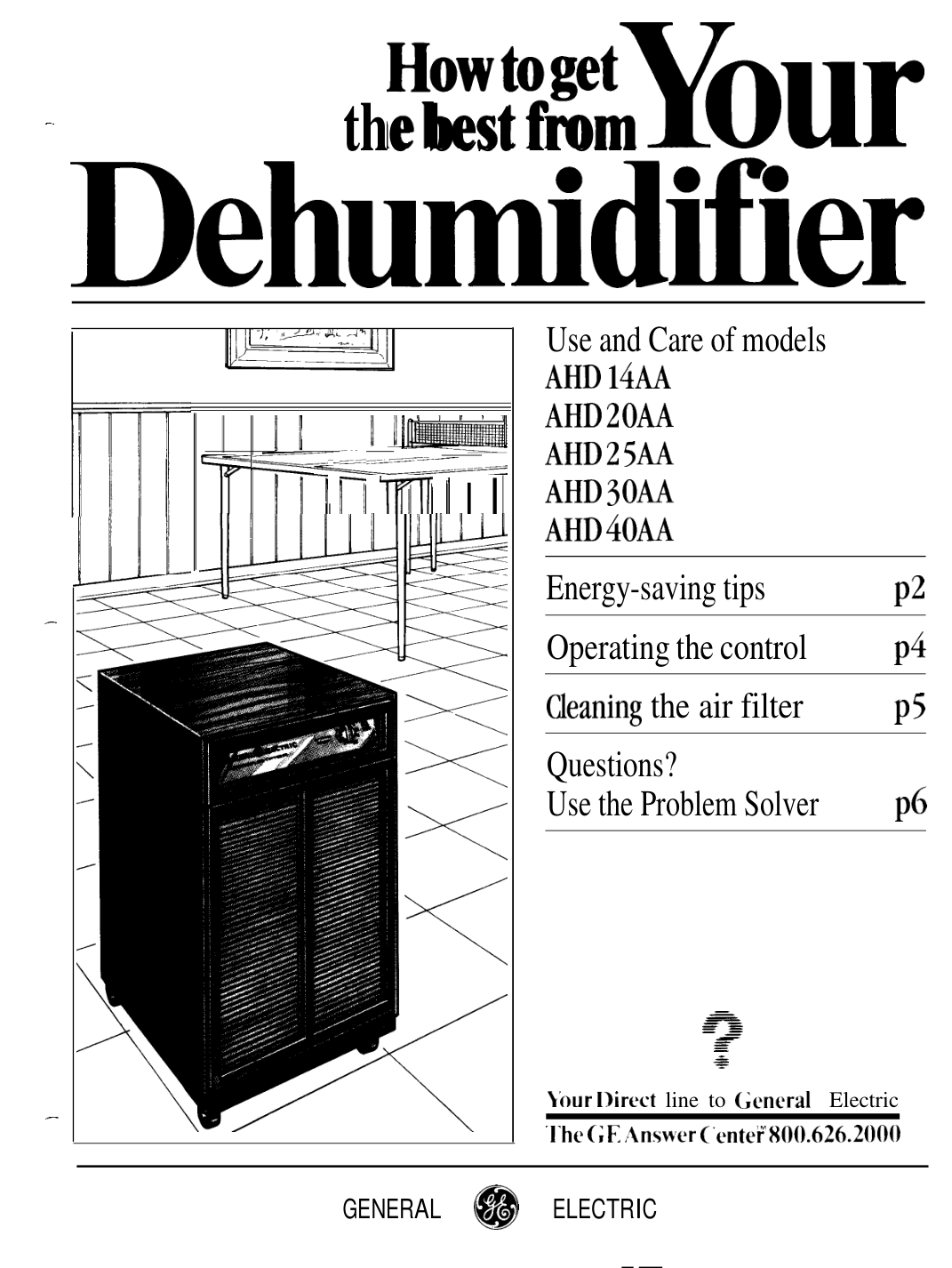
Explore this need in the finder →A manual reference for an exact old model code, not a buying recommendation. GE’s Use and Care Guide 49-7300 names AHD20AA, but it does not publish a suffix-specific pints-per-day rating or test condition. Read the code as an identity clue, not as proof of twenty pints a day. The booklet provides useful family instructions for controlling humidity and collecting water, while leaving the model’s performance and present-market status open.
The GE 49-7300 family guide lists AHD20AA on its cover. Its shared instructions explain operation and care; they do not supply a model-by-model rating table.
Why the number in the name is not enough
Dehumidifier codes often look like capacity shorthand, but this guide does not confirm that AHD20AA removes a specific number of pints under any stated conditions. It has no exact AHD20AA product chart for daily removal, energy use, dimensions, noise, airflow, or electrical nameplate. The individual suffix matters too: the guide covers several AHD..AA models and says some family members have frost control, but does not map that option to AHD20AA. So a capacity threshold, cold-room behavior, or efficiency request cannot be answered from the “20” alone.
That makes this record most useful in an ownership situation. If a unit is already installed, remove its bucket and read the side-wall model/serial label described by GE. Verify that it actually says AHD20AA rather than another AHD model, then consult the family booklet as a general operating guide. Do not use a seller’s broad AHD-family description to fill a missing spec. An old appliance’s condition, prior repairs, seals, wiring and refrigerant performance are separate questions that the paper manual cannot settle.
Bucket capacity and drying capacity answer different questions
The 49-7300 guide describes an eight-quart bucket for its covered family. That tells you how much water the reservoir can hold, not how quickly AHD20AA removes water from air. If you collect in the bucket, the machine needs attention when it fills: GE describes a float and full-pan light that stop dehumidification to prevent overflow. The guide advises setting the humidity dial low before removing the bucket, then reinstalling it completely and ensuring the float hangs freely before resuming normal operation.
In practice, a bucket plan is only useful if you can check it often enough. The unknown daily rating means this record cannot estimate how many times a particular basement bucket will fill or whether the unit can keep up with a wet season. Do not substitute reservoir volume for daily performance when estimating maintenance. For a room that needs unattended drainage, the manual’s alternative is a standard garden hose, not supplied, attached to the threaded drain after removing the bucket. This is a gravity drain to a lower outlet; the manual does not document a lift pump or a raised discharge route.
What the dial can and cannot do
The booklet describes a mechanical humidity control with positions 1 to 10. A higher number requests more dehumidification; these positions are not percent-RH targets. GE recommends starting at a high setting when moisture has accumulated and adjusting later as the desired condition is approached. The shared guide warns that a damp room can take time to dry and that outside air entering through openings adds load. Close doors and windows in the treated room, keep the rear intake and front outlet unobstructed, and leave at least 10 inches between the cabinet and a wall. These tips explain how to use the appliance, but they do not give AHD20AA a room-area rating.
The manual also discusses frost at room temperatures below 65°F and distinguishes units with and without automatic frost control. It does not identify which configuration carries the AHD20AA suffix. If your installation may run in a cold cellar or seasonal cabin, do not treat the generic family paragraph as proof that this model will defrost automatically or continue operating at a particular temperature. A current unit with an exact model-linked low-temperature specification is the safer comparison.
Care, drainage and replacement decisions
GE describes a removable washable rear filter and warns that restricted airflow reduces effectiveness. It recommends cleaning the filter, keeping the intake and outlet clear, and avoiding direct hose spray at the coil. For gravity drainage, the manual’s garden-hose arrangement requires a secure connection and a continuously downward route. It states no hose length or pressure capability, so do not route it uphill or assume an arbitrary hose run will work. A pump is not described for this model in the available guide.
AHD20AA is therefore a useful owner-reference entry for the exact-label holder who needs the family’s basic bucket, dial and cleaning instructions. It is not a defensible replacement-shopping choice from the available evidence: capacity, test conditions, energy use, dimensions, exact frost-control version, connected features, lifecycle and exact model photograph remain unestablished. If shopping now, compare actual published ratings, measured installation dimensions and an explicitly documented drain mode. Keep AHD20AA out of the purchase shortlist rather than allowing an unknown specification to pass a hard requirement.
Key details at a glance
| Built-in lift pump | No |
|---|---|
| Bucketless operating mode | Yes |
| Controls and settings | The manual depicts a rotary humidity dial with settings 1–10; these settings are not relative-humidity percentages. The guide mentions frost-control and non-frost-control versions but does not map that option to this exact suffix. |
| Water-removal setup | GE 49-7300 describes a fitted collection bucket and, as a separate family procedure, removing it and attaching an unsupplied standard garden hose to the threaded drain. This is gravity to a lower outlet. No pump, lift or exact hose-run limit is documented. |
| Care and operating limits | The family manual says the rear filter is washable, calls for unobstructed rear intake/front discharge airflow, and warns not to spray a hose at the coil. Verify the actual unit’s rating plate and condition before use. |
Use the exact model’s instructions for operating limits, supplied equipment and version differences.
Sources for this assessment
Check the route before the room-size claim.
Match the rated capacity and drainage setup to a real place for the water to go.