
Your needs, this model
Does it fit your priorities?
What daily capacity does the GE AHD24 record verify?
The exact AHD24 is listed on the GE family-guide cover, but guide 49-7222 gives no pints-per-day rating or test conditions for that suffix. The model number is not an established capacity.
Explore this need in the finder →Can the evidence for GE AHD24 meet an app-control-essential request?
No app or Wi-Fi control is mapped to AHD24 in the exact model-listed booklet; the generic exact support response provides no feature table. Unknown connectivity cannot satisfy an essential app requirement.
Explore this need in the finder →Does GE's family hose paragraph prove a bucketless gravity plan for AHD24?
No. The shared 49-7222 manual describes a hose connection but does not map the exact bucket/drain fitting or a pump to AHD24. Only fitted-bucket collection is represented in this reference profile.
Explore this need in the finder →Owner reference only. The GE AHD24 is named on the cover of guide 49-7222, but that booklet groups it with AHD15 and AHD38 without publishing an AHD24 capacity, test condition, tank size, product photo, or model-specific control map. The useful choice here is not “how many pints?”—the surviving evidence cannot answer that—but how to safely read the shared instructions without assigning another model’s features to yours.
Sources checked for this assessment are GE’s official Use & Care guide 49-7222, the exact AHD24 support response (generic unavailable page), and the exact GE product-route response (not found). Those route outcomes do not by themselves establish the model’s lifecycle or retail availability.
Why the exact suffix matters more than the shared cover
The guide’s cover lists three exact model numbers: AHD15, AHD24, and AHD38. That is solid evidence that AHD24 belongs to the intended U.S. household-appliance family, but it is not a spec sheet. The numeric suffix must not be converted into a daily water-removal rating. GE provides no AHD24 pints-per-day figure, no rating temperature or humidity, and no room-size test in this booklet. It also says nothing exact about cabinet size, bucket volume, weight, wattage, or sound level. An owner who needs those values has to inspect the complete label and locate literature for that exact appliance, not extrapolate from another AHD model.
The booklet says the model and serial label sits in front of the bucket at the back of the appliance. This is particularly useful when several older GE units look alike: capture every character and do not use an AHD15 or AHD38 listing to order parts for an AHD24. GE’s exact AHD24 support archive returns the generic “Product is Unavailable” message, so it contributes no suffix-specific specifications, model image, or date range.
Dial positions are not measured humidity
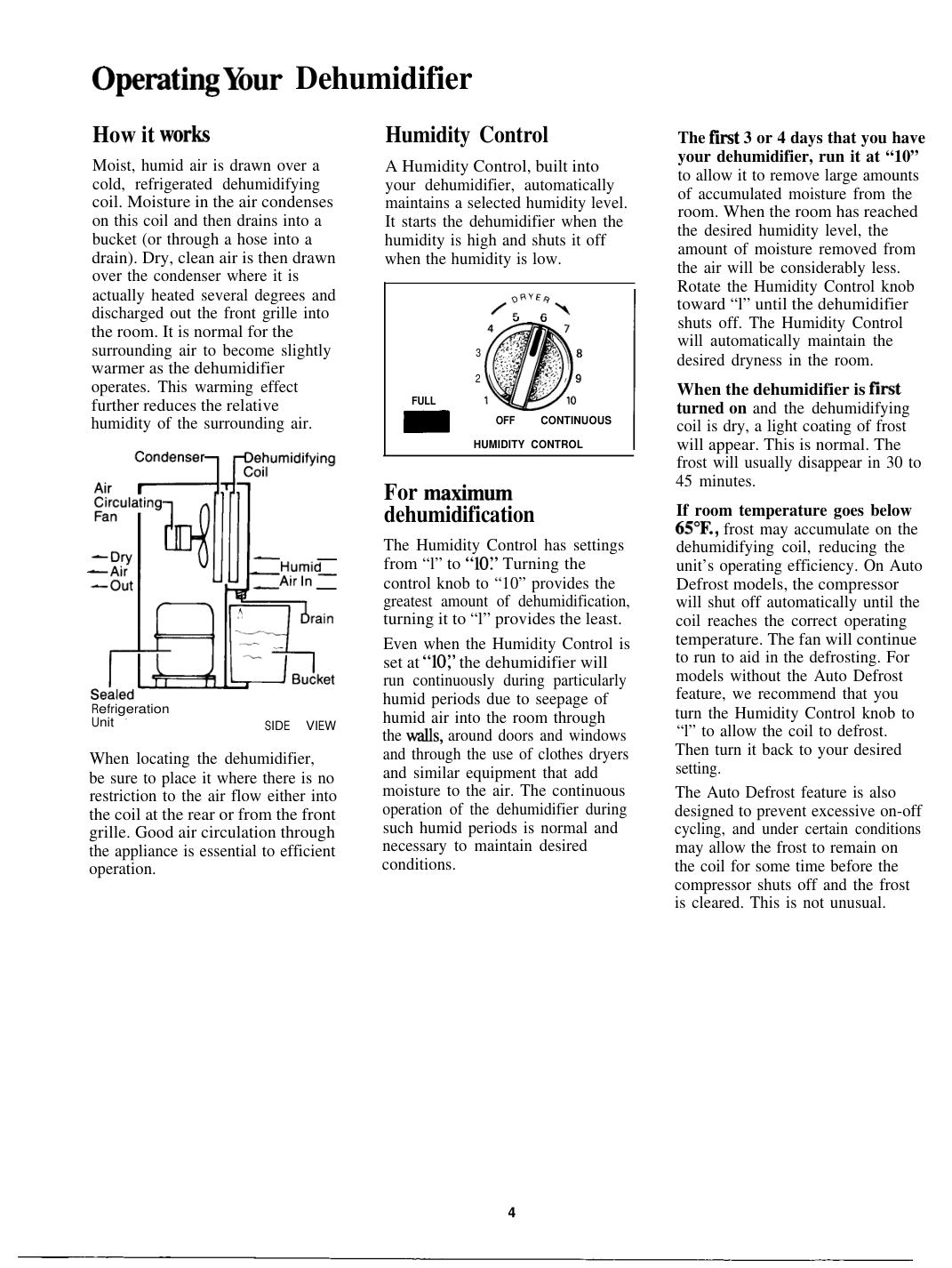
For the family covered by 49-7222, GE describes a mechanical humidity dial from 1 through 10. The manual tells owners to run the dial high for the first few days when the room contains substantial accumulated moisture and then move it toward the low end until the appliance cycles off at the desired dryness. The marks are settings, not percentages on a display. This is a simple manual interaction, but the booklet does not state that AHD24 displays room humidity, allows app control, or supports schedules. None of those capabilities should be assumed from a modern GE banner or another suffix’s feature list.
Air circulation is a more direct consideration. GE tells owners to leave the rear coil intake and front outlet unobstructed. It says the outgoing air can feel warmer, and that accumulated frost can reduce performance when room temperature falls below 65°F. The guide explains different instructions for models with and without automatic defrost, including compressor pause and fan operation on the former, but it never maps that distinction to AHD24. That matters in an unheated room: this evidence is not a cold-basement rating and does not prove that AHD24 has the automatic feature.
Water handling requires a look at the individual cabinet
As a conservative owner-reference plan, use the fitted bucket and the full-bucket shutoff described in the manual. GE says a full indicator lights and dehumidification stops. It then notes two different ways that can happen: bucket weight can push a switch on some models, while a float and attached control cord activate the overflow control on others. Since the booklet does not identify which version is AHD24, inspect the machine before emptying it and follow the matching instruction. Do not treat the generic diagram as a product photograph or a suffix-specific parts illustration.
A hose procedure also appears in the family guide. It describes a standard garden hose, not supplied, and a male thread on a drain or water bucket. That does not establish the exact AHD24 hose connection, whether its bucket stays installed, or any built-in pump. This review therefore does not offer a gravity, bucketless, or pump-lift matcher plan. A buyer who needs to send water to a floor drain or lift it into a sink should confirm the complete route from exact AHD24 literature and the installed unit first.
What the booklet does well for an owner
GE gives useful maintenance boundaries: disconnect power before cleaning, keep the grille clear, brush the coil gently, and do not let wash water enter the electrical or machine compartment. It says a filter screen appears only on some models, so an AHD24 filter cannot be promised. The guide also asks for proper grounding and warns against operation where standing water may accumulate. These are sensible instructions to read before repositioning or cleaning any machine covered by the booklet.
The practical tradeoff is uncertainty, not an established weakness in the appliance. AHD24 may have configurations that differ from its two booklet siblings, but the available primary records do not resolve those differences. This record cannot say it is discontinued, available new, or supported with parts today; an unavailable support page is not a dated lifecycle announcement. If replacement is being considered, compare a current model with an exact printed daily rating and confirmed water route rather than using “24” as a capacity value. Midea MAD35S1QWT, for example, has a separate verified 35-pint/day profile on this site; that provides a documented capacity reference, not an AHD24 performance comparison.
The right use for this page
Keep 49-7222 with an AHD24 only after checking the full nameplate. It can orient an owner to the family’s numbered dial, fitted-bucket shutoff, airflow, frost, grounding, and care instructions. It cannot answer a new-purchase question that depends on minimum capacity, a particular drain path, pump height, app control, dimensions, or low-temperature operation. Those fields remain unknown, and an unknown answer should not qualify an essential need. Use an exact-model source before buying a replacement or promising a feature to another owner.
Key details at a glance
| Controls and settings | GE guide 49-7222 describes a built-in 1–10 humidity dial; these dial positions are not relative-humidity percentages. It describes automatic defrost for some covered configurations and a different manual defrost instruction for others, without identifying which applies to this exact suffix. |
|---|---|
| Water-removal setup | The model-listed family guide documents an installed plastic collection bucket and full-water signal/shutoff; its bucket-weight switch and float/control-cord arrangements are alternatives without exact suffix mapping. The guide also describes an unsupplied standard garden hose on a threaded drain or bucket, but does not establish this suffix's adapter, bucketless arrangement, or pump. |
| Care and operating limits | The model-listed family guide says to unplug before cleaning, keep the grille open, clean the coil gently, and avoid letting excess water enter the electrical/machine compartment. It mentions a filter screen only for some models, without mapping it to this suffix. |
Use the exact model’s instructions for operating limits, supplied equipment and version differences.
Sources for this assessment
Check the route before the room-size claim.
Match the rated capacity and drainage setup to a real place for the water to go.