
Your needs, this model
Does it fit your priorities?
Can AHD25AA inherit the published or manual specifications of AHD25?
No. GE’s 49-7300 cover names AHD25AA, not every similarly named AHD25 variant. No model bridge establishes that their capacity, fittings or controls are interchangeable. Keep the exact suffix and treat AHD25AA’s numeric rating as unknown.
Explore this need in the finder →Can AHD25AA drain downhill without its fitted bucket?
Yes, the GE family manual applies to this exact listed model and describes removing the bucket and fitting a standard garden hose (not supplied) to the threaded drain. This is a gravity route to a lower outlet, not a pump or raised drain.
Explore this need in the finder →Can AHD25AA satisfy an essential app-control requirement?
No confirmed app or Wi-Fi feature is mapped to this exact suffix in the family guide or exact support response. Unknown connectivity cannot meet an app-essential request.
Explore this need in the finder →The suffix is the point of this entry. GE’s 49-7300 Use and Care Guide lists AHD25AA, but that does not make it interchangeable with a differently suffixed AHD25 or another GE cabinet carrying “25” in its name. The booklet provides shared owner instructions for its AHD..AA group; it does not provide an AHD25AA capacity table, test conditions, or a suffix-by-suffix feature map. This is an identification reference for an existing machine, not a new-buy recommendation.
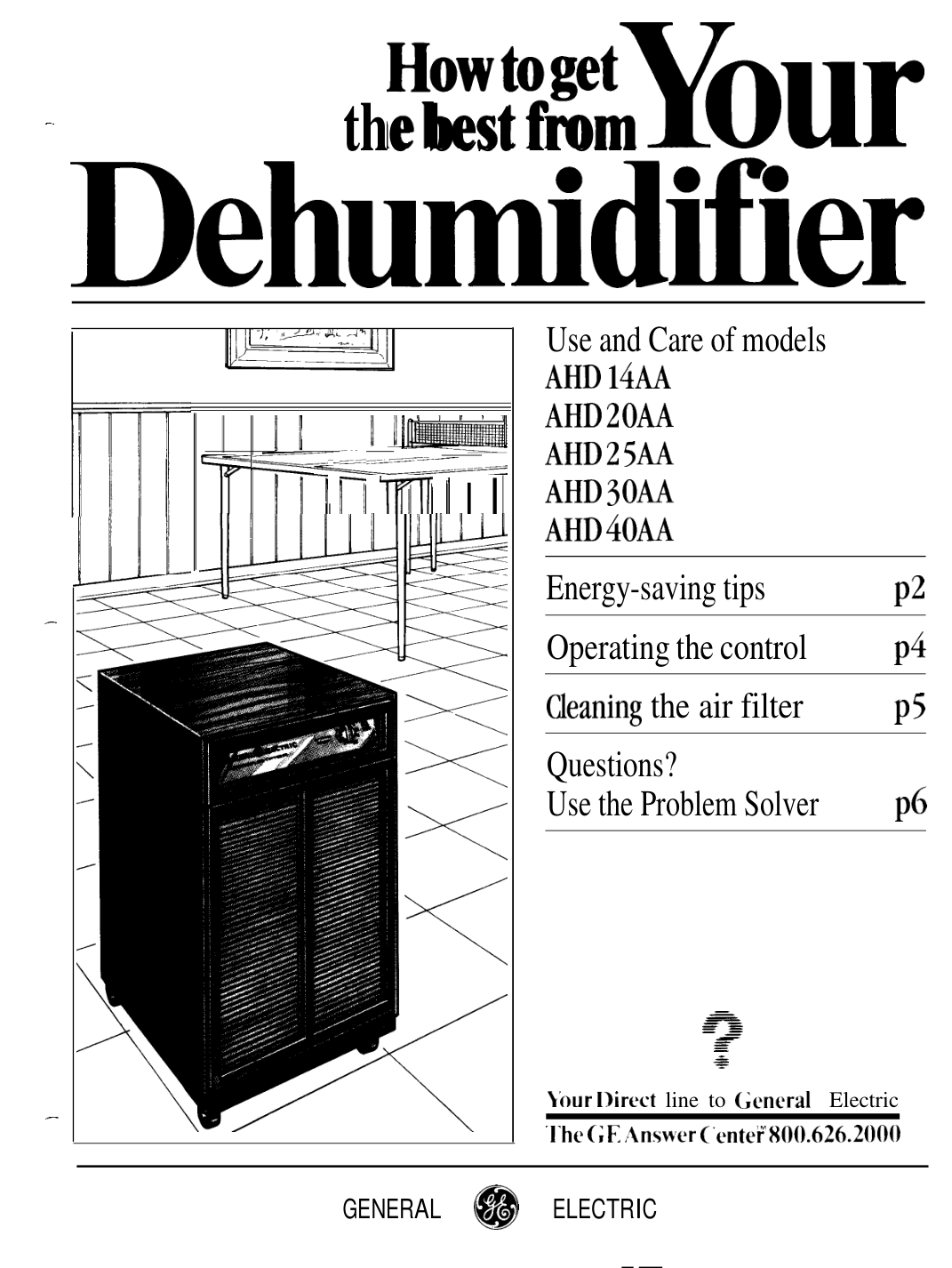
The GE Use and Care Guide 49-7300 lists the exact AHD25AA suffix. The model number and operating details below should be checked against the actual rating plate and cabinet.
Do not collapse AHD25AA into AHD25
The archived manual cover explicitly lists AHD25AA. The distinction matters because model families often include revisions that change tank shapes, controls, drain fittings, wiring or other hardware. A manual that covers AHD25AA cannot be assumed to cover every model with the AHD25 stem, and another manual’s AHD25 specifications cannot be imported into this fact record without a model bridge. Start by removing the bucket and reading the label on the side wall, the location GE gives for the model and serial number.
The manual does not say that the “25” in this exact model string is a daily pints rating. No exact AHD25AA capacity, rating temperature/humidity, energy figure, room-size claim, dimensions, weight, noise, current production status or date range is established in the source set. The exact GE support response for the suffix does not provide a technical specification table. For a unit in hand, use the rating plate for electrical requirements and treat performance as a separate question from the model code.
Water handling: bucket or lower gravity drain
The GE family guide describes an eight-quart collection bucket. That is a reservoir measurement only; it does not tell you the day’s extraction rate. The documented bucket setup includes a float that turns on a PAN FULL light and stops dehumidification before the tank overflows. Before removing the bucket, GE tells owners to turn the humidity control to its low position. When returning it, push it all the way into place and confirm the float can move. If the bucket is not seated correctly, a unit may remain stopped even though power is available.
For continuous drainage, the same model-listed guide says to remove the bucket and attach a standard garden hose to the threaded drain. The hose is not included; water must flow downward to a lower drain. This documentation supports a gravity plan for the manual-covered family, not a pump. There is no described lift limit, pump activation, supplied pump tube or uphill discharge. AHD25AA can therefore be considered only for the two routes the booklet explains: collection in the fitted bucket, or an unsupplied hose descending to a suitable drain. It should not be matched to a pump-lift essential.
Read the dial as a relative control, not a measurement
GE describes a rotary humidity control labeled from 1 to 10, with a higher setting calling for more dehumidification. Those numbers are not a percentage-humidity display. The guide suggests initially setting the control high when a room has accumulated moisture and then turning it back as the desired dryness is reached. It also cautions that the first effort can take time and that warm, damp air entering through doors, windows or other equipment can increase the workload. That is sensible operating context, not an AHD25AA performance guarantee or recommended area.
The guide’s cold-room passage is another place where a family description should not be overread. It mentions frost buildup below 65°F and automatic compressor cycling on frost-control models, but does not tell us whether AHD25AA has that feature. If low-temperature operation is a must, use a model whose exact suffix and manual document a defrost range. Do not infer an automatic-defrost tag from the AHD25AA name or from another AHD member’s manual.
Maintenance is documented more clearly than performance
The booklet says the rear filter can be removed and washed, and that blocked airflow reduces effectiveness. It tells the owner to leave at least 10 inches from a wall, keep the rear inlet and front outlet clear, and avoid directing a hose at the coil. These instructions can help an existing owner avoid airflow and cleaning problems. They do not tell you whether an older machine’s sealed system, electrical parts or float still work. If the cord, plug, cabinet, bucket seal or drain connection is damaged, stop before operation and seek qualified service advice.
How to use AHD25AA in a replacement decision
Keep the full suffix when searching for parts or reading old paperwork, and do not assume the feature set from a numerically similar GE product. The manual’s shared bucket, float shutoff, dial and gravity-hose guidance is helpful for identification. But it cannot establish an exact daily rating, a cold-room capability, app control, dimensions or current lifecycle. For a present-day purchase, choose a dehumidifier whose exact manual and product sheet answer the needs that matter: a defined capacity basis, a suitable drain route, the required cabinet footprint and a stated temperature range. AHD25AA remains an earlier-owner reference and is excluded from buying results because its exact performance and current status are not confirmed.
Key details at a glance
| Built-in lift pump | No |
|---|---|
| Bucketless operating mode | Yes |
| Controls and settings | The manual depicts a rotary humidity dial with settings 1–10; these settings are not relative-humidity percentages. The guide mentions frost-control and non-frost-control versions but does not map that option to this exact suffix. |
| Water-removal setup | GE 49-7300 describes a fitted collection bucket and, as a separate family procedure, removing it and attaching an unsupplied standard garden hose to the threaded drain. This is gravity to a lower outlet. No pump, lift or exact hose-run limit is documented. |
| Care and operating limits | The family manual says the rear filter is washable, calls for unobstructed rear intake/front discharge airflow, and warns not to spray a hose at the coil. Verify the actual unit’s rating plate and condition before use. |
Use the exact model’s instructions for operating limits, supplied equipment and version differences.
Sources for this assessment
Check the route before the room-size claim.
Match the rated capacity and drainage setup to a real place for the water to go.