
Your needs, this model
Does it fit your priorities?
Does the 1987 ad’s 14–38-pint range prove a 30-pint rating for AHD30AA?
No. The ad names AHD30AA but groups five GE models in a 14–38-pint range without assigning an individual capacity. Neither the “30” in the model code nor the family range satisfies an exact numeric requirement.
Explore this need in the finder →Can AHD30AA drain downhill without its fitted bucket?
Yes, the GE family manual applies to this exact listed model and describes removing the bucket and fitting a standard garden hose (not supplied) to the threaded drain. This is a gravity route to a lower outlet, not a pump or raised drain.
Explore this need in the finder →Can AHD30AA satisfy an essential app-control requirement?
No confirmed app or Wi-Fi feature is mapped to this exact suffix in the family guide or exact support response. Unknown connectivity cannot meet an app-essential request.
Explore this need in the finder →Does the five-model 14–38-pint range in the AHD30AA ad provide its exact daily rating?
No. The July 1987 ad identifies AHD30AA and a family range but does not assign a rating to this suffix or state comparable test conditions. The matcher keeps exact capacity unknown.
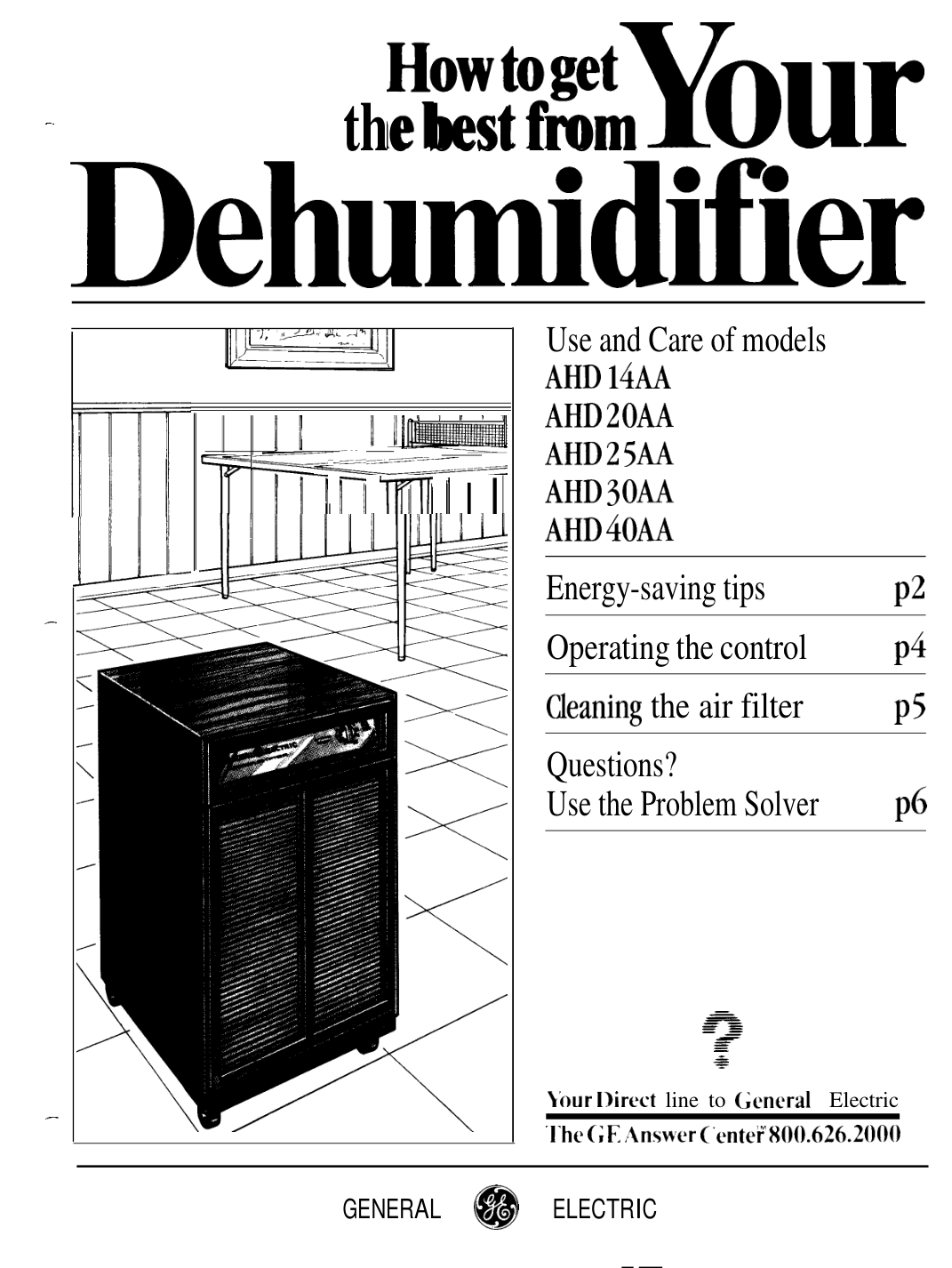
Explore this need in the finder →A period model reference with one important unresolved number. GE’s 49-7300 family guide lists AHD30AA, and a July 1987 retailer advertisement names the same exact model. That advertisement groups five GE units into a 14-to-38-pint range but does not assign one rating to AHD30AA. The “30” in the model name is not proof of a 30-pint/day rating. This record is useful for identifying an old unit and understanding its family manual, not for choosing a current replacement.
The GE 49-7300 Use and Care Guide lists AHD30AA. A July 10, 1987 Community Appliance advertisement names AHD30AA and describes five models across a 14–38-pint range; that range is not an exact-model rating.
What the 1987 advertisement does—and does not—prove
The ad is useful historical evidence that AHD30AA was sold by a GE dealer. It positions a dehumidifier with this model code beside language about five available models ranging from 14 to 38 pints. It does not say which endpoint belongs to AHD30AA, list a test temperature or humidity, or provide a manufacturer performance table. Other bullets in the promotion describe family features such as a humidistat, shutoff, full indicator, filter, hose connector and casters; the shared product panel does not give a controlled suffix-by-suffix specification. Treat it as an old retail advertisement, not as a current model sheet.
The exact official GE support response identifies an Owner Center for AHD30AA, while the archived exact product route is not a current technical listing. The manufacturer’s 49-7300 guide independently lists the suffix, but neither source gives current production or sale status. For that reason this is retained as a historical owner reference without claiming a formal discontinuation date. The machine’s actual condition, parts situation and accuracy of a secondhand seller’s description must be established separately.
The GE manual’s practical water routines
For this exact model-listed family, GE describes a removable eight-quart bucket. A reservoir that size is not a daily removal rating: a unit can stop when the bucket fills long before a full day, and the actual number of daily bucket trips depends on conditions and an unverified AHD30AA performance level. The manual says a float activates a PAN FULL light and stops dehumidification before the bucket overflows. It tells the owner to turn the dial down before removing the tank, return it fully, and leave the float free to move.
The guide also instructs the owner to remove the bucket and connect a standard garden hose to the threaded drain for continuous drain-off. The hose is not supplied and the documented route is downhill to a lower drain. There is no pump or supported vertical-rise value in this manual. A raised laundry sink or drain above the dehumidifier is not covered by the family’s gravity instructions; do not assume the appliance can push water upward. Check the fitting and hose position before leaving the unit unattended.
Simple humidity adjustment, limited cold-room certainty
The guide shows a 1–10 rotary humidity dial. A higher number calls for more dehumidification, but the knob is not a percentage display. GE recommends starting toward the high end to remove built-up moisture and easing back after the room reaches the desired condition. The manual also stresses closing doors and windows, leaving at least 10 inches from a wall, and keeping the rear coil inlet and front outlet open. Those instructions offer a practical baseline, but they do not turn the 1987 retail range into a precise capacity estimate for this suffix.
The same guide warns that frost may form when room temperature falls below 65°F, then describes automatic cycling for some frost-control models and different handling for versions without it. The AHD30AA record does not identify which version was supplied. A cold basement owner should not assume the more capable frost behavior from the AHD30AA label or from a neighboring model. If a particular winter operating range is essential, compare a current exact model whose manual explicitly states it.
Care instructions can still help an owner
The family manual describes a washable rear filter and says airflow restriction lowers efficiency. It recommends clearing the intake and outlet, washing the filter when dirty, and avoiding a direct hose spray on the coil. It also stresses correct grounding and use of the actual appliance’s rating plate for electrical information. These are useful maintenance checks, but they cannot confirm whether an old compressor, cord, float, control or coil is sound today. Water leaks, damaged wiring or uncertain repairs warrant stopping and getting qualified help.
Keep the exact model out of modern capacity comparisons
AHD30AA is a reasonable library reference for someone checking a cabinet label or trying to follow GE’s shared bucket and gravity-drain instructions. It is not a verified “30-pint” choice. Exact rated capacity, test conditions, electrical values, dimensions, energy use, app capability, model-specific frost control and an exact product photo remain unconfirmed. For a replacement, compare units with current exact-specification documents and choose based on the actual room load, low-temperature needs and drain geometry. AHD30AA is not included in buying matches, and the 1987 range should not be used to satisfy a hard minimum.
Key details at a glance
| Built-in lift pump | No |
|---|---|
| Bucketless operating mode | Yes |
| Controls and settings | The manual depicts a rotary humidity dial with settings 1–10; these settings are not relative-humidity percentages. The guide mentions frost-control and non-frost-control versions but does not map that option to this exact suffix. |
| Water-removal setup | GE 49-7300 describes a fitted collection bucket and, as a separate family procedure, removing it and attaching an unsupplied standard garden hose to the threaded drain. This is gravity to a lower outlet. No pump, lift or exact hose-run limit is documented. |
| Care and operating limits | The family manual says the rear filter is washable, calls for unobstructed rear intake/front discharge airflow, and warns not to spray a hose at the coil. Verify the actual unit’s rating plate and condition before use. |
Use the exact model’s instructions for operating limits, supplied equipment and version differences.
Sources for this assessment
Check the route before the room-size claim.
Match the rated capacity and drainage setup to a real place for the water to go.