
Your needs, this model
Does it fit your priorities?
Can the guide-listed AHD40AA use a lower gravity drain without the fitted bucket?
The GE family guide names AHD40AA and instructs the owner to remove the bucket and attach an unsupplied standard garden hose for continuous drain-off. It is a lower gravity arrangement with no stated lift limit. This old reference remains outside buying results.
Explore this need in the finder →Can AHD40AA be relied on for a numeric minimum such as 35 pints per day?
A 1987 newspaper retailer advertisement calls the exact model a 38-pint-capacity dehumidifier, but GE's model-listed guide has no capacity table or rating conditions. The matcher therefore treats numeric capacity as unconfirmed; an essential threshold must not be satisfied by an old unstandardized advertisement.
Explore this need in the finder →Does the documented garden-hose route prove a pump lift or a raised outlet?
No. The guide describes a hose connection for continuous gravity drain-off and gives no pump or numeric lift limit. A pump-lift requirement must be met by a different configuration with an explicit pump specification.
Explore this need in the finder →Can app control or a specific cold-room frost behavior be confirmed for AHD40AA?
No. The family guide does not document app controls and discusses frost-control and non-frost-control versions without identifying which version is AHD40AA. Unknown features do not satisfy an essential app or temperature requirement.
Explore this need in the finder →Historical identification reference, not a buying recommendation. The GE manual that names AHD40AA describes an 8-quart bucket, a 1–10 rotary humidity dial, a washable rear filter and an optional hose-to-drain procedure. A dated 1987 retailer ad calls the model 38-pint capacity, but GE’s guide provides no daily-capacity table or rating conditions. Do not treat that old retail claim as directly comparable with a present-day label.
The GE Use and Care Guide 49-7300 lists AHD40AA in its model family. A Belleville Times retailer advertisement from August 13, 1987 pairs this exact model number with a 38-pint-capacity claim; it is contemporaneous retail advertising, not a manufacturer test sheet.
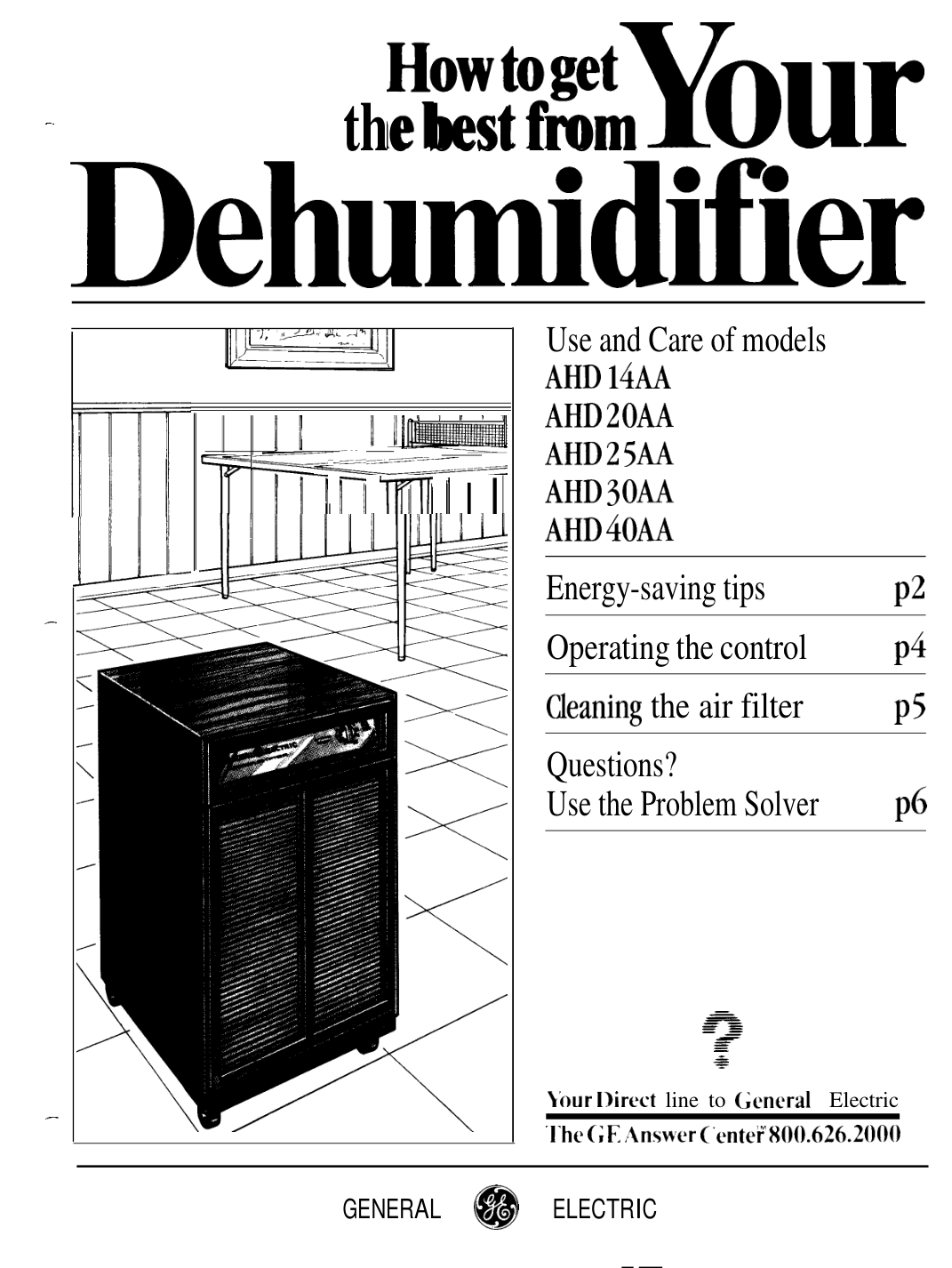
GE’s family guide includes a labeled cross-section and operating drawings. They explain airflow and the bucket/control arrangement; they are instructional diagrams, not a photograph of the exact AHD40AA cabinet or proof of its exterior details.
What this model record can—and cannot—tell you
AHD40AA is a genuine U.S. GE dehumidifier identity: it appears on GE’s model-listed guide, and the dated retailer ad names it directly. This is useful if you are checking a unit’s label, matching an old manual to a machine, or trying to understand the intended water-handling routine. It is not enough to establish that any particular used unit works, is safe, has available parts, or is being sold under an accurate listing.
The advertisement’s 38-pint wording is worth retaining as a historical clue, but not as a capacity recommendation. The source is an individual retailer ad, not a GE specification table; it gives no test temperature, humidity, energy result or comparison protocol. GE’s manual explains operation and care, not rated daily extraction. For modern shopping, compare models whose manufacturer or certification records give a defined capacity basis, and treat AHD40AA’s numeric rating as unconfirmed in the finder.
The manual describes two distinct ways to handle water
For ordinary collection, the guide says the appliance uses an 8-quart bucket. That amount is storage volume, not a daily removal rating: a tank can fill before a day is over, interrupting operation until someone empties it. GE describes a float that raises a full-bucket light and stops dehumidification before overflow. The instructions also tell owners to switch the humidity control to its lowest setting before removing the bucket, then push the bucket back fully and make sure the float hangs freely before returning to the desired setting.
For longer unattended drainage, the guide instructs the owner to remove the bucket and attach a standard garden hose (not supplied) at the threaded drain. Route that hose downhill to an appropriate drain. This is a gravity arrangement, not evidence of an internal lift pump: the guide gives no supported rise, total hose length or raised-outlet procedure. If a basement floor drain is not lower than the appliance connection, or if the route must climb stairs or a standpipe, this manual does not establish that the arrangement will work.
Simple controls, with an important cold-room unknown
The guide depicts a rotary humidity control from 1 through 10. Higher settings call for more dehumidification, but those dial numbers are not percentages and the guide does not provide an exact relative-humidity setpoint scale. It recommends running at the high end initially when a room contains accumulated moisture, then adjusting the dial once the desired dryness is reached. That is a period owner instruction, not a quantified room-size promise or a modern sensor reading.
GE’s family guide warns that frost can collect on the coil below 65°F. It describes automatic compressor cycling for models with a frost-control feature and a manual dial adjustment for models without it, but it does not map either version to AHD40AA. So the cold-room behavior of this exact suffix remains unknown. If operation near that temperature is essential, choose a unit whose exact manual identifies its low-temperature range and defrost behavior rather than relying on a shared-family instruction.
Routine care and placement still matter
The same manual advises keeping the appliance at least 10 inches from a wall and leaving the rear intake and front outlet unobstructed; restricted airflow reduces performance. Its rear filter snaps out and is washable; clean it when dirty and reinstall it before running the appliance. For coil and cabinet cleaning, the guide recommends gentle methods and specifically warns against spraying a hose at the coil. The electrical instructions emphasize a properly grounded outlet; the document does not provide an AHD40AA-specific nameplate table, so check the actual plate instead of assuming the exact voltage, current or cord condition.
How to use this reference when replacing an old unit
If the cabinet label really says AHD40AA, the most useful documented distinction is water routing: bucket collection requires regular emptying; the manual’s alternative removes the bucket and uses an unsupplied downhill hose. There is no verified pump-lift plan, numeric modern capacity rating, exact dimension set, app feature, energy certification or suffix-specific frost-control assignment in this source set. Those unknowns are deliberate—neighboring model numbers and old retail language cannot fill them in.
For a replacement, begin with current requirements: how much water a verified rating must remove, where gravity can drain, whether a pump and a stated lift are necessary, what room temperature the unit must handle, and the space available for airflow and bucket access. AHD40AA remains in the library for identification and manual context, but not in purchase results. Its age, condition, electrical label and repairability need a separate check on the actual unit; the historical 38-pint advertisement is not a reason to buy it.
Key details at a glance
| Bucketless operating mode | Yes |
|---|---|
| Controls and settings | GE's family guide depicts a rotary 1–10 humidity control and explains that a higher number requests more dehumidification. It does not state an RH percentage or exact-model fan-speed setting. Frost-control versions are discussed but not mapped to AHD40AA. |
| Water-removal setup | The model-listed GE guide describes removing the bucket and attaching an unsupplied standard garden hose to the threaded drain for continuous drainage. That is a gravity arrangement; the manual gives no pump, lift limit or total hose-length rating. It does not map the optional frost-control variation to this suffix. |
| Care and operating limits | The guide says the rear filter snaps out and is washable; it recommends keeping the rear inlet and front outlet clear. It warns against directing a hose at the coil. Follow the original guide and inspect the actual unit before service. |
Use the exact model’s instructions for operating limits, supplied equipment and version differences.
Sources for this assessment
Check the route before the room-size claim.
Match the rated capacity and drainage setup to a real place for the water to go.