
Your needs, this model
Does it fit your priorities?
Does the AHE25 suffix prove a 25-pint-per-day capacity?
No. GE's 49-7302 guide lists AHE25 but gives no AHE25 daily capacity or rating conditions. The numeric suffix is not used as a pints-per-day value, so a capacity minimum remains unmet.
Explore this need in the finder →Can the exact AHE25 be relied on for continuous gravity drainage without its bucket?
The family guide describes a bucket modification and garden-hose route, but it does not map the open/closed bucket variations to AHE25. The profile therefore supports the fitted bucket only; a bucketless or gravity requirement does not match this exact suffix.
Explore this need in the finder →What bucket size should an AHE25 owner plan around?
The manual describes collection in a bucket and a full-bucket shutoff, but supplies no AHE25 bucket volume. Do not use the bucket capacity as a daily removal rating or assume an emptying interval from the suffix.
Explore this need in the finder →Does the AHE25 have selectable fan speeds, Wi-Fi or a pump?
Those features are not established for AHE25. The manual says fan control is present on some models but does not identify this suffix; it gives no pump or app mapping. Unknown features do not satisfy an essential requirement.
Explore this need in the finder →Owner-identification reference, not a buying recommendation. GE’s family guide lists AHE25, but it does not give an AHE25 capacity table, exact drain setup, dimensions or present lifecycle. The “25” in the model name is not evidence of 25 pints per day. This page is most useful when the label on an existing unit says AHE25 and you need to separate family instructions from model-specific facts.
The GE Dehumidifier Use and Care Guide 49-7302 lists AHE25, AHE50 and AHE40 on its cover. GE’s AHE25 support route does not provide a model-specific specification or product gallery. The available materials establish neither a rated daily capacity nor a manufacture date for this exact model.
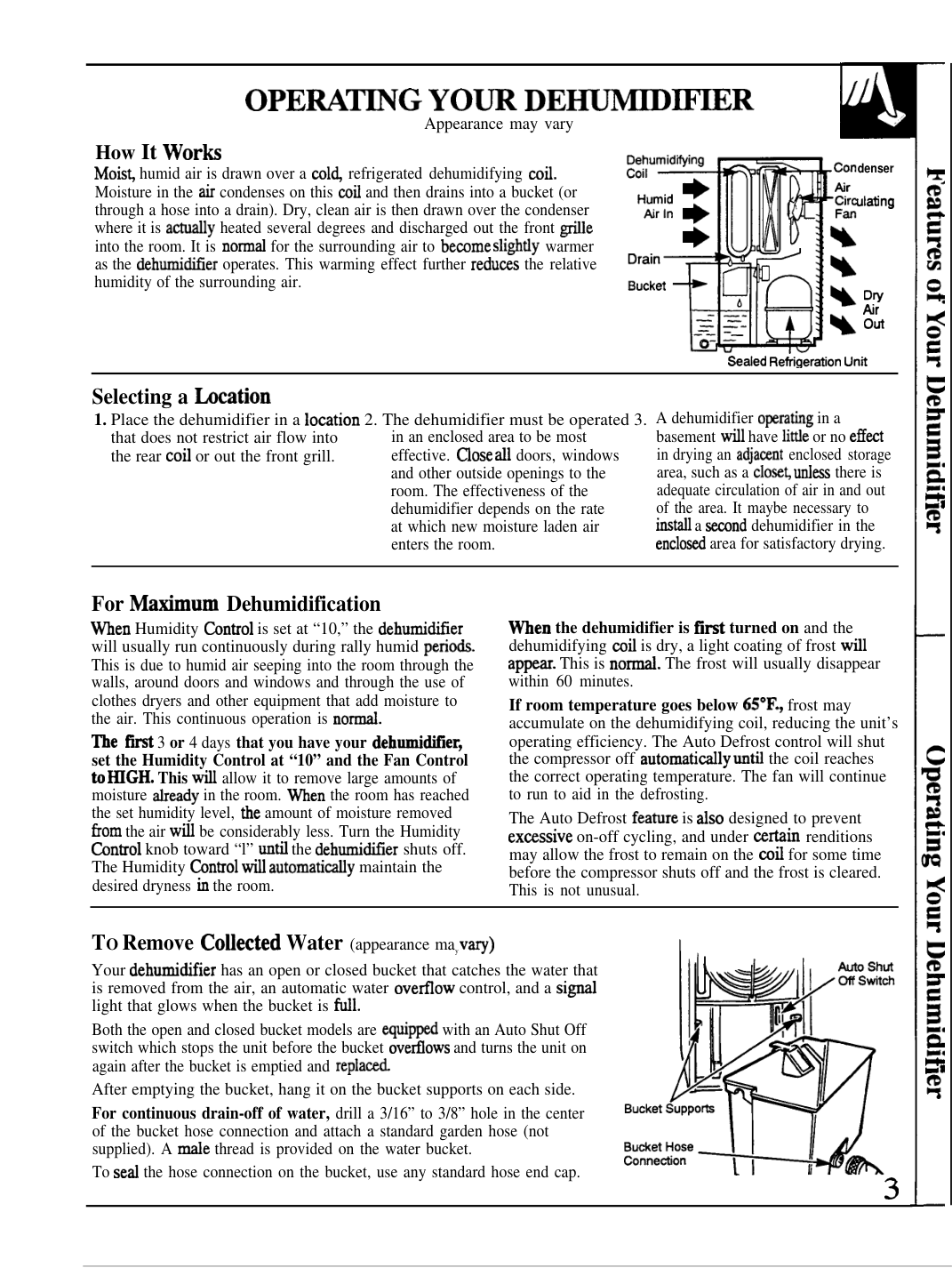
No exact AHE25 cabinet photograph is established here. The GE guide’s diagrams are instructional, and it says appearance may vary; they should not be used to identify this suffix’s exterior or bucket shape.
What the model number does—and does not—tell you
AHE25 is a real U.S. GE dehumidifier identity because GE prints the exact model on the family guide. That is a useful starting point for someone matching a paper manual to the label on a machine. The “25” is not a published removal rate: the guide gives no pints-per-day table, test conditions, energy factor, room-size guarantee, dimensions or weight for AHE25. The GE support page does not fill those gaps. If a used listing calls it a 25-pint unit, ask for the unit’s rating plate and model-specific paperwork rather than converting the suffix into a specification.
The guide says the model and serial label is behind the bucket at the back of the appliance. If the label is difficult to read, switch the unit off and follow the manual’s safe bucket-removal instructions; do not rely on a seller’s headline or a neighboring AHE model number. The exact condition of an individual old appliance, cord, controls and refrigerant is also not established by its model-family guide.
Local humidity control is the clearest documented control
The manual describes a built-in humidity control and depicts a rotary scale marked from 1 through 10. Those are dial positions, not relative-humidity percentages. Its instructions explain that the control starts dehumidification when room humidity is above the selected level and stops it when the level is reached. The guide suggests starting high while a damp room dries, then turning the setting down toward the point where the appliance cycles off. That is a practical adjustment routine, not a numerical moisture target for this exact model.
The same page qualifies fan-speed control as available “on some models.” Since it does not say whether AHE25 is one of them, a fan-speed selection is not promised here. The manual separately describes automatic defrost and full-bucket shutoff for its covered family. A full-bucket light and shutoff are useful if you are collecting water in the tank, but the manual does not give AHE25’s bucket volume. Tank size and daily extraction are different measurements in any case.
Plan around the bucket before assuming continuous drainage
GE’s family instructions describe condensate draining to a collection bucket and explain that the full-bucket switch stops operation before overflow. That is the conservative route to understand first: water must be emptied, and a full tank interrupts dehumidification. The guide also describes a continuous-drain modification: drill a small hole at the bucket hose connection and attach a standard garden hose, which is not supplied. It covers open- and closed-bucket appearances but does not map those variants to AHE25. For that reason, this assessment does not treat a no-bucket gravity installation as a verified AHE25 setup. Check the exact bucket and unit instructions before modifying an appliance or leaving it unattended; there is no documented pump or raised-outlet plan here.
Cold rooms and upkeep need extra caution
The manual advises keeping the rear coil intake and front grille clear and operating in an enclosed room with outside openings closed. Below 65°F, it warns, frost can build on the coil and reduce efficiency. Its auto-defrost explanation says the compressor pauses while the fan continues until the coil warms enough. The manual describes the feature without a separate AHE25 low-temperature rating, so this does not establish reliable performance in every cold basement or unheated space.
For cleaning, GE says to unplug the appliance first, keep the cabinet and grille clear, and use gentle care on the coil; it warns against spraying the coil with a hose. The electrical section discusses 115-volt models and grounded outlets, but there is no AHE25-specific nameplate table in this guide. Read the plate on the actual unit and do not alter its plug or use a damaged cord.
Who should use this assessment
AHE25 belongs in an identification library for an owner whose label matches and who needs the shared manual’s basic control, bucket, placement and care guidance. It is not a sound choice for a new purchase shortlist when the exact capacity, dimensions, lifecycle, bucket variant, drainage configuration, energy data and product image are unverified. In the finder, unknown capacity cannot meet even a 25-pint minimum, and unknown app or pump features cannot satisfy those essential needs.
If you are replacing an AHE25, begin again with the requirements of the room: a published capacity rating, a place for collected water, measured cabinet fit and the actual operating temperature. Compare current models whose exact manuals establish the water route you can install. This reference does not claim that AHE25 is still made, discontinued, repairable or safe to buy used; those questions need evidence about the individual appliance and its exact sale.
Key details at a glance
| Controls and settings | The family manual describes the built-in humidity dial and automatic defrost. Fan control is qualified as applying to some models, without identifying AHE25 as one of them. Dial positions are not RH percentages. |
|---|---|
| Water-removal setup | The family guide describes bucket collection and a separate bucket-modification/gravity-hose procedure, but does not identify AHE25's exact bucket variant or suffix-specific continuous-drain setup. No pump or lift rating is established. |
| Care and operating limits | The model-listed guide instructs owners to unplug before cleaning, keep the airflow path clear and use gentle coil/cabinet cleaning; it warns against directing a hose at the coil. Verify the actual nameplate and unit condition. |
Use the exact model’s instructions for operating limits, supplied equipment and version differences.
Sources for this assessment
Check the route before the room-size claim.
Match the rated capacity and drainage setup to a real place for the water to go.