
Your needs, this model
Does it fit your priorities?
Can this earlier GE meet a 35-pint/day rating minimum with a lower gravity drain?
GE lists 40 pints/day, and its linked manual shows a bucket-nozzle hose route to a floor drain. This is an earlier owner-reference setup, not a current-buy comparison.
Explore this need in the finder →Will the AHH40LH fit under a 21-inch cabinet-height limit?
GE lists the cabinet at 20 7/8 inches tall. That is the cabinet measurement only; the manual also calls for air space around the appliance.
Explore this need in the finder →Can I require app control or an upward pump from this exact model?
No such route is established by the exact sources reviewed. App and pump details remain unknown, while the documented hose route leads to a floor drain and keeps the bucket fitted.
Explore this need in the finder →The GE AHH40LH is an earlier 40-pint-per-day dehumidifier for a household that already owns this exact model or is identifying one in a used listing. Its 21-pint bucket, 36-pound net weight and compact-width cabinet make a practical profile, but GE dates manufacture to March 2005–September 2006 and says the model is no longer being manufactured. Treat this as an owner reference, not a current new-buy recommendation.
GE’s exact product page identifies model AHH40LH and lists its rating and specifications. The model-specific support page gives the manufacturing dates and links the AHH40LH owner’s manual used for the controls and drainage assessment.
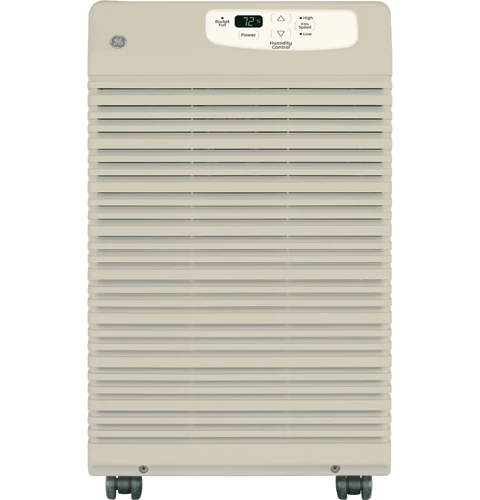
The product image is linked by GE’s exact AHH40LH page. It shows a light neutral cabinet with a front grille, wheels and top controls; it does not show the model label or drainage hardware. GE does not identify this image as a photograph or a rendering.
Read the capacity label in its era
GE’s exact technical table lists 40 pints per day and a 21-pint removable bucket. That rating is not a promise of 40 pints in every room; temperature, starting humidity, air exchange and moisture sources affect collection. Since this is a 2005-era model, do not line its historic rating up against a newer label as though test conditions were necessarily identical.
The tank is a meaningful part of daily ownership. The tank holds a little over half the daily rating, so a wet basement can require frequent emptying; do not leave bucket operation unattended indefinitely. GE lists an automatic shutoff and a “Water Full” indicator; those are safeguards for a full or misseated bucket, not a drain or an alert system you can rely on remotely.
Two speeds, an adjustable target and defrost
The exact page lists electronic controls, an automatic humidistat, two fan-speed selections, automatic defrost and automatic shutoff. The owner manual describes a humidity target from 35% to 70% relative humidity in five-point steps, plus continuous operation, and a display whose stated accuracy is ±5 percentage points. Use the display as a guide, not a precision instrument or proof that every room has reached the same humidity.
Automatic defrost is useful protection when frost forms on the refrigerated coil, but it does not make a 2005 compressor dehumidifier a guaranteed choice for a cold crawlspace. For a cold room or a required low-temperature rating, verify the manual for your unit and compare current models with explicit documentation. The product materials reviewed here do not establish app control, sound level or modern connected features, so those needs should not be treated as satisfied.
Bucket collection or a deliberately modified gravity route
The manual describes ordinary collection in the fitted bucket and a hose route to a floor drain. It says the hose is not supplied. Setting up the hose is not simply attaching a loose tube to an exposed port: the instructions describe drilling open the nozzle at the lower side of the bucket, then hand-tightening a garden hose to that nozzle. Once opened, the nozzle cannot be restored in the same way; GE recommends a hose cap if it needs to be closed. This is a real tradeoff for an owner deciding whether automatic draining is worth modifying the bucket.
Keep the bucket securely seated during operation, including with the hose arrangement. The manual says the unit shuts off when the bucket is removed or out of position, so the documented hose plan is not bucketless. The route is suitable only where the hose can reach a lower floor drain; the materials reviewed do not establish an upward pump or a maximum pump lift. If the only available drain is above the appliance, this model’s documented plans do not solve that installation. Avoid kinks and arrange the hose so water can flow toward the drain.
Size, placement and care
The specification table lists a 20⅞-inch-high, 12⅝-inch-wide and 17⅛-inch-deep cabinet, 36 pounds net, 580 watts and 115 volts. Casters help reposition it on an appropriate smooth floor, but they do not remove the need to measure the whole installation: GE’s manual asks for roughly 12–18 inches of air space around the cabinet, along with access to pull out the bucket and clean the filter. Those clearances can matter more than the narrow body when the appliance is placed beside storage or a wall.
The owner manual calls for checking the rear air filter at least every 30 days and more often when needed; it warns not to run the unit without the filter. Build regular inspection into ownership, and check the bucket, hose connection and floor-drain path for leaks after moving or modifying the setup. The wattage is a nameplate value, not an energy-cost estimate; no sound measurement was found.
Who should keep this model in view?
AHH40LH makes sense as a precise reference for an existing owner, a person matching a model label, or someone deciding whether an intact used unit can work with a bucket or lower floor drain. Its published 40-pint class, 21-pint removable tank, simple two-speed controls and caster-equipped cabinet are the useful documented traits. The older date range and the required bucket modification for hose draining are equally important to the decision.
For a new appliance, use current reviewed models in the finder, not a stale clearance page or a used listing. When replacing an AHH40LH, compare drain elevation, clearance, capacity and controls against a current exact-model manual. A current pump model may answer an uphill-drain need, while a bucket-and-gravity unit may be simpler when a floor drain is already available; those are different setups, not interchangeable promises. For an installed AHH40LH, verify the model and condition from its own label and follow its manual rather than borrowing features from another GE suffix.
Key details at a glance
| Published daily removal rating | 40 pt/day |
|---|---|
| ENERGY STAR certified | Yes |
| Published dimensions | 20 7/8 in H × 12 5/8 in W × 17 1/8 in D |
| Bucketless operating mode | No |
| Published product weight | 36 lb |
| Controls and settings | Local electronic controls provide two fan selections (HIGH/LOW), a humidity target from 35% to 70% RH in five-point steps, continuous operation, an automatic humidistat, a humidity display stated ±5 percentage points, automatic defrost, a full-bucket indicator and shutdown. |
| Water-removal setup | The exact AHH40LH-linked manual documents bucket collection or a garden hose attached to a nozzle on the bucket and led to a floor drain. Hose is not included; setup requires drilling the bucket nozzle. Bucket must remain correctly seated; unit shuts off if it is removed. No upward-pump or maximum-lift plan is documented. |
| Care and operating limits | GE’s linked owner manual describes indoor residential use and a washable rear filter; check and clean at least every 30 days or more often as needed. Confirm clearances, bucket seating and hose connection from the exact manual. |
Use the exact model’s instructions for operating limits, supplied equipment and version differences.
Sources for this assessment

Check the route before the room-size claim.
Match the rated capacity and drainage setup to a real place for the water to go.