
Your needs, this model
Does it fit your priorities?
Can APER50LZ pump condensate to a point 16 feet above the unit?
The GE manual linked from its exact support page gives a maximum pump lift of 16 feet. The fitted bucket must remain installed, and GE includes a separate pump hose.
Explore this need in the finder →Does APER50LZ have a bucketless pump setup?
No. The manual requires the bucket to be securely seated for pump use. Its downhill gravity hose is a separate route and also requires the bucket installed.
Explore this need in the finder →Does the 50-pint/day model fit a 16-foot pump need without entering current-model results?
Yes when earlier references are requested: GE lists a 50-pint/day capacity and a 16-foot maximum lift. It is excluded by the default current-model filter because GE says APER50LZ is no longer manufactured.
Explore this need in the finder →Will the exact APER50LZ documentation satisfy a required app-control feature?
No. Its model-specific specifications and 49-5000427 manual do not establish Wi-Fi/app setup; generic hidden SmartHQ page content does not qualify. Unknown does not satisfy an essential app requirement.
Explore this need in the finder →The GE APER50LZ is an earlier 50-pint-per-day portable dehumidifier with a built-in pump, a 15-pint bucket and three fan speeds. Its useful distinction is a documented pump lift of up to 16 feet—but the bucket still has to remain fitted, and the pump waits until that bucket fills before it moves water. Treat it as an exact-model owner or used-unit reference, not a current new-product recommendation.
Model-specific details come from GE’s U.S. APER50LZ page, its exact support record, and the manual linked from that product page. The manual cover calls the family APER50 rather than repeating the LZ suffix; the exact support and product pages identify APER50LZ.
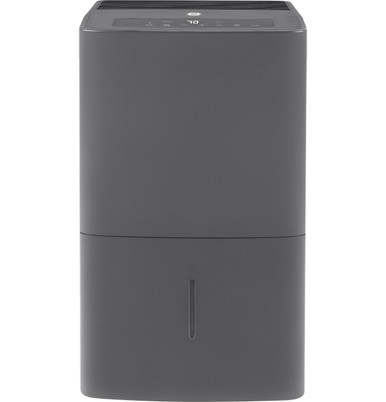
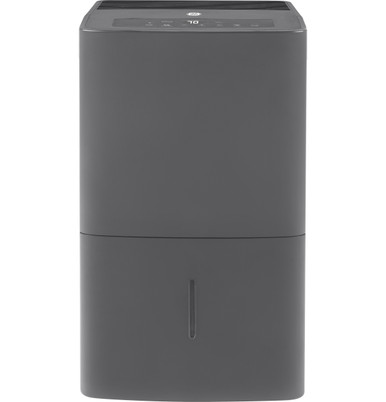
GE’s exact APER50LZ page links this gray cabinet image. It shows the controls and front water-level window, not the internal pump or hose. The same exterior image is also linked from another GE product page, and GE does not say whether it is a photograph or rendering; use the label on the unit, not the image, to confirm the exact model.
Start with the lift and the bucket
The APER50LZ supports three separate water routines: collect condensate in its fitted bucket; attach a garden hose, not supplied, and let water run downhill to a floor drain; or attach the included pump hose and send water to a more distant or higher outlet. GE’s manual gives a 16-foot maximum lift for the pump. Measure the vertical rise from the appliance to the discharge point and check the full hose route for kinks, bends and a safe place to drain. Sixteen feet is a ceiling, not a guarantee for every route.
The pump does not make the tank optional: the bucket must be seated, and after you activate the pump it waits until that tank fills, empties it and repeats. A full bucket can accumulate before pumping starts, and a blocked or disconnected hose can still spill. This is not bucketless pump operation. The separate downhill gravity route also needs the bucket reinstalled.
Capacity is only one part of fit
GE lists 50 pints per day, a 15-pint removable bucket, a gray cabinet measuring 24 inches high by 14.75 wide by 11.375 deep, and a dry weight of 43.7 pounds. The 50-pint label is a published capacity class, not a forecast for a particular basement; actual water removal changes with the room’s temperature, humidity, air circulation and moisture entering the space. The bucket holds less than one third of that daily rating, so using bucket-only collection can mean repeated emptying in a damp room. The built-in pump eases the carrying routine after it cycles, but not the need to keep the tank seated or inspect the drain.
Controls include three fan settings and humidity selection from 35 to 80 percent in five-point steps, plus continuous operation, a two- or four-hour delay-off timer, automatic restart after an interruption, automatic defrost and a full-bucket shutoff. The exact product page calls the model ENERGY STAR qualified and lists a maximum sound level of 51 dBA. The exact APER50LZ specification table and 49-5000427 manual do not establish app control. A hidden generic SmartHQ block also appears on exact GE pages whose model-specific evidence does not confirm Wi-Fi; do not treat that block as proof for this suffix.
Placement and upkeep affect the practical choice
This is a conventional compressor unit for indoor residential use. GE’s manual says not to use it below 41°F or above 90°F, to provide at least 18 inches of air space on every side, and to set it on a smooth, level surface strong enough for the appliance and a full bucket. The rollers help on a flat hard floor, not carpet or obstacles. Allow room for the top air discharge and for the front bucket to slide out; the cabinet dimensions alone do not describe a workable installation footprint. The manual also prohibits extension cords and multi-outlet adapters, so plan for a properly grounded outlet near the unit.
The washable filter sits behind the front grille and should be checked and cleaned at least every 250 operating hours; the unit has a filter reminder. The manual separately describes cleaning the bucket filter and washing the tank every few weeks. For pump operation, confirm that the included hose is present, locked in place, unkinked and routed to a drain that can accept the discharge. A secondhand machine’s present condition, pump performance, hose completeness and service history cannot be inferred from the model number or GE’s product image.
Who should keep it in the comparison?
The APER50LZ is most relevant to someone identifying an installed unit or evaluating a particular used example who needs a documented 16-foot pump rise, can keep the 15-pint bucket seated and has space for GE’s clearance guidance. Compared with the earlier GE APEL45LY, it adds five pints per day of published rating while retaining a 15-pint bucket and a 16-foot pump limit; the exact APER50LZ source set does not establish Wi-Fi any more than the APEL45LY sources do. Do not infer a connected-feature difference from their suffixes or from a generic page template. Against the Midea Cube MAD50PS1QWT, GE’s documented pump rise is two feet higher, while the Midea manual separately describes bucketless gravity drainage—a different mode that the GE APER50LZ manual does not provide.
GE’s exact product page says APER50LZ is no longer being manufactured; its support record dates manufacture from March 2020 through July 2026. That history does not prove a new unit is available now, nor does it establish the condition of a used one. If the model is being considered secondhand, match the full APER50LZ label and inspect the fitted tank, pump controls, hose, filter and outlet path before relying on the 16-foot limit. Choose a current model only after checking its own manual: a similar capacity or cabinet is not evidence of the same pump routine.
Key details at a glance
| Published daily removal rating | 50 pt/day |
|---|---|
| Built-in lift pump | Yes |
| Stated maximum vertical pump height | 16 ft |
| Published bucket capacity | 1.88 gal |
| ENERGY STAR certified | Yes |
| Published high-fan sound rating | 51 dBA |
| Published dimensions | 24 in H × 14.75 in W × 11.375 in D. GE’s manual asks for at least 18 in of clearance on all sides. |
| Bucketless operating mode | No |
| Published product weight | 43.7 lb |
| Controls and settings | Three manual fan speeds; 35–80% RH setting in five-point steps or continuous operation; 2- or 4-hour delay-off; filter reminder; automatic restart, defrost and full-bucket shutoff. Exact suffix Wi-Fi is unknown; the hidden SmartHQ panel is generic page-template content. |
| Water-removal setup | Three separately documented plans: the 15-pint bucket; a garden hose (not supplied) routed downhill to a lower floor drain with bucket installed; or the included pump hose, with a maximum 16-foot lift and bucket installed. Pump remains on standby until the bucket fills. Bucketless operation is not documented. |
| Care and operating limits | Clean the washable filter at least every 250 operating hours, clean the separate bucket filter, and wash the bucket every few weeks. Operate indoors from 41°F through 90°F, on a smooth level floor with at least 18 inches of clearance. Do not use extension cords or multi-outlet adapters. |
Use the exact model’s instructions for operating limits, supplied equipment and version differences.
Sources for this assessment
Check the route before the room-size claim.
Match the rated capacity and drainage setup to a real place for the water to go.