
Your needs, this model
Does it fit your priorities?
Would a marketed 50-pint class and fitted bucket fit your minimum need?
Yes if the 50-pint class is acceptable and you can empty the fitted bucket. The EPA record gives a separate 49.95-pint/day test value; a 60-pint minimum is above this rating.
Explore this need in the finder →Can the side garden-hose connection meet an essential lower-gravity or bucketless installation?
The page mentions a hose, but the reviewed exact-model material does not establish hose slope, outlet height or bucketless operation. Do not select it for an essential gravity/bucketless setup without the DH5026K1W instructions.
Explore this need in the finder →Do you need an uphill pump route, or can water collect in the bucket?
The exact page does not identify a pump or pump-rise limit. This assessment supports the fitted-bucket route, not pump lift.
Explore this need in the finder →Is an ENERGY STAR factor of 2.01 L/kWh enough for your comparison?
The exact EPA record lists 2.01 L/kWh, so it meets a 2.0 minimum but not a 2.1 minimum.
Explore this need in the finder →Must the dehumidifier connect to an app?
The exact ENERGY STAR record says Connected Capable: No. That does not meet an essential connected-app need; the product remains a candidate when app control is optional.
Explore this need in the finder →Hisense’s DH5026K1W is the white, 50-pint-class member of its newer portable dehumidifier line. It pairs an internal collection bucket with an optional side garden-hose connection, a 38°F lower operating boundary and a listed 46 dB(A) low-speed figure. ENERGY STAR separately reports 49.95 pints per day under its test procedure, 2.01 L/kWh and 526 kWh per year. Those numbers help compare models; they do not predict what a particular basement will remove or cost to run.
The Hisense DH5026K1W U.S. product page identifies its marketed 50-pint class, bucket and garden-hose choices, operating modes, temperature boundary and low-speed sound figure. The exact-model ENERGY STAR record supplies the standardized capacity, efficiency and connected-capability fields.
How to read the capacity and room claim
The manufacturer names the model as 50-pint capacity and advertises coverage up to 4,500 square feet. ENERGY STAR’s test figure is 49.95 pints per day, which is the same rounded class, not a second promise that the unit will collect that much water in your room. Temperature, initial humidity, ventilation and how much new moisture enters the space all affect real output. Treat the square-foot number as a broad label, not a sizing guarantee for a damp basement with several separated rooms.
The EPA record lists an integrated energy factor of 2.01 liters per kilowatt-hour and 526 kWh per year. That provides a program-based comparison with other certified models. It is not your utility bill: actual runtime and conditions determine household use. The unit is a sensible fit if you want this capacity class and a published efficiency value, but a shopper with a hard energy threshold above 2.01 should look elsewhere.
A bucket-first water decision
Hisense describes a slide-out internal bucket with a full-tank alert and automatic shutoff. That is the clearest operating plan. It is straightforward, but it makes ongoing emptying part of ownership; how often depends on the moisture load. The exact listing also mentions a garden hose connected through the side of the cabinet and says the hose is not included. It does not publish a pump-rise limit, hose length, or a specific bucket-removal procedure for this model. A hose port alone does not prove the unit can push water uphill or run without its tank, so I would not buy it to satisfy either essential need without the DH5026K1W instructions in hand.
That distinction matters because Hisense sells a separate 50-pint pump configuration, DH5026KP1G. Its product page explicitly describes a pump and supplied quick-connect hose, though it too leaves the numerical lift limit unclear in the material reviewed. The similar capacity and branding do not make the two water paths interchangeable. If the outlet is above the appliance, compare an exact model with a documented pump route and a suitable published lift limit. If the outlet is lower, confirm the fitting and instructions before treating a hose connection as an approved continuous-drain setup.
Controls and cool-room use
The product listing names manual, continuous and auto-dry modes, an adjustable humidistat, a programmable 24-hour on/off timer and three-speed operation. Those choices support basic local control without implying app access. ENERGY STAR marks this exact model “Connected Capable: No,” so it does not meet a requirement for connected control. The manufacturer states operation down to 38°F. That lower boundary can be useful in a cooler utility space, but it does not promise the same extraction rate at 38°F as in warmer test conditions.
Hisense publishes 46 dB(A) on low and a two-year parts-and-labor warranty. The sound figure is specifically a low-speed claim, not a guarantee for every mode or room position. The page does not give a precise cabinet weight, footprint, tank capacity or a detailed service interval here. If stairs, narrow clearances, frequent bucket carrying or a measured noise ceiling decides your purchase, find those values in the instructions and label rather than estimating from another Hisense model.
Who should consider it
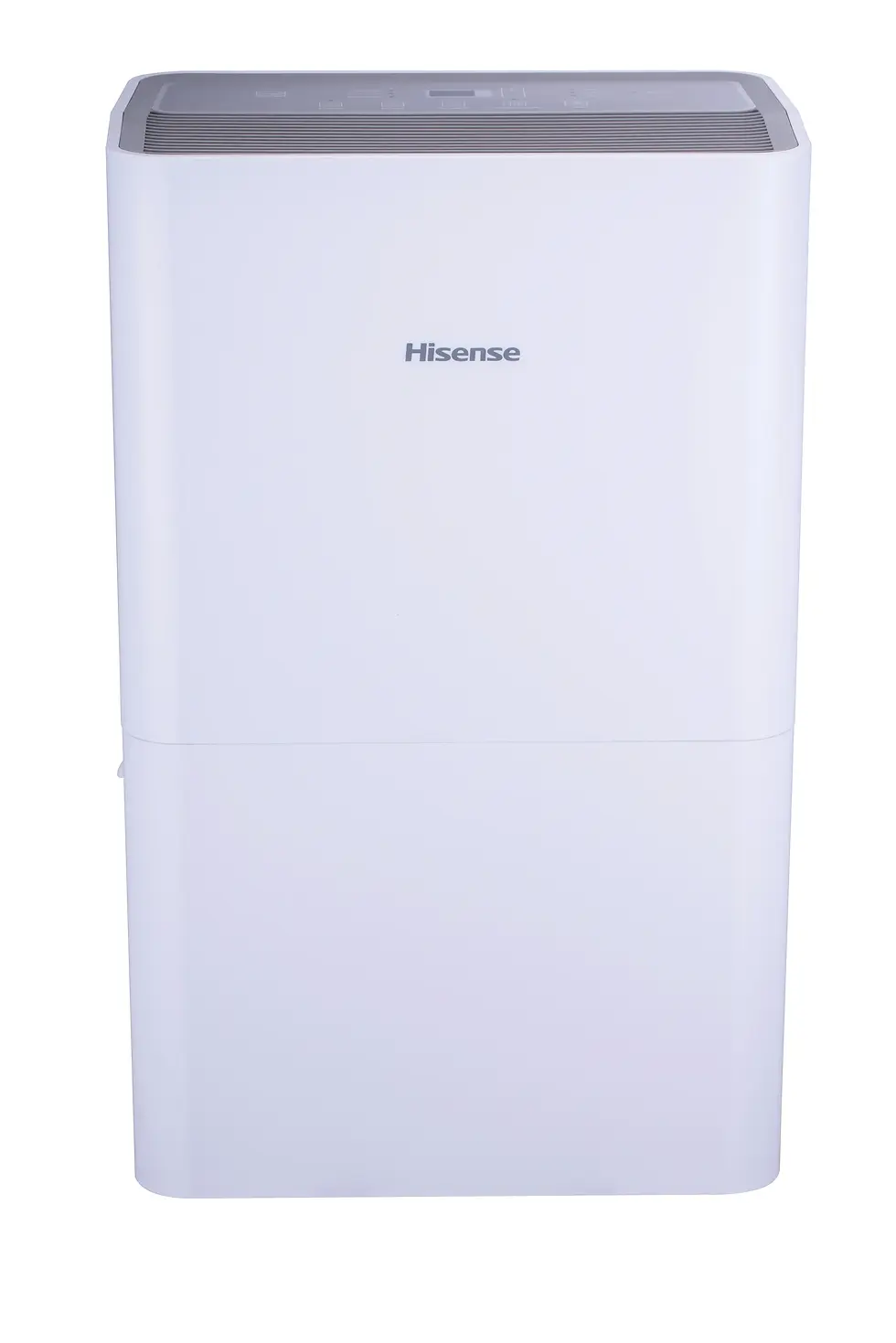
Consider the DH5026K1W if a 50-pint class is appropriate, bucket emptying is manageable, and the 38°F boundary and 2.01 IEF match your comparison priorities. Its white exterior image shows a tall cabinet, top outlet and front collection section; it does not show the hose fitting, internal pump or rating plate, and the manufacturer does not identify whether the image is a photograph or a rendering.
Choose a smaller 25- or 35-pint Hisense if your room and moisture load call for less capacity; look at the DH5026KP1G if a pump itself is essential, while checking its actual lift capability; and compare a model with an explicit bucketless-gravity plan if tank-free draining is the priority. Pass on the DH5026K1W when a pump rise, app connection, tank volume, exact dimensions or weight is a must-have and you cannot verify it. The honest advantage is its listed capacity class and measured efficiency record; the important limitation is that the garden-hose mention does not answer every drainage question.
Use the exact model’s instructions for operating limits, supplied equipment and version differences.Key details at a glance
Published daily removal rating 50 pt/day Wi-Fi enabled No ENERGY STAR certified Yes Published low-fan sound rating 46 dBA Published dimensions Exact dimensional and dry-weight values were not established from the reviewed exact-model materials. Controls and settings Hisense lists three operating modes (manual, continuous and auto-dry), an adjustable humidistat, programmable 24-hour on/off timer, full-tank alert/shutoff, three-speed model label and a low-speed sound figure of 46 dB(A). The exact material does not enumerate manual fan-step selections, so the three-speed label is not used to satisfy a minimum manual-speed rule. The ENERGY STAR record says Connected Capable: No. Water-removal setup Hisense describes an internal slide-out bucket or a garden hose connected through the cabinet side and says the hose is not included. The exact product page does not identify a pump or establish hose rise, length, slope or bucket-removal procedure. The accepted matching plan is bucket collection only; gravity and pump are not inferred from the garden-hose mention. Care and operating limits The exact page says the unit has a full-tank alert/shutoff but does not state bucket volume or an exact maintenance interval. Follow the actual DH5026K1W instructions for hose setup, filter care and clearances; do not use a DH5024 manual to fill in those details. Exact model detail DH5026K1W is Hisense's white 50-pint-class, three-speed listing. EPA's exact ENERGY STAR record gives 49.95 pints/day, 2.01 L/kWh and 526 kWh/year; the same record marks it not connected-capable. Only fitted-bucket collection is an established matcher plan here. Published integrated energy factor 2.01 L/kWh Sources for this assessment

Check the route before the room-size claim.
Match the rated capacity and drainage setup to a real place for the water to go.