
Your needs, this model
Does it fit your priorities?
Can the water drain without carrying the bucket?
Yes, with the documented continuous gravity hose and a lower receiving point; the guide also describes bucketless gravity mode. It cannot pump water uphill.
Explore this need in the finder →Does a 50-pint minimum fit this exact model?
No. The product page rates this unit at 20 pints/day. No area claim turns that into a 50-pint rating.
Explore this need in the finder →Can I keep the bucket installed and direct water to a raised drain?
No built-in pump is listed for MAD20S1QWT. Choose a lower gravity outlet or another model with documented pump lift.
Explore this need in the finder →The Midea Cube MAD20S1QWT is a 20-pint-per-day dehumidifier for someone who wants a smaller-rated Cube with bucket, gravity-hose and bucketless-gravity setups. It is not the choice for a drain above the appliance: the exact product page lists no built-in pump. Its lift-and-twist storage design and app/voice-control features add convenience, but room fit still depends on the moisture load and where condensate can go.
Source documents: Midea’s 20-pint MAD20S1QWT product page and current Cube owner guide. Confirm the exact label and current seller details before purchase.
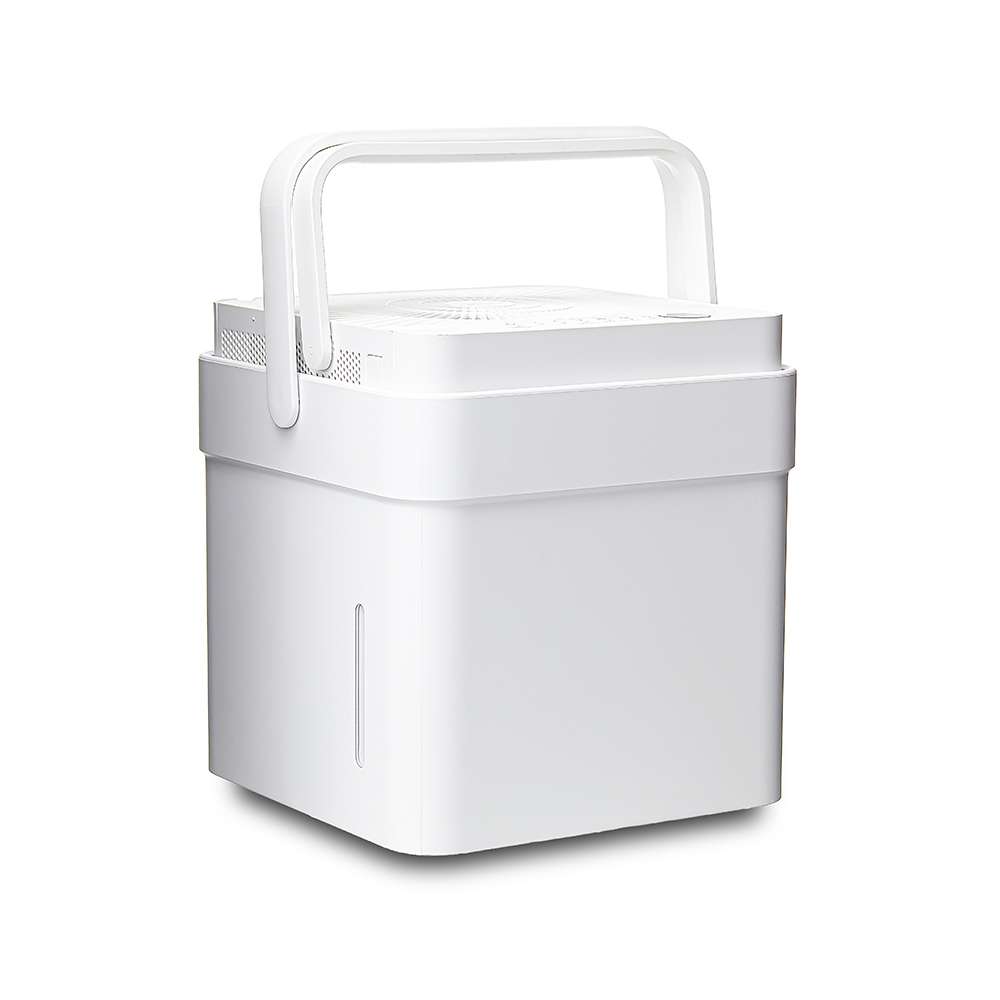
Midea gallery image note: this is the official product-page image, but the source does not identify whether it is a photograph or a render.
Read the rating as a capacity class, not a room promise
Midea lists this model at 20 pints per day, with a claim of up to 1,500 square feet. That figure should not be read as a guaranteed extraction rate or a promise that every 1,500-square-foot basement will dry at the same pace. Temperature, starting humidity, air movement, leakage and moisture entering the room all affect the workload. Use the rating to distinguish this model from the 50-pint Cube, then assess the actual room and its dampness. The manufacturer page does not give a test result for your home.
The listed product dimensions are 13.5 by 13.5 by 13.39 inches and the published weight is 33.07 pounds. The weight is for the product, not a water-filled bucket. If the job involves stairs, lifting limits or frequent room changes, plan for the dry appliance and the additional water separately. Its narrower footprint and lighter listed weight are meaningful differences from the two 50-pint Cube configurations, not proof that it is adequate for a large or persistently wet space.
Choose the drain before choosing a location
MAD20S1QWT has three useful water-handling ideas, but they are not interchangeable. Bucket collection is simplest when you can check and empty it. Continuous gravity drainage uses the supplied hose and needs the unit positioned so water can run down to a lower drain. The guide also describes a bucketless gravity configuration. Neither gravity arrangement can move water uphill; the product page explicitly lists no built-in pump.
That distinction is the first filter for a basement installation. If the only nearby outlet is higher than the appliance, the 20-pint model cannot solve that routing problem on its own. The MAD50PS1QWT-A Cube is the documented pump alternative in this small comparison: its manual specifies up to 14 feet of vertical lift, but pump mode requires the bucket installed and is not bucketless. The 50-pint non-pump Cube increases rated capacity without adding a lift pump, so it does not address a raised drain either.
Nested storage is useful after the water is dealt with
Midea describes a lift-and-twist Cube that can be used in an extended form and nested for storage. That is practical if you take the dehumidifier out seasonally or need a more compact stored shape. It does not make the running unit weightless or remove the need to empty it first. Follow the model guide’s order for emptying, nesting and storing the pieces, and store it upright, clean and dry rather than assuming that damp parts can be packed away.
The manufacturer also lists SmartHome app and voice-control support. Those features may suit a household that already wants remote controls, but they are secondary to a stable level floor, unobstructed airflow and a workable drain. The unit remains a compressor appliance with limits in colder rooms: the current Cube guide gives a 41–95°F safe working range. A cold cellar below that range is not an ideal match merely because the square-foot claim sounds large.
Care is part of the installation
The manual asks users to keep airflow areas clear, place the unit on a level sturdy surface, clean the filter every two weeks and respond to the filter reminder at about 250 operating hours. It also calls for bucket cleaning every few weeks and not washing the bucket in a dishwasher. Those tasks are modest, but a drain hose does not eliminate filter and seasonal upkeep. For long storage, unplug the appliance, empty it, nest the pieces and store it upright in a dry ventilated place.
The guide recommends a continuous first run of 24 hours. Treat that as an initial operating instruction, not a promise that one day is enough to correct a moisture problem. If there is recurring water intrusion, an active leak or persistent dampness, investigate the source rather than relying on a consumer dehumidifier as a repair.
Who should consider this exact model?
Consider MAD20S1QWT when 20 pints per day is a reasonable starting capacity, the bucket or downward gravity route is usable, and its storage arrangement matters. Prefer a verified higher-rated product if your moisture load calls for it; choose the built-in pump version only if the drain geometry needs vertical lift and you can keep its bucket in place. Midea’s published square-foot number, app support and nested shape should not substitute for measuring the outlet, checking the room temperature and confirming the full model suffix.
Key details at a glance
| Published daily removal rating | 20 pt/day |
|---|---|
| Built-in lift pump | No |
| Wi-Fi enabled | Yes |
| Bucketless operating mode | Yes |
| Nested storage arrangement | Yes |
| Published product weight | 33.07 lb |
| Controls and settings | SmartHome app and voice-control support are listed; onboard settings and ordinary operation remain subject to the model guide. |
| Water-removal setup | Bucket collection, continuous gravity hose drainage, and documented bucketless gravity drainage. No built-in upward pump. Gravity outlets must be lower than the unit. |
| Care and operating limits | Official current Cube user guide specifies a working range of 41–95°F, a clear airflow path, a level/sturdy surface, filter cleaning every two weeks, a 250-hour filter reminder, and bucket cleaning every few weeks. Empty, unplug, nest and store upright and dry for extended storage. No lab output or noise tests are claimed. |
| Exact model detail | Midea lists 20 pints/day and up to 1,500 sq ft; that area claim is not guaranteed extraction or a substitute for room conditions. Product page supports exact MAD20S1QWT identity. Recall index did not provide an exact serial/date clearance for this unit. |
Use the exact model’s instructions for operating limits, supplied equipment and version differences.
Sources for this assessment
Check the route before the room-size claim.
Match the rated capacity and drainage setup to a real place for the water to go.