
Your needs, this model
Does it fit your priorities?
Can this 22-pint EasyDry use a lower gravity drain without a lift pump?
Yes, with a suitable downhill hose, the tank installed and a receiver below the unit outlet. It cannot pump to a higher drain.
Explore this need in the finder →Does its published capacity meet a 35-pint/day minimum?
No. Midea rates the exact MAD22C1AWS at 22 pints per day; room-area copy does not turn it into a 35-pint model.
Explore this need in the finder →Can it run without its collection tank or use app control?
The manual requires the tank to be correctly seated, and the exact US page lists Smart Control: No. No bucketless operation or connected control is established.
Explore this need in the finder →Midea’s MAD22C1AWS is the white EasyDry model rated at 22 pints per day. Its conventional wheeled cabinet, built-in tank and timer suit someone who wants a straightforward portable unit rather than the taller-capacity options in the EasyDry line. It has no listed lift pump and Midea’s US specification says Smart Control: No, so plan on the tank or a lower gravity drain and do not buy it for app control or a raised outlet.
Source documents: Midea’s exact MAD22C1AWS US product page, its model support page, and the linked MAD20/35/50 C1AWS family manual. The family manual cover expressly lists MAD22C1AWS and MAD35C1AWS. Check the full suffix on the appliance and carton.
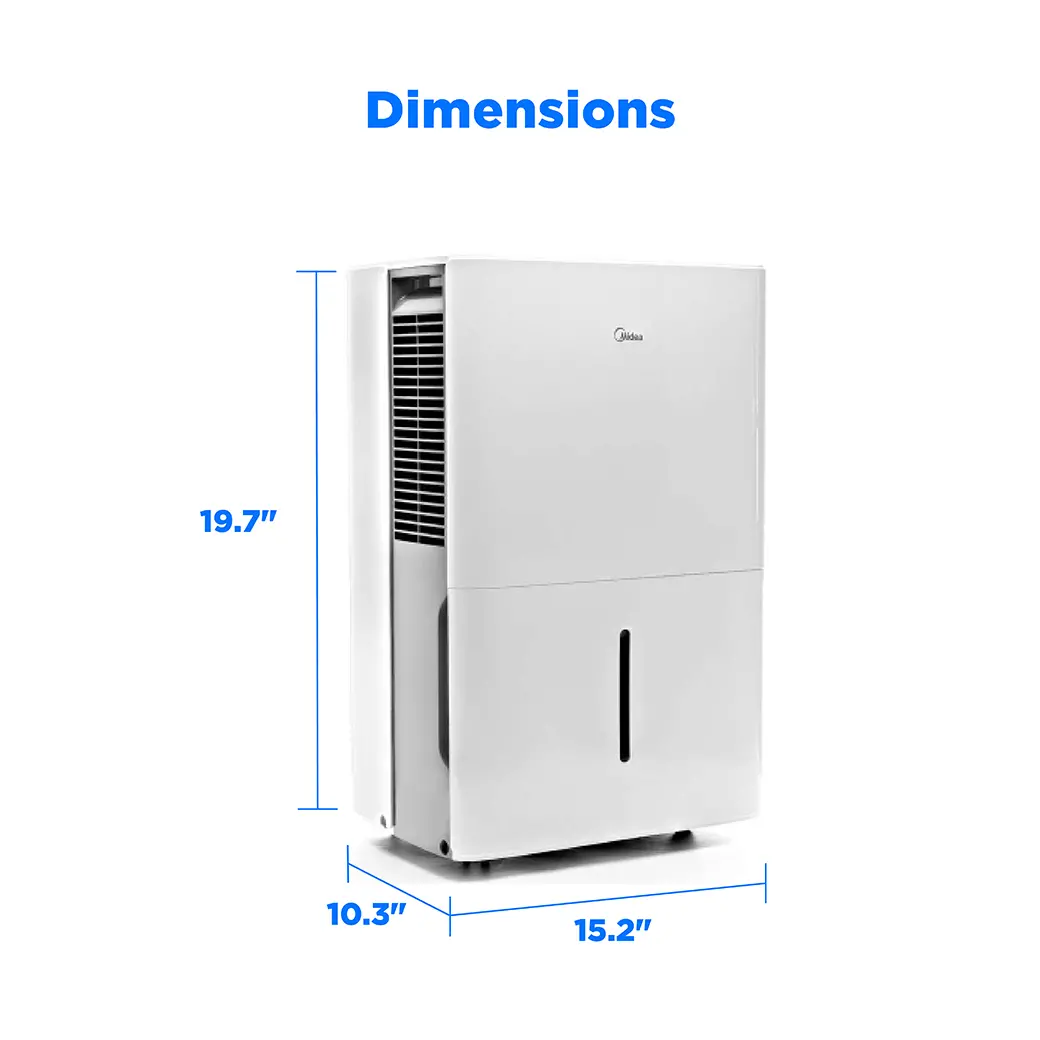
The image used here is Midea’s model-specific MAD22C1AWS dimension illustration, not a stock photograph. The US product page’s separate white EasyDry gallery rendering is byte-identical on its MAD35C1AWS page, so that generic view alone cannot establish which capacity is pictured.
A modest rating in a familiar cabinet
Midea lists this configuration at 22 pints per day and advertises it for spaces up to 1,500 square feet. The area figure is a manufacturer claim, not a prediction that a room of that size will dry at a fixed rate. Treat the pint rating as a way to separate this model from a 35-pint unit, not as an hourly promise.
The US page lists a 15.2-inch width, 10.24-inch depth, 19.69-inch height and 32.41-pound product weight. The model-specific Midea dimensions graphic rounds the measurements to 15.2 by 10.3 by 19.7 inches. Four casters make short moves across a smooth floor practical, but the listed dry weight excludes collected water. A filled tank adds weight; do not treat the wheels as a way to carry it over a step or lift it into a vehicle. The tank capacity itself is not stated as a number on the US page I reviewed, so I would not estimate how often it needs emptying from the “large tank” phrase.
Choose between the bucket and a downhill hose
With bucket collection, the manual says to pull the tank straight out using its side handles, empty it, and reseat it fully. The appliance will not operate unless the tank is in the correct position. This routine is simple, but it means someone must check the full-bucket light and carry the water away; the 22-pint rating does not guarantee a whole day between visits.
For continuous drainage, the shared C1AWS manual describes a hose connection at the rear that empties by gravity into a floor drain or suitable receiver. Midea specifies a 5/16-inch internal-diameter hose and a female threaded end, both not included in the manual’s general instructions; the manual adds that an adapter is supplied on some models, without identifying which. Confirm the exact fitting for MAD22C1AWS rather than assuming a hose in the carton. Route it downhill, below the unit’s outlet, without kinks. The tank still must be fitted for the machine to run. There is no built-in pump and no documented bucketless mode, so it cannot lift water to a laundry sink above the appliance or run with its tank removed.
This distinction changes a finder answer: “gravity drain” can fit when the receiver is lower and a hose can be kept sloped; “bucketless” and “pump lift” are hard misses. If the drain is higher, compare a model whose exact manual documents a pump and check its separate rise limit.
Controls: do not infer Wi-Fi from a shared booklet
The exact US page lists a timer, wheels, no pump and no Smart Control. The common family manual contains instructions for optional wireless/app features, but it also says the illustrations and controls can vary by model and some indicators or buttons may be absent. That shared booklet is not proof that every listed function is fitted to this 22-pint SKU. I would make the purchase decision on the controls the model-specific page actually promises: an onboard timer and ordinary dehumidification, not remote app or voice operation.
The manual’s general C1AWS instructions give an operating range of 41–90°F and 30–80% relative humidity. It calls for a level indoor surface, 8 inches of clearance around the case and 16 inches at the air outlet. Keep the intake and outlet clear; do not tuck the unit into a closet or place it outdoors. Allow about three minutes before restarting after a stop. Clean the filter every two weeks and wash the bucket every few weeks. The exact page states a one-year warranty. I found no reliable exact-model noise rating or independent extraction test, so I do not describe this as quiet or promise a result.
Where it sits beside other Midea choices
The Cube MAD20S1QWT is rated at 20 pints per day, has a nested storage design, and its specific manual documents a separate bucketless gravity arrangement. It is a better comparison if compact off-season storage or tank-free gravity matters more than the small rating difference. The Smart Access MAD22S1AWWT is also rated at 22 pints/day but weighs 30.84 pounds, has side-access tank construction and manufacturer-listed connected controls; its own manual still requires the tank installed and offers no pump. That is the more relevant alternative if app control matters. Do not confuse either with the EasyDry C1AWS: its product page says Smart Control: No, it is 32.41 pounds, and its 19.69-inch height takes more vertical space than the Smart Access 22-pint model.
Consider MAD22C1AWS when a 22-pint class, a familiar tank routine, wheeled room-to-room movement and an optional downhill hose suit the installation. Move to the 35-pint EasyDry only if the higher published rating is useful and its larger, taller body fits. Choose a documented pump model when the receiving drain is above the unit. If persistent dampness comes from a leak or wet building material, address that source instead of expecting any portable dehumidifier to repair it.
Key details at a glance
| Published daily removal rating | 22 pt/day |
|---|---|
| Built-in lift pump | No |
| Wi-Fi enabled | No |
| Bucketless operating mode | No |
| Published product weight | 32.41 lb |
| Controls and settings | Midea US exact-model page lists a built-in timer and Smart Control: No. Do not infer app or voice features from a shared family manual; buttons and optional functions vary by model. |
| Water-removal setup | Use the correctly seated built-in bucket, or a separately obtained 5/16-inch-ID gravity hose and appropriate threaded fitting routed downhill below the unit outlet. Midea says the fitting is included on some models but does not identify this SKU’s bundle. No built-in pump or documented bucketless mode. |
| Care and operating limits | Shared C1AWS manual gives 41–90°F and 30–80% RH operating ranges, a level indoor location, 8 inches clearance around the case and 16 inches at the air outlet; clean the filter every two weeks and the tank every few weeks. No independent noise or extraction test is claimed. |
| Exact model detail | Exact US model MAD22C1AWS: 22 pints/day, no built-in pump, no Smart Control. Manufacturer room-area claim: 1500 sq ft; do not treat as guaranteed output. |
Use the exact model’s instructions for operating limits, supplied equipment and version differences.
Sources for this assessment
Check the route before the room-size claim.
Match the rated capacity and drainage setup to a real place for the water to go.