
Your needs, this model
Does it fit your priorities?
Does the exact model carry a 35-pint/day rating?
Yes. The Midea page model field and full specifications identify MAD35S1QWT at 35 pints/day, and the 2024 Cube manual lists the exact model. The product-page title itself incorrectly says 'Cube 20 pt.'
Explore this need in the finder →Can it use a bucketless hose to a lower drain?
Yes. The exact-model family manual describes bucketless continuous gravity mode; the hose must slope down to a point no higher than the drain outlet, and the separate mode has to be enabled after plugging in.
Explore this need in the finder →Will the 39.62-pound dry appliance fit my handling limit?
It fits a 40-pound dry-weight cap with a narrow margin, but a 39-pound limit is too strict. Water collected in the bucket adds weight beyond the listed dry-product figure.
Explore this need in the finder →Midea’s Cube MAD35S1QWT is the in-between capacity choice in the Cube line: it is rated at 35 pints per day, but it keeps the no-pump design of the gravity-drain models. Its strongest fit is a room where a bucket or lower drain is workable and the bucketless setup is useful. It is not the right Cube when condensate has to be lifted uphill.
Sources: Midea’s exact MAD35S1QWT product page and Cube owner manual listing MAD35S1QWT. Check the complete model number on the seller’s listing and appliance label.
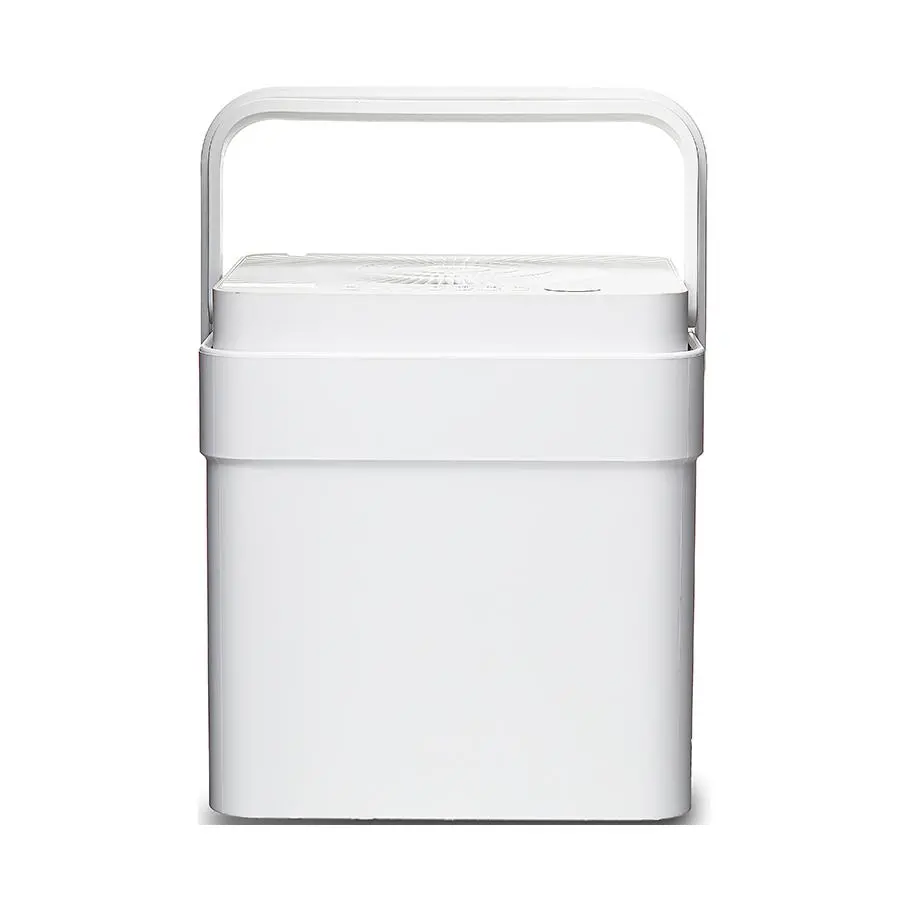
Midea’s exact-model gallery image is shown. It appears to be a studio product rendering, but Midea does not identify whether the image is a photograph or render.
First, disregard the wrong capacity in the page title
Midea’s official page title says “Cube 20 pt.”, yet the page body names model MAD35S1QWT and its specifications list 35 pints per day. The exact 2024 Cube manual also lists MAD35S1QWT alongside the 20- and 50-pint Cube models.
There is a second mismatch: the page headline and specification say coverage up to 3,500 square feet, while product copy lower down says 1,500. Neither claim can be treated as a dependable room-sizing guarantee. Pints per day is a more useful way to distinguish this product from the 20-pint Cube and the 50-pint versions, but even a published rating is not a promise of the same water removal in every room. Temperature, starting humidity, outside air, and continuing moisture sources all affect the job.
It is a 35-pint Cube, not a pump Cube
The useful installation question is where the water can go. MAD35S1QWT can collect water in its installed bucket or use the continuous gravity hose when the outlet is below the appliance and the hose can maintain a downward path. The manual also describes a distinct bucketless gravity mode: the unit sits on a level surface, the hose connects to the continuous-drain port, and the other end stays lower than the port. Midea says to enable this mode within three minutes of plugging the unit in.
That bucketless route is not a hidden pump feature. The product specification says Built-in Pump: No, and the manual limits pump mode and the pump hoses to pump-equipped units. If a drain, window, or sink is above the dehumidifier, this exact model cannot move condensate up to it. The 50-pint Cube with a built-in pump is a more relevant alternative when lift is essential, but its manual requires the bucket to remain installed during pumping; it is not a way to have both uphill pumping and bucketless operation.
One operational detail matters after an outage: the manual says automatic restart restores the previous operating setting except for bucketless mode. After a power interruption, confirm the intended mode again rather than assuming a bucketless setup will simply resume.
Compact storage does not mean light handling
The manufacturer lists a dry weight of 39.62 pounds and dimensions of 14.45 inches deep, 14.76 inches wide, and 14.57 inches high. Those figures describe the appliance, not water in the bucket. The shape can be nested for storage, which is useful at the end of a damp season, but you still have to lift the top unit off the bucket to empty or store it. Midea’s instructions call for lifting with two hands and checking that the appliance is seated correctly on its matching bucket. Do not roll the bucket-and-unit assembly when it contains water.
For a smaller area or frequent carrying, the 20-pint Cube is the lighter rated option; its published dry weight is 33.07 pounds. For a higher published capacity, the non-pump 50-pint Cube is the next gravity-oriented alternative, but it does not solve a raised outlet either. The 35-pint MAD35S1QWT sits between those ratings while keeping a Cube footprint and bucketless gravity option; it is not a guarantee that a damp basement will dry faster or stay dry.
Plan for temperature, airflow, and routine care
The Cube manual describes indoor residential use, a 41–95°F working range, and clearances of at least eight inches around the sides and sixteen inches at the air outlet. A cold cellar or garage that drops below the stated operating range is a poor match, even if a large area claim looks attractive. Give the unit room to move air, set it on a level and sturdy surface, and keep it away from heaters and clothes dryers as instructed.
The manual asks users to clean the filter every two weeks and wash the bucket every few weeks. A continuous drain removes the chore of emptying a full bucket, not filter maintenance or seasonal cleaning. For longer storage, Midea advises letting the system dry, cleaning the unit and bucket, nesting the appliance in the bucket, and storing the pieces upright in a dry, ventilated place. The guide also recommends a continuous 24-hour initial run; that is an operating instruction, not a result guarantee.
Midea lists SmartHome app and voice-assistant control. These may make remote adjustments convenient, but the guide notes that network changes or connection problems can require setup again. The basic match remains a physical one: capacity, temperature, air clearance, and a realistic drain route.
Who should choose this exact model?
Consider MAD35S1QWT if the 35-pint/day rating is the class you want, its approximately 40-pound dry weight is manageable, and a bucket or downhill outlet fits the room. Its separate bucketless gravity setup is useful only where water can flow down and the mode can be checked after power loss. If you need lift, choose a verified pump configuration instead; if you need less carrying weight or more capacity, compare the exact 20- and 50-pint models. Above all, verify the label: Midea’s page title is inconsistent, and a similar Cube image does not establish the model or pump configuration.
Key details at a glance
| Published daily removal rating | 35 pt/day |
|---|---|
| Built-in lift pump | No |
| Wi-Fi enabled | Yes |
| Bucketless operating mode | Yes |
| Nested storage arrangement | Yes |
| Published product weight | 39.62 lb |
| Controls and settings | Midea lists SmartHome app and voice-assistant control. The manual includes wireless setup and notes that app compatibility or network problems may require reconnection. |
| Water-removal setup | Collect into the installed bucket, use the documented continuous gravity hose to a lower outlet, or use the separate bucketless gravity mode. This exact model has no built-in lift pump; a gravity hose must slope down. |
| Care and operating limits | The exact Cube manual gives an indoor residential working range of 41–95°F, at least 8 inches of open space on sides and 16 inches at the outlet, filter cleaning every two weeks, and bucket cleaning every few weeks. The bucketless mode is not restored by auto-restart after a power interruption. For long storage, clean and dry the components, nest the unit in the bucket, and store upright in a dry ventilated area. |
| Exact model detail | Midea's official page is titled 'Cube 20 pt.' although its body, model field, and full specification identify MAD35S1QWT at 35 pints/day. The same page gives conflicting room-area copy (3,500 sq. ft. in the heading/specification and 1,500 sq. ft. in body text); neither area claim is used as a match condition. |
Use the exact model’s instructions for operating limits, supplied equipment and version differences.
Sources for this assessment
Check the route before the room-size claim.
Match the rated capacity and drainage setup to a real place for the water to go.