
Your needs, this model
Does it fit your priorities?
Does MAD50P1AWS provide a built-in pump route for a 50-pint setup?
Yes. Midea lists the built-in pump, and the exact family manual separates the pump-hose route from bucket and gravity drainage.
Explore this need in the finder →Can its pump be relied on for a specified 15-foot rise?
The exact Midea sources do not give this model a numeric maximum pump rise, so a 15-foot essential requirement is not confirmed.
Explore this need in the finder →Will its low cabinet fit a 12-inch height and 25-inch depth allowance?
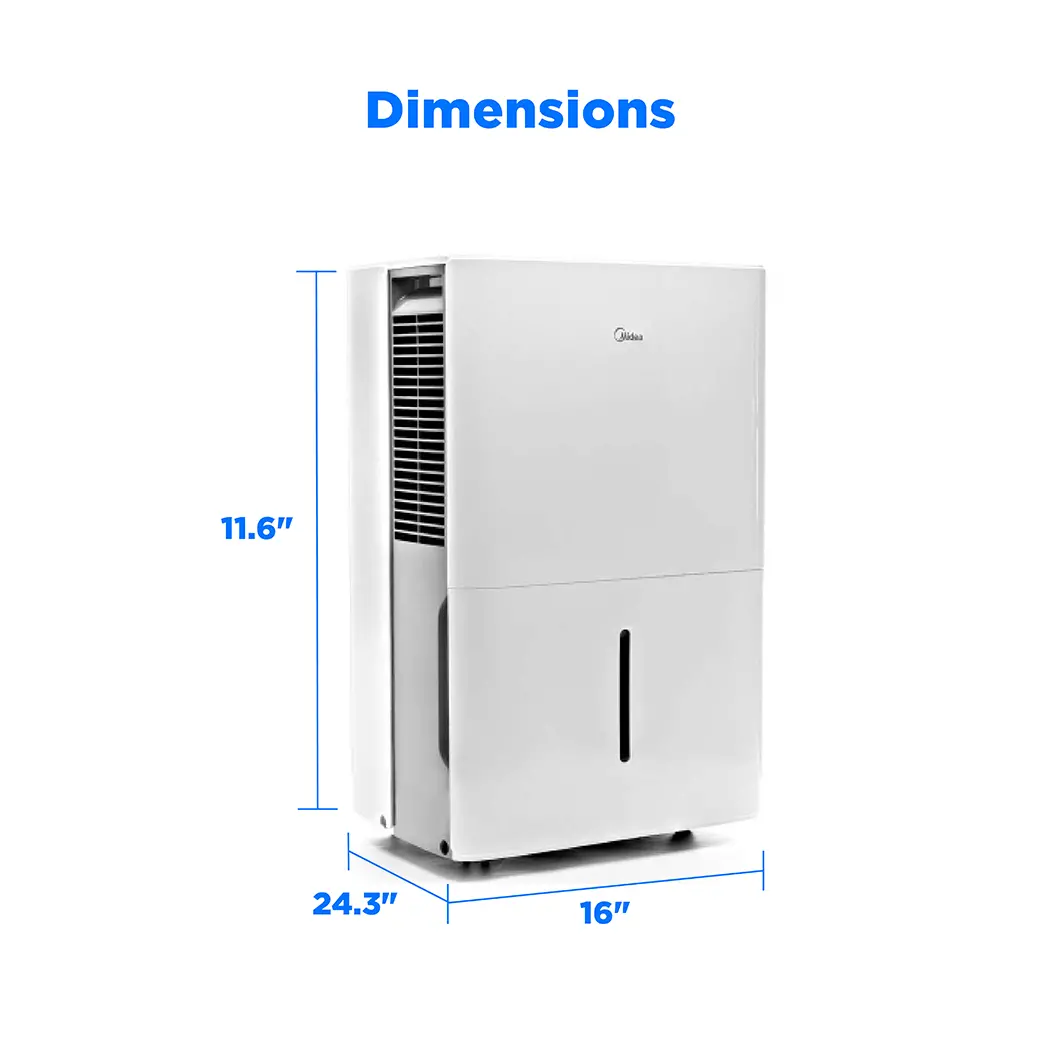
Midea lists 11.54 inches high and 24.29 inches deep; the manufacturer drawing rounds those to 11.6 by 24.3 inches. Leave the required airflow clearance as well.
Explore this need in the finder →Midea’s MAD50P1AWS is a 50-pint EasyDry with a built-in drain pump, four wheels and a low, broad body. Its exact U.S. page marks Smart Control, and the shared EasyDry manual includes SmartHome setup. It is the more flexible choice when the water route cannot rely on gravity alone, but Midea does not publish this model’s maximum pump rise in the sources I reviewed.
Sources: Midea’s exact MAD50P1AWS U.S. product page, its model support page, and Midea’s four-model EasyDry manual, which names MAD50P1AWS on the cover. This is not a Cube; keep its suffix distinct from MAD50PS1AWBL and MAD50PS1QWT.
Midea’s exact model page links a dimension illustration used here. The drawing shows an approximately 11.6-inch-high body with a 24.3-inch depth and 16-inch width; this is a manufacturer graphic, not a stock photograph. The page’s ordinary front gallery image is shared with the no-pump C1AWS and cannot identify the pump by appearance.
A 50-pint EasyDry with a different footprint
Midea rates MAD50P1AWS at 50 pints per day and advertises coverage up to 4,500 square feet. Read the room-area number as the manufacturer’s claim, not as a field-tested promise. Humidity, temperature, air exchange and ongoing moisture sources affect how much water ends up in the bucket or drain. The useful comparison is its published capacity class and specific installation options, not a guaranteed daily volume in a particular house.
The product page lists the white cabinet at 24.29 inches deep, 15.94 inches wide, 11.54 inches high and 41.01 pounds dry. Its exact dimensions graphic rounds that to 24.3 by 16 by 11.6 inches and shows a low, broad body. Do not substitute the dimensions of the no-pump EasyDry: MAD50C1AWS is 24.25 inches tall, while this pump version is only about 11.5 inches high but more than two feet deep. Measure the route to the room as well as the final floor location. The four wheels support moving on a level floor, but Midea warns against rolling it with water in the bucket. The specification does not state an exact bucket volume, so the phrase “large tank” cannot support a precise emptying interval.
Separate bucket, gravity and pump arrangements
The manual lists three water routes. Seat the bucket fully for collection; remove, empty and reinstall it carefully. The gravity option uses a 5/16-inch inner-diameter hose with a threaded end to a lower outlet. Midea says the adapter is included on some models, without identifying whether this exact SKU’s package contains it, so check the fitting before planning a permanent run.
The third arrangement is pump drainage. The exact product page says the built-in pump can send water out of a window or into a sink, and the manual identifies a separate pump-hose outlet and a pump-only hose. The bucket still belongs in the machine: the manual says to keep it properly fitted and describes pump operation when the bucket fills. Pump, bucket and gravity are separate plans, not a combined bucketless-pump setup. Midea’s manual says to route the hose safely and avoid kinks but gives no MAD50P1AWS maximum vertical rise or hose-distance limit. If a measured lift is essential, confirm the limit with Midea or choose a model whose exact manual specifies one.
In the finder, bucket and gravity needs can fit their own operating plans; an upward-pump need can fit the separate pump route. However, a numeric maximum-lift question remains unanswered for this SKU, and bucketless operation is not documented. A required bucketless plan should exclude it even though the pump is built in.
Controls: connected, but not a voice-control promise
The U.S. specification marks “Smart Control” for MAD50P1AWS; unlike MAD50C1AWS, it does not say “No.” The shared manual lists P1AWS and includes SmartHome setup, supporting this app distinction. The exact page does not confirm voice-assistant control. No independent noise, energy or extraction test is provided.
The family manual recommends indoor operation at 41–90°F and 30–80% relative humidity, with a level floor and at least 8 inches of clearance around the case and 16 inches at the outlet. It instructs owners to clean the air filter every two weeks and the tank every few weeks. When using pump drainage, Midea also advises emptying the bucket weekly and cleaning the pump filter; it warns the pump may make a loud noise for the first three to five minutes. Keep the drain route protected from freezing. Midea lists a one-year warranty.
Compare the low-body pump with the alternatives
The no-pump EasyDry MAD50C1AWS shares the 50-pint rating and conventional EasyDry family, but its 24.25-inch height makes it a tall cabinet; it is slightly heavier at 41.23 pounds and has no listed Smart Control or built-in pump. Its bucket and lower gravity route suit a simpler drain layout. The MAD50P1AWS costs its installation more depth—about 24.3 inches—while reducing height to about 11.6 inches and adding pump routing and connected control. That difference may decide whether it fits beneath a counter or blocks a walkway.
The Midea Cube MAD50PS1QWT is another 50-pint pump option, but it is nearly cube-shaped and nests for storage; its manual gives a 14-foot maximum pump rise and a separate bucketless-gravity setup. Those are documented Cube features, not EasyDry features. If you need a known pump height or bucketless gravity, the Cube has stronger model-specific evidence; if a low profile and Smart Control matter and you can confirm the drain rise, the EasyDry P1AWS may fit better. Check the exact carton model number, intended hose destination and clearance before purchase. For ongoing dampness caused by leaks, correct the source rather than relying on a dehumidifier alone.
Key details at a glance
| Published daily removal rating | 50 pt/day |
|---|---|
| Built-in lift pump | Yes |
| Wi-Fi enabled | Yes |
| Nested storage arrangement | No |
| Published product weight | 41.01 lb |
| Controls and settings | Midea’s exact MAD50P1AWS page marks Smart Control; the shared EasyDry family manual cover lists this model and includes SmartHome setup steps. The exact page does not document voice-assistant control. Do not infer a connected feature from the no-pump C1AWS model. |
| Water-removal setup | The shared manual lists the fitted bucket, continuous gravity hose and a separate pump-hose outlet for pump models. Gravity requires a downhill route; the exact product page says pump drainage can route out a window or into a sink, but the manual and U.S. product page state no maximum pump-rise number for this model. Pump and bucketless gravity are not the same plan; the bucket must remain correctly seated. |
| Care and operating limits | The shared EasyDry manual gives a 41–90°F and 30–80% RH range, level indoor placement, 8-inch clearance around the case and 16 inches at the outlet; clean the filter every two weeks and the tank every few weeks. During pump use, it calls for weekly bucket emptying and pump-filter cleaning and says initial pump noise for 3–5 minutes can occur. No independent sound, energy or extraction testing is claimed. |
| Exact model detail | Exact Midea U.S. model MAD50P1AWS: 50 pints/day; published area claim up to 4,500 sq ft is not a guarantee. Built-in pump; the maximum rise is not stated for this exact model. |
Use the exact model’s instructions for operating limits, supplied equipment and version differences.
Sources for this assessment
Check the route before the room-size claim.
Match the rated capacity and drainage setup to a real place for the water to go.