
Your needs, this model
Does it fit your priorities?
Does the Advance Dry110 meet its published 110-pint/day threshold?
Yes at the manufacturer's 80°F/60% RH test point. The separate 65°F/60% RH rating is 70 pints/day, so the warm-condition nameplate number is not a guaranteed daily room yield.
Explore this need in the finder →Can the Advance Dry110 run bucketless to a lower drain, and does that differ from pump lift?
The exact manual documents the base continuous gravity route with no bucket and no integral lift pump. An uphill essential drain route does not fit the standard configuration.
Explore this need in the finder →Does the Advance Dry110 cabinet fit a 14.35-inch maximum width?
The exact product dimension is 14.35 inches wide. This cabinet figure does not include airflow or maintenance clearance.
Explore this need in the finder →Is the dry Advance Dry110 weight within a 102-pound handling limit?
The exact manufacturer sheet lists 102 pounds dry; the number does not include water or installation materials. Plan delivery and lifting accordingly.
Explore this need in the finder →The Santa Fe Advance Dry110 is a large, horizontal stand-alone dehumidifier whose defining feature is two exhaust outlets, not an automatic two-zone system. The manufacturer rates it at 110 pints per day at 80°F/60% RH and 70 pints at 65°F/60% RH. It weighs 102 pounds, needs a real condensate drain, and has no built-in lift pump or water bucket.
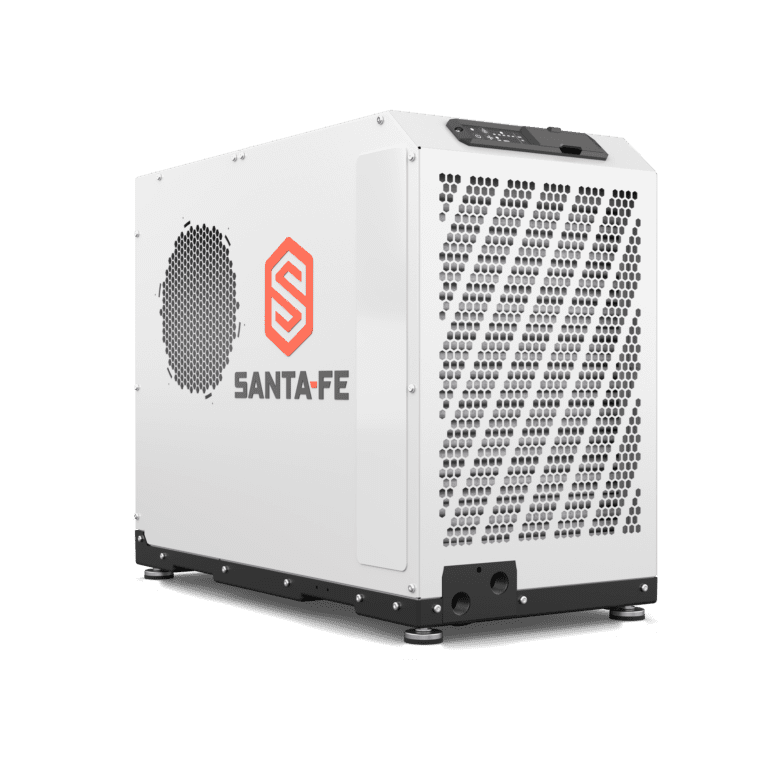
I checked the exact Advance Dry110 product page, the current TS-2136 data sheet and the TS-2135 installation and operation manual. Manufacturer photographs show the cabinet exterior only; internal drainage is established by the manual.
Dual outlets can distribute air, but do not create two independent machines
Santa Fe describes the pair of exhaust ports as a way to distribute treated air to multiple locations. The exact manual calls it a stand-alone appliance intended to operate in the space being dehumidified, and the data sheet describes ducting for divided spaces. That distinction matters: a second outlet can help a designed air path reach another partitioned area, but the product literature does not promise separate humidity settings or independent control for each branch. Duct resistance and layout affect airflow. Its listed 370 CFM is measured at zero external static pressure; a real duct system adds resistance and will not preserve that free-air figure automatically.
The performance figures are useful for comparison when their conditions stay attached. The sheet reports 110 pints per day, 7.7 pints/kWh and 3.66 L/kWh Energy Factor at 80°F/60% RH; at 65°F/60% RH it reports 70 pints, 5.92 pints/kWh and 2.81 L/kWh. These Energy Factor values are not an EPA IEF. The model was absent from the current EPA active certification dataset query, so certification and an IEF remain unconfirmed rather than being inferred from manufacturer efficiency numbers.
Controls are local, and install weight is significant
The Advance Dry110’s onboard digital panel adjusts the relative-humidity set point and fan mode. A terminal block can be wired to the optional SmartAire remote sensor and a separate float switch. Those are wired accessories; the exact pages do not establish Wi-Fi, voice control or a phone app. If app control is essential, this model does not pass that requirement on the evidence reviewed. Its auto-restart and dew-point cut-out are useful installation features, but a low-temperature cut-out does not replace solving an active leak or sizing the room.
The 14.35-by-24-by-29-inch cabinet is supplied with leveling feet. The manual calls for a level installation, 115 VAC supply, a grounded outlet on a minimum 15-amp circuit and access to a suitable drain. The data sheet reports 4.1 amps at 65°F/60% RH; its manual says the unit can operate from 40°F to 95°F but works most effectively between 56°F and 95°F. At 102 pounds, it is not a casual carry-upstairs dehumidifier. Plan where it will stay, how it will be supported if suspended, and who will install the drain and ducting.
The built-in trap is not a pump
This distinction prevents a common matching mistake. The Advance Dry110 includes an internal P-trap design and an 8-foot gravity-drain hose. The trap manages the air and water path; it does not lift condensate. The manual gives a built-in ball-trap option and also describes a conventional external P-trap. A float-switch port is available, but the switch is not included. Gravity drainage still needs a lower outlet and a clear route. Santa Fe sells a separate condensate pump kit for installations where water must rise; that accessory is not the Advance Dry110’s built-in operating plan and should not be treated as included equipment.
The MERV-13 filter, hardwire kit, drain adapter, trap ball and other included parts are listed in the current manual, but version details matter; inspect the carton and current manual for the purchased revision. A raised installation over finished space needs a safe drain pan and overflow shutoff. Cleaning the filter and preserving access to the trap are part of ownership, not optional once the unit is hidden above a ceiling.
Who should shortlist it?
Consider the Advance Dry110 when a basement, crawlspace or attic needs the 110-pint warm-condition rating and a planned duct layout can use the dual outlets. It offers the lowest documented operating-temperature floor in this four-model group, but the manufacturer says best performance is at warmer temperatures. It weighs more than the Oasis105 and has a larger footprint; the Compact70 is easier to fit in a low opening, while the vertical Classic is a basement-specific alternative. None of those alternatives should be substituted without checking the actual duct, airflow and drain requirements. If an uphill drain, mobile room-to-room use, bucket collection or smartphone control is non-negotiable, the Advance Dry110 is not a match in its standard configuration.
Key details at a glance
| Published daily removal rating | 110 pt/day |
|---|---|
| Built-in lift pump | No |
| ENERGY STAR certified | No |
| Published dimensions | Cabinet dimensions only; allow for manufacturer airflow clearances, service access, filter removal and a workable drain route. |
| Bucketless operating mode | Yes |
| Published product weight | 102 lb |
Use the exact model’s instructions for operating limits, supplied equipment and version differences.
Sources for this assessment
- Santa Fe exact current U.S. Advance Dry110 product page
- Santa Fe Advance Dry110 exact-model installation and operation manual
- Santa Fe Advance Dry110 model-specific manufacturer data sheet
- Santa Fe Advance Dry110 exact U.S. product-page-linked image
- U.S. EPA current active certified-dehumidifier dataset exact part/model query

Check the route before the room-size claim.
Match the rated capacity and drainage setup to a real place for the water to go.