
Your needs, this model
Does it fit your priorities?
Does the Compact70 meet its published 70-pint/day threshold?
Yes at the manufacturer's 80°F/60% RH test point. The separate 65°F/60% RH rating is 43.7 pints/day, so the warm-condition nameplate number is not a guaranteed daily room yield.
Explore this need in the finder →Can the Compact70 run bucketless to a lower drain, and does that differ from pump lift?
The exact manual documents the base continuous gravity route with no bucket and no integral lift pump. An uphill essential drain route does not fit the standard configuration.
Explore this need in the finder →Does the Compact70 cabinet fit a 12-inch maximum width?
The exact product dimension is 12 inches wide. This cabinet figure does not include airflow or maintenance clearance.
Explore this need in the finder →Is the dry Compact70 weight within a 55-pound handling limit?
The exact manufacturer sheet lists 55 pounds dry; the number does not include water or installation materials. Plan delivery and lifting accordingly.
Explore this need in the finder →The Santa Fe Compact70 is a low-profile, horizontal dehumidifier for a basement, crawl space or other bounded area where a taller cabinet will not fit. Its model name and 70-pint headline describe the warm 80°F/60% RH rating; the current sheet reports 43.7 pints per day at 65°F/60% RH. It has no collection bucket and no built-in pump, so plan a lower drain before treating its compact cabinet as convenient.
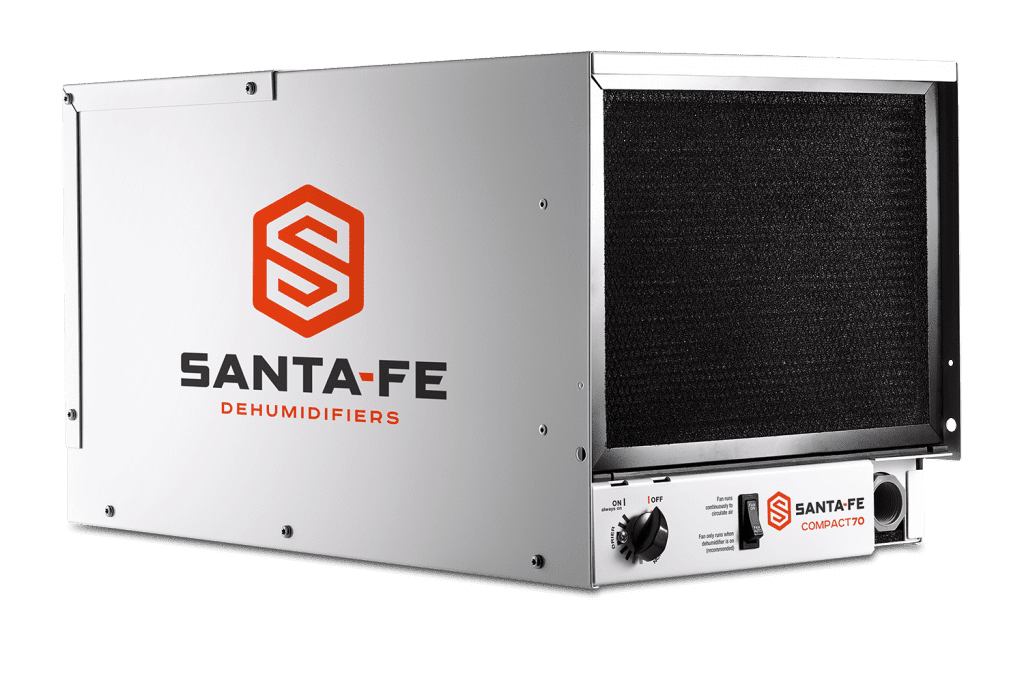
This assessment uses Santa Fe’s exact Compact70 U.S. page, the manufacturer TS-2108 specification sheet and its TS-2081 installation and operation manual. The page-linked cabinet image is an exterior identification aid, not evidence of hidden drain hardware or room performance.
Read both rating conditions, not just “70”
The manufacturer lists 70 pints per day at 80°F and 60% relative humidity, falling to 43.7 pints per day at 65°F and 60% RH. Both are stated test points, not a promise that a cool crawlspace will produce either number every day. Santa Fe also reports 5.5 pints/kWh at the warmer condition and 4.1 at the cooler condition, with Energy Factor values of 2.6 and 1.96 L/kWh. Those are the manufacturer’s named metrics; they are not the EPA Integrated Energy Factor. An exact search of EPA’s active certified-dehumidifier dataset, last updated October 17, 2026, did not find the Compact70 part number or name, so I do not mark this exact unit ENERGY STAR certified or borrow an IEF.
Published room-area guidance also changes with the source and sealing assumption. The detailed page gives separate crawl-space and basement ranges, while the Product Wizard gives a different tighter basement figure. Treat those as broad application guidance, not a load calculation. Repair active water intrusion and excessive outdoor-air entry first; then size from the room’s conditions and consider whether the drain and airflow can be installed as instructed.
The shape is the useful feature
The cabinet measures 12 inches wide by 12 high by 21 deep and weighs 55 pounds. Its horizontal form fits certain low crawlspaces or between floor joists more readily than a 24- or 36-inch-high model. The manual does not turn that size into casual portability: it must sit level, should be installed near the drain, and needs enough service access to remove the filter and reach connections. Santa Fe also offers a hanging installation option, but the manual calls for proper support from structural members and says not to hang it from the sheet-metal cabinet. A flooded location needs a separate elevation or protection plan.
There is a washable pre-filter ahead of the MERV-13 filter. That is useful for routine dust capture, but it does not make the unit a medical air cleaner. The manufacturer’s sheet lists 150 CFM at zero external static pressure, 55 dBA, a 115-volt grounded supply, 3.7 amps at 65°F/60% RH and an operating range of 49–95°F; the manual says it works most effectively from 56–95°F. Leave the air openings clear and clean the filters as the manual directs.
Drainage is not optional convenience
The Compact70 has no tank to empty and no integral lift pump. The manual requires a drain trap and specifies a continuously descending drain run; its slope guidance is one inch per ten feet. The 8-foot gravity hose and adapter are included. The outlet must be lower than the appliance so water can leave without being lifted. If the only drain is uphill, the manufacturer's optional condensate pump kit is a separately purchased accessory, not a built-in Compact70 mode. A pump installed later needs its own power, routing and overflow protection.
The questionnaire’s gravity-and-bucketless choices fit this model only when the installed hose really falls to a suitable drain. A pump-lift essential need does not fit the Compact70 as sold, even though a separate pump accessory exists. It is also not a good match for someone who needs a bucket for an occasional portable setup or wants app control; the exact manual describes local dehumidistat operation and does not establish a phone-control feature.
Who should compare it?
Compare the Compact70 when low height and a horizontal cabinet solve a real installation constraint, and 70/43.7-pint ratings are appropriate for the actual load. It is the lightest and shortest of this four-model Santa Fe freestanding group, but it does not have the capacity margin or dual discharge arrangement of the Advance Dry110, and it is not as flexible in control or drain design as the Oasis105. The taller vertical Classic is a different basement-oriented choice. If the measured space has a low overhead, its 12-inch height is the differentiator; if the drain cannot run downhill, the small cabinet does not solve the essential water route. Confirm the current part number, hose slope, filter, power circuit and service clearances before buying.
Key details at a glance
| Published daily removal rating | 70 pt/day |
|---|---|
| Built-in lift pump | No |
| ENERGY STAR certified | No |
| Published dimensions | Cabinet dimensions only; allow for manufacturer airflow clearances, service access, filter removal and a workable drain route. |
| Bucketless operating mode | Yes |
| Published product weight | 55 lb |
Use the exact model’s instructions for operating limits, supplied equipment and version differences.
Sources for this assessment
- Santa Fe exact current U.S. Compact70 product page
- Santa Fe Compact70 exact-model installation and operation manual
- Santa Fe Compact70 model-specific manufacturer data sheet
- Santa Fe Compact70 exact U.S. product-page-linked image
- U.S. EPA current active certified-dehumidifier dataset exact part/model query

Check the route before the room-size claim.
Match the rated capacity and drainage setup to a real place for the water to go.