
Your needs, this model
Does it fit your priorities?
Does Ultra V100 meet its exact 100-pint/day manufacturer rating threshold?
The exact page and data sheet list 100 pints/day at 80°F/60% RH and 82 at 73°F/60% RH. These are controlled test points, not guaranteed household extraction.
Explore this need in the finder →Can Ultra V100 run with bucketless gravity drainage rather than an uphill pump?
Yes only when the documented 3/4-inch gravity connection can reach a lower drain with the prescribed pitch. The base unit has no tank or built-in pump; a separate pump accessory does not meet an integral-pump need.
Explore this need in the finder →Does the exact EPA record for 4047100 meet its current IEF threshold?
EPA exact model number 4047100 lists certification and an IEF of 2.45 L/kWh. Santa Fe's manual table conflicts at 2.63 L/kWh; the matcher uses the current EPA exact record and preserves the version conflict.
Explore this need in the finder →Is Ultra V100 documented for whole-home HVAC duct integration?
Yes. The exact V-series manual calls it a fixed ventilating dehumidifier that integrates with heating and cooling duct systems; the return, supply, backdraft damper and static-pressure plan still require design.
Explore this need in the finder →Can Ultra V100 provide optional mechanically ducted outdoor air?
The exact model sheet/manual provide an optional 8-inch outdoor-air intake; a separate ventilation calculation, damper/control and code-compliant installation are still required.
Explore this need in the finder →Is the 101-pound dry Ultra V100 within a stated handling limit?
Santa Fe lists 101 pounds for the unit. This is not a safe-lifting recommendation; delivery, suspension supports and service access must be planned separately.
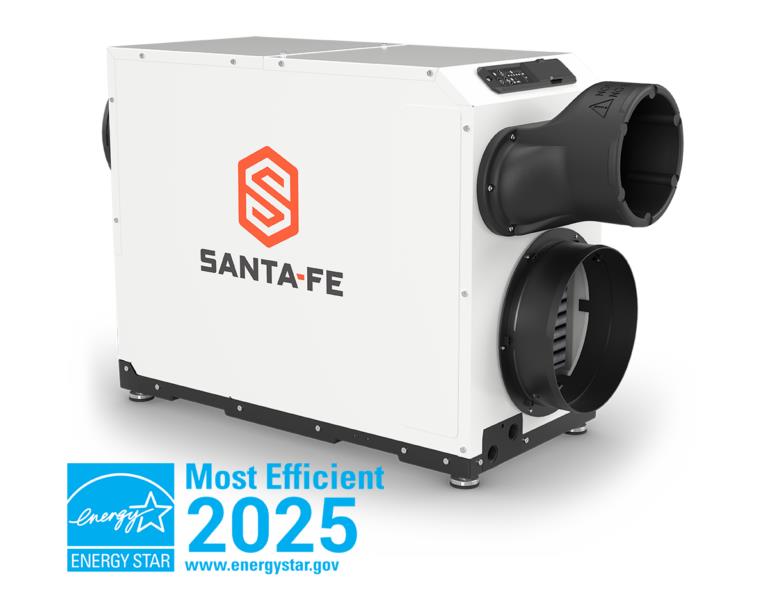
Explore this need in the finder →The Santa Fe Ultra V100 is a fixed, ducted whole-home dehumidifier rated at 100 pints per day at 80°F/60% RH and 82 pints at 73°F/60% RH. Its useful distinction is not simply its capacity: it shares the V-series cabinet, return/supply arrangement, optional outdoor-air inlet and gravity-drain installation with the larger V125 and V155, while remaining the smallest and lightest of the three.
This review uses Santa Fe’s exact V100 product page, its model-numbered TS-2152 data sheet, the shared TS-2157 V100/V125/V155 installation manual and the EPA’s exact 4047100 certification record. Santa Fe’s direct product-page route returned HTTP 403 to the archive request; the recorded browser observation and manufacturer documents are not represented as saved product-page HTML.
A hundred-pint rating is not a room promise
The page and data sheet give 100 pints per day at 80°F/60% relative humidity, 82 at 73°F/60% RH, and up to 2,300 square feet of application guidance. Those are different claims: the pints are controlled test points, and the area figure is a sizing hint based on a ten-foot ceiling, not an engineering calculation. The manufacturer lists 6.4 pints per kilowatt-hour at the warmer test point and 5.55 at 73°F/60% RH. Neither number predicts a particular home’s electricity bill or daily yield; duct resistance and actual return-air conditions matter.
The current EPA record for exact part 4047100 reports ENERGY STAR certification, an Appendix X1 capacity of 85.62 pints/day, an IEF of 2.45 L/kWh and annual energy consumption of 419 kWh. It also lists the model as meeting Most Efficient criteria. That EPA record is not the manufacturer’s 100-pint AHAM-style rating. There is a source discrepancy worth keeping visible: the April 2026 TS-2157 manual’s registration table lists 82 pints and IEF 2.63 for this part, whereas EPA’s current exact record lists 85.62 and 2.45. The 2025 TS-2152 sheet separately calls 3.0 and 2.63 L/kWh “Energy Factor” at its two test points. I use the exact EPA record for the current certification/IEF matcher fields and the product page/data sheet for their separately named ratings rather than combining or averaging the series.
The installation is part of the product
V100 is not a wheeled room appliance: it is designed to be fixed into ductwork, with a dedicated return and supply route to the home or a designated area. The model sheet lists vertical or horizontal airflow discharge, a 10-inch return and 10-inch supply collar, plus an optional 8-inch outdoor-air intake. A qualified installer still has to size the ducts and balance supply paths. The shared manual calls for at least 10-inch round duct up to 25 feet, 12-inch duct for longer runs, and says to reconfigure if system static pressure would reach 0.5 inches water gauge. Its ventilation tables use household area and bedroom/occupancy inputs; an 8-inch collar alone does not prove a code-compliant ventilation rate. The optional damper and remote controls are separate choices, not app control included in the base appliance.
The cited exact EPA record identifies R-454B and 24 ounces of charge. The product page rates water removal at 100/82 pints, while the sheet lists 620 watts at 73°F/60% RH and a 15-amp dedicated-circuit requirement. The manual describes a grounded 120-volt outlet, a ten-foot cord and at least 15-amp circuit capacity; confirm electrical work and the nameplate with the installer, rather than treating a single test-condition amp figure as a circuit-sizing instruction. A MERV-13 filter is supplied, with replacement access on either side. The manufacturer gives 14.35 by 24 by 39.25 inches and 101 pounds, but the page and specification-sheet notes disagree about whether listed dimensions include collars. Measure the full route, filter-removal space and clearances instead of relying on that cabinet number alone. No dBA value is published on the exact page and sheet, so cabinet insulation is not a sound-level test.
Plan the water route before the ducts close in
The normal setup is bucketless gravity drainage. The manual specifies a 3/4-inch male NPT/PVC drain assembly pitched about a quarter inch per foot and requires the outlet to sit at least 6.75 inches above the floor drain so the trap can fit. If the appliance is above finished space, it calls for a secondary drain pan and float protection; the float switch is separate. There is no collection bucket and no built-in lift pump. Santa Fe lists an optional condensate-pump kit for installations that need a lift, but its presence does not give the V100 an included pump plan or a documented lift ceiling. Choose “gravity” and “bucketless” only when the planned drain really falls continuously; a required uphill pump route should exclude the standard configuration.
Who should choose the V100?
Compare it when a designed whole-home return/supply installation needs a 100-pint warm-condition rating, optional outdoor-air capability and a lighter 101-pound chassis than the V125 or V155. If an installer’s load assessment points toward 125 pints, the V125 shares nearly the same cabinet and duct options but carries a different rating and electrical load. The V155 is a higher-capacity, ECCO-equipped alternative with more rated airflow and a distinct efficiency profile. If you need a freestanding appliance, a bucket or a built-in pump, this is the wrong operating class; Santa Fe’s Compact70, Advance Dry110, Oasis105 and Classic are separate stand-alone choices, not interchangeable V100 configurations. Before buying, verify the part number, current manual revision, measured duct static, external control plan, service access and gravity outlet elevation.
Key details at a glance
| Published daily removal rating | 100 pt/day |
|---|---|
| Built-in lift pump | No |
| ENERGY STAR certified | Yes |
| Published dimensions | Exact detail page lists 14.35 × 24 × 39.25 inches while labeling dimensions without collars; manufacturer sheet footnote says unit dimensions and weight are with collars. The difference is retained; do not treat the nominal cabinet figure as an opening or clearance guarantee. |
| Bucketless operating mode | Yes |
| Published product weight | 101 lb |
| Controls and settings | Exact page states onboard digital controls plus 24-V AC terminal block/on-board power. Separate DEH 3000/R or SmartAire remote sensor/damper options require separate purchase and setup. App control not documented. |
| Published integrated energy factor | 2.45 L/kWh |
Use the exact model’s instructions for operating limits, supplied equipment and version differences.
Sources for this assessment
- Santa Fe exact U.S. Ultra V100 product page
- Santa Fe Ultra V100/V125/V155 installation and operation instructions, TS-2157 04/26 Rev H
- Santa Fe Ultra V100 TS-2152 Rev A, 08/25 data sheet
- EPA ENERGY STAR exact Santa Fe part 4047100 current dehumidifier record
- Santa Fe Ultra Series category image linked for exact Ultra V100 listing

Check the route before the room-size claim.
Match the rated capacity and drainage setup to a real place for the water to go.