
Your needs, this model
Does it fit your priorities?
Does this exact model meet a 20-pint/day class need?
Yes in TOSOT’s rounded 2019 DOE class; the exact detailed entry is 21.11 pints/day. The older 2012 comparison number uses a different procedure.
Explore this need in the finder →Can it continuously drain to a lower floor outlet?
The exact page documents a ¾-inch female garden-hose connection for gravity drainage; route the hose downhill to a lower drain.
Explore this need in the finder →Can it pump water up to a raised outlet?
No. The exact TST-NDHM-20WHT specifications state no built-in pump.
Explore this need in the finder →Can this exact retail page establish bucketless or app operation?
No. The page establishes a fitted removable bucket and does not document bucketless operation or app/Wi-Fi control. Unknown features do not satisfy an essential requirement.
Explore this need in the finder →TOSOT’s exact listing identifies TST-NDHM-20WHT as the smallest model in this four-unit family: a 2019 DOE-standard 20-pint class machine with a seven-pint removable bucket and a lower-outlet hose option. Its most useful advantage is physical scale, not a promise that it will remove twenty pints from every small room each day.
Earlier model: TOSOT currently labels this listing discontinued and unavailable. Keep this assessment for an existing unit, model identification or a specific used/clearance comparison; it is not a current new-product recommendation.
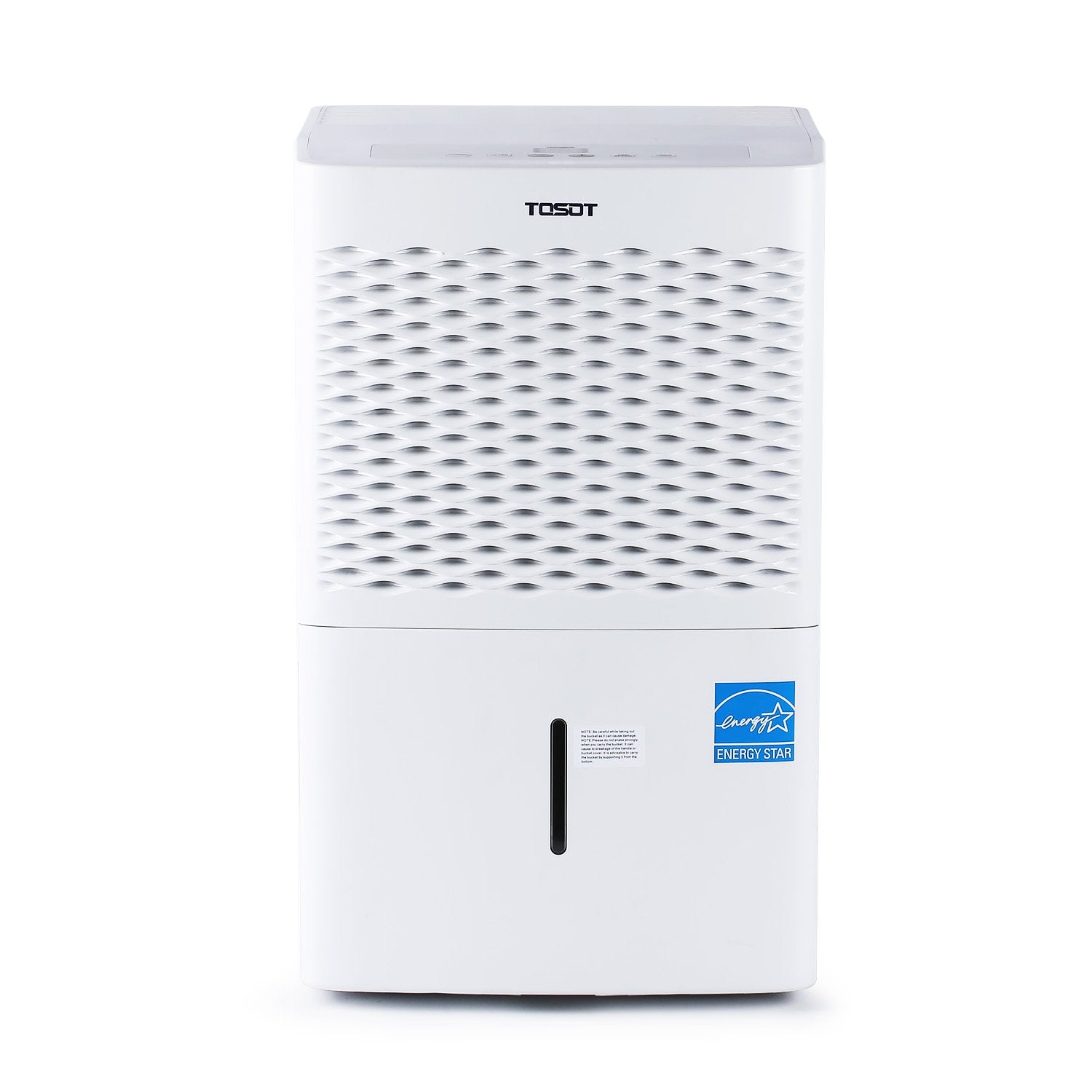
TOSOT links the same front-cabinet image to its exact TST-NDHM-20WHT listing and to other capacities. It shows the cabinet, controls and water-level window, but cannot distinguish a 20-pint unit from the larger models. TOSOT does not state whether the image is a photograph or a rendering.
Manufacturer references: TOSOT’s exact TST-NDHM-20WHT page, its dehumidifier collection and the product-document index. The official document index lists GDN20AZ-A3EBA2A under the matching 20-pint product card and links this TST-NDHM retail page, its exact technical sheet, ENERGY STAR certificate and family manual. The technical sheet agrees with this page at 21.11 pints/day; its 2021 certificate instead reports 20.11, so the review retains the retail-page/technical-sheet value and does not hide the source discrepancy.
Read the capacity label in its test-standard context
The exact product page gives 21.11 pints per day in its detailed specification and calls the 2019 DOE rating 20 pints per day. Its comparison table also gives a 2012 DOE-era 30-pint number. Those numbers belong to different testing procedures; the older label is not evidence that this model is a current-standard 30-pint machine. The fine-grained rating is a manufacturer result under specified test conditions, not an expected bucket fill in your basement. Air temperature, relative humidity, air movement and moisture entering the space all affect actual collection.
TOSOT’s product page also prints suggested room-area ranges. Treat those as manufacturer planning guidance, not as a reliable guarantee for a divided floor plan, damp building envelope or a cold space. If your essential need is a strict rating above 20 pints per day, use the detailed 21.11 figure rather than the old 30-pint comparison label. If you are selecting by a small-room or bedroom description, check the actual moisture load and the manual’s temperature range instead of assuming that square footage alone settles capacity.
The seven-pint bucket sets the emptying routine
The 1-gallon tank holds seven pints. That gives the unit a smaller reservoir than the 1.5-gallon 35-pint and 2-gallon 50-pint family members. A compact bucket can be easier to handle, but it also means more frequent attention when removal is active. There is a full-tank indicator and automatic protection, so the machine stops rather than continuing to send water into an already full tank. The interval between emptying is not fixed: it depends on how much water the unit is actually condensing, not on the maximum rating printed on the cabinet.
For a room with a floor drain below the dehumidifier, the page lists a continuous gravity-hose option. The listed connector is for a garden hose with a ¾-inch female end. The hose still needs a continuously descending path to the lower outlet; a level or uphill route does not become gravity drainage just because a hose is attached. TOSOT also describes a removable bucket, but the exact TST page does not document bucketless operation. Do not remove the bucket and assume the machine will run in that configuration.
What the controls and upkeep ask of you
The specification lists three fan speeds, a humidity setting range from 35 to 80 percent, a two- or four-hour on/off timer, automatic restart after an outage, automatic defrost, washable filtration and casters. The published sound figures are 48, 46 and 44 dB at the high, medium and low settings; those are manufacturer figures, not independent room measurements. The exact page lists 115 volts, 360 watts and 3.1 amps. A power label is useful when checking an existing circuit, but it is not an energy-cost estimate.
The exact-page FAQ recommends warm-water/mild-detergent filter cleaning every 30 days of operation. TOSOT’s document portal maps this retail page to GDN20AZ-A3EBA2A, printed on the family-manual cover; that manual’s filter indicator illuminates after 250 hours of operation. These are two manufacturer maintenance cues, not equivalent elapsed-time schedules. Check the appliance indicator and follow the supplied instructions. The page lists an operating range of 41–90°F; below that span, do not count on normal dehumidification or treat this unit as a freeze-room solution.
Who might keep one—and what it cannot replace
This is a plausible earlier-model reference when the exact TST-NDHM-20WHT identity is already confirmed, a 20-pint-class rating is appropriate and a seven-pint bucket or lower gravity outlet fits the room. It is not the choice when you need a lift pump, a documented bucketless setup, app control, a high published capacity threshold or a quantified energy result. The model’s exact page does not establish Wi-Fi operation or a pump; the larger TOSOT variants should not be treated as mere accessories for this one.
For a larger water load, compare the 35-pint TST-NDHM-35WHT or the 50-pint models, recognizing that they add cabinet size and, in the 50-pint pump version, a separate water-removal capability. If the outlet is already below the unit, the 20-pint’s gravity route may be more relevant than buying a pump. Repair an active leak or persistent water intrusion at its source; a portable dehumidifier is not a substitute for building repair, ventilation design or remediation advice.
Key details at a glance
| Published daily removal rating | 21.11 pt/day |
|---|---|
| Built-in lift pump | No |
| Published bucket capacity | 1 gal |
| ENERGY STAR certified | Yes |
| Published product weight | 31 lb |
| Exact model detail | Exact TOSOT Direct retail model TST-NDHM-20WHT; official product-document portal pairs this listing to manufacturer model code GDN20AZ-A3EBA2A. This retail listing is discontinued/unavailable; it remains useful for existing-owner identification or a specific used reference only. |
Use the exact model’s instructions for operating limits, supplied equipment and version differences.
Sources for this assessment
- TOSOT Direct exact U.S. product page for TST-NDHM-20WHT
- TOSOT Direct U.S. dehumidifier collection snapshot
- TOSOT Direct U.S. dehumidifier collection page 2
- TOSOT Direct product document index
- TST-DHM 2019 DOE family user manual (GDN model cover; no TST crosswalk)
- Official TOSOT document-index map from GDN20AZ-A3EBA2A to retail SKU TST-NDHM-20WHT, with exact code-specific technical sheet, ENERGY STAR certificate and UL report
- TOSOT 2019 DOE family manual, now applied through the exact GDN/TST documentation crosswalk
- Exact product-document-index image attached to GDN20AZ-A3EBA2A; original bytes match the TST retail image

Check the route before the room-size claim.
Match the rated capacity and drainage setup to a real place for the water to go.