
Your needs, this model
Does it fit your priorities?
Does the exact E130 meet the 130-pint warm-condition manufacturer rating?
Yes at the sheet’s specified 80°F/60% RH and zero external static pressure; the same current sheet lists 105 pints/day at 73°F/60% RH. EPA’s 105-ppd Appendix X1 rating is separate, and neither is guaranteed daily household output.
Explore this need in the finder →Can E130 run bucketless on a lower gravity drain, and can it pump uphill by itself?
It has no collection bucket or integral pump. The manual documents a drain to a floor/waste outlet; gravity requires continuous fall to a lower suitable drain. The optional 22-foot Model 4856 is a separate accessory.
Explore this need in the finder →Does E130 pass an essential app-control need?
No. EPA’s current E130 record says Connected Capable: No and AprilAire describes a local control for exact E130. Compare the W suffix if app control is essential.
Explore this need in the finder →Does the current EPA entry support E130 ENERGY STAR and a 2.3 L/kWh IEF minimum?
Yes. EPA’s current exact E130 record lists certification, IEF 2.35 L/kWh, 105 ppd Appendix X1 and E130’s 105-pint annual energy listing.
Explore this need in the finder →The AprilAire E130 is a fixed, high-capacity whole-home and dedicated-space dehumidifier, not a rolling basement appliance. Its headline 130-pint rating applies at 80°F and 60% RH, and the permanent installation needs an air path, service access and a suitable drain. The unlettered E130 has leveling feet, a local digital control, no bucket and no integral pump.
This assessment uses AprilAire’s exact E130 page, its manufacturer-authored 2025 E130 submittal sheet and E130/E130C installation and owner manual, plus the EPA record for E130. Those manuals and sheets were individually checked; the exact product photo is only an exterior identity aid.
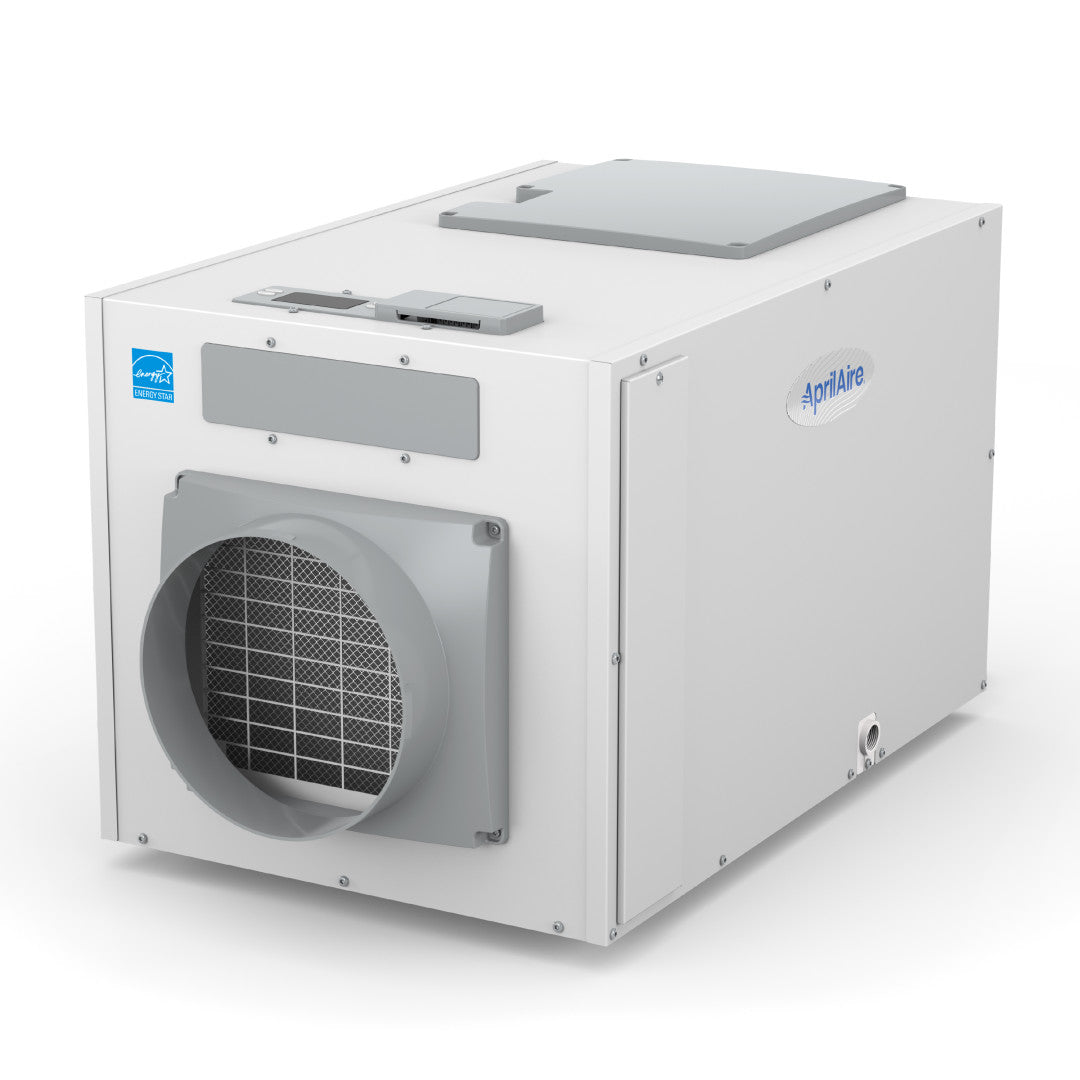
The E130 product-page hero shows a white cabinet, large circular duct opening, access panels and a low drain connection. AprilAire does not say whether the picture is a photograph or a product rendering. It does not prove capacity, internal construction or that a particular duct and drain arrangement will work at your home.
Separate the two capacity yardsticks
AprilAire’s current listing says “up to 130 pints” per day. The E130 manual and current submittal sheet tie 130 ppd to inlet air at 80°F/60% RH and zero external static pressure; the newer sheet also gives 105 ppd at 73°F/60% RH. EPA reports 105 ppd under Appendix X1, with an integrated energy factor of 2.35 L/kWh and estimated annual consumption of 926 kWh. That 105-pint EPA result is a different rating basis from the warm-air manufacturer 130-pint result. Neither means a real home will yield that many pints every day: humidity load, room temperature, air circulation, duct resistance and infiltration all affect the result.
The shop page markets coverage up to 7,200 square feet, but a large marketing area is not a house-specific moisture calculation. A contractor should compare the planned capacity with the actual building, return-air route, crawl-space or basement boundaries, climate and control locations. AprilAire describes several installation patterns—from return-to-return HVAC ducting to dedicated inlet/outlet grilles—so this may serve a whole-home system or one bounded problem area. It is not a replacement for fixing a water intrusion source.
Plan for a permanent installation, not a tank
The current E130 package lists 10-inch inlet and outlet collars, a backdraft damper, washable MERV 8 filter, threaded drain fitting, leveling feet and an eight-foot power cord. Cabinet dimensions are 18.75 inches high by 19.5 wide by 30 long; the submittal notes those cabinet dimensions exclude duct collars and access clearances. The unit weighs 98 pounds and the manual says a two-person lift is required. Leave enough space to open the filter door, reach the drain and service the controls. The manual recommends installing the unit in or above a condensate pan when it sits over finished space and calls for qualified installation that follows local codes.
The control can be repositioned from the top to the front for access in the chosen orientation. The manual lists ventilation and zoning setup as capabilities, but those are installation and wiring decisions, not automatic air cleaning. The MERV 8 filter is washable and needs maintenance; the manufacturer does not support treating it as a medical purifier. AprilAire’s current product page presents six-year coverage (five years full replacement plus one year parts), while the 2025 technical sheet says five years. Confirm the written terms that apply to the specific purchase and installation.
Gravity drainage is the base water plan
There is no removable collection tank to empty and no built-in lift pump. The E130 has a threaded drain connection and included barbed fitting. The manual routes condensate toward a floor drain or condensate pump; gravity works when the installer can maintain a continuous fall to a suitable lower outlet. A clogged or uphill line is not solved by the E130’s capacity rating. AprilAire separately lists Model 4856 as an optional 22-foot-lift pump. That is a separate accessory, with its own wiring and overflow considerations—not an E130 pump mode or a part of the standard box.
For homes without a conveniently lower drain, include a pump, safe overflow shutoff and pan in the installation estimate. If you want to avoid a separate pump, choose a different site or a model with an actual built-in pump plan. The E130’s listed 50 dBA ducted sound figure is a manufacturer specification, not a promise that an unducted cabinet will be inaudible in a finished room.
Who should compare the E130?
Consider this model when a professional design calls for the 130-pint warm test-point capacity, a ductable stationary system, a local control and a lower gravity-drain route. It is a poor fit if you need a water bucket, a light movable appliance, an app, or a guaranteed uphill pump built into the unit. The E130C keeps the same capacity class but adds four casters and ten-foot drain tubing; the E130W adds Wi-Fi/app control. Those suffixes solve different installation preferences and should not be substituted by assuming all E-series variants have the same equipment.
The current EPA record explicitly lists E130 and names E130C as a caster configuration. EPA also marks E130 Connected Capable: No, so its local control is not smartphone control. The rating record does not establish the connected status of E130W, whose separate exact page and manual describe Wi-Fi. AprilAire routes the E130 through its Healthy Air Professional network; the manufacturer pages do not establish local stock, an installed quote or a particular contractor’s design. Ask for the exact suffix, electrical requirements and drain/duct drawing before buying.
Key details at a glance
| Published daily removal rating | 130 pt/day |
|---|---|
| Built-in lift pump | No |
| Wi-Fi enabled | No |
| ENERGY STAR certified | Yes |
| Published dimensions | Exact current product page and E130 sheets give 18.75 in H x 19.5 in W x 30 in length/cabinet depth. Manufacturer notes cabinet dimensions exclude duct collars, filter doors or adjustable feet as applicable; reserve service clearance. |
| Bucketless operating mode | Yes |
| Published product weight | 98 lb |
| Controls and settings | Exact page describes local built-in digital control repositionable from top to inlet/front side; EPA record says Connected Capable No. No app plan is documented for exact E130. |
| Water-removal setup | No bucket or integral pump. The exact current page lists a barbed drain fitting but no tubing. The model-listed manual routes condensate to a floor drain or separate pump; the standard plan is continuous gravity fall to a lower outlet. Model 4856 is external accessory equipment. |
| Care and operating limits | Clean the washable filter and drain per the exact model-listed manual; preserve service access. Install a condensate pan/overflow protection where the manufacturer manual requires it above finished space. |
| Published integrated energy factor | 2.35 L/kWh |
Use the exact model’s instructions for operating limits, supplied equipment and version differences.
Sources for this assessment

Check the route before the room-size claim.
Match the rated capacity and drainage setup to a real place for the water to go.