
Your needs, this model
Does it fit your priorities?
Does the E130W meet the 130-pint manufacturer rating under its documented test conditions?
Its exact sheet gives 130 ppd at 80°F/60% RH and 105 ppd at 73°F/60% RH at zero external static pressure. No exact active EPA row was returned for E130W; do not substitute E130 Appendix X1 capacity.
Explore this need in the finder →Does the exact E130W support phone app control?
Yes. The exact page and model-listed W manual document Bluetooth-assisted setup, Wi-Fi and the Healthy Air app for control, alerts and diagnostics. Network compatibility and cloud service lifetime are not guaranteed.
Explore this need in the finder →Can it drain continuously without a bucket, and does it include a built-in pump?
The E130W has no collection bucket or integral pump. Its normal model-listed drain route is continuous gravity to a suitable lower floor/waste outlet; Model 4856 is separate optional pump hardware.
Explore this need in the finder →Can exact E130W meet an essential ENERGY STAR certification and IEF minimum from the current record?
Unknown. The exact current E130W dataset query is empty; the page/manual’s dated Most Efficient 2025 statement is not enough to transfer E130 certification or its 2.35 IEF. Unknown does not meet an essential certification or IEF filter.
Explore this need in the finder →The AprilAire E130W is the 130-pint Wi-Fi member of the E-series whole-home line. Its app is the reason to consider the W suffix: AprilAire documents Bluetooth setup, Wi-Fi connection and Healthy Air app controls, alerts and diagnostics. The rest remains a heavy stationary system with duct collars and a continuous drain plan, not a wheeled bucket appliance.
This review is based on the exact AprilAire E130W page, the model-listed 2025 E070W/E080W/E100W/E130W manual (reused from this site’s archive), the exact E130W sheet and an exact-string EPA active-dataset query. The query returned no row; the W model’s certification and EPA IEF therefore remain unknown rather than borrowed from E130.
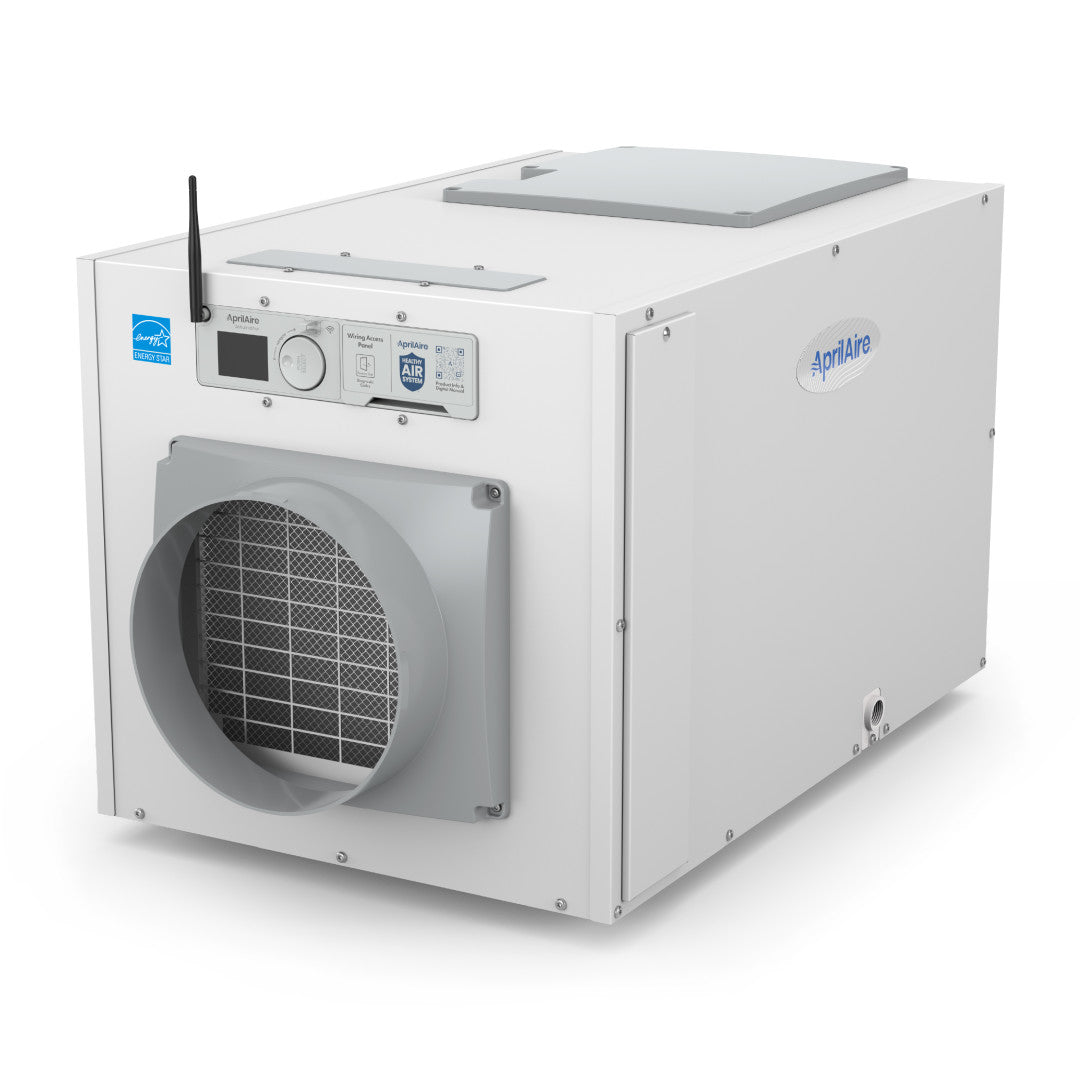
The E130W product-page hero shows the fixed cabinet, front digital control and external antenna. Its gallery is linked by the exact W-model manufacturer page. AprilAire does not say if the art is a photograph or rendering, and the exterior cannot prove app behavior; the product page and W-family documentation do that separately.
The app distinction has a practical use—and limits
AprilAire documents a Bluetooth pairing sequence followed by connecting the unit to home Wi-Fi and the Healthy Air account. The app can control the dehumidifier and provide alerts, diagnostics and updates. This is useful when the cabinet lives in a crawl space, mechanical room or other location you do not visit often: a phone can show status without requiring the user interface to remain visible. The exact manual also describes Wi-Fi connection and troubleshooting; network compatibility, cloud-service lifetime and uninterrupted connectivity are not guaranteed by the product documentation.
The E130W page also offers a local color graphical control, which may be placed at the top or front, and the manual says Bluetooth pairing is available at power-up for a limited period before it must be restarted. That means this is not merely a remote sensor disguised as an app: a successful app setup depends on working through the documented account and network process. If you do not want an account, cloud setup or Wi-Fi dependency, the non-W E130 is the simpler local-control choice. If you need casters rather than app control, compare E130C.
Check what the 130-pint headline measures
The exact E130W sheet lists 130 pints per day at 80°F/60% RH and 105 at 73°F/60% RH, with manufacturer energy factors of 2.9 and 2.35 L/kWh at those respective test conditions. It gives 310/270/225 CFM at 0/0.2/0.4 inches water-column static pressure, 98 pounds, 50 dBA ducted and a 19.5-inch-wide by 18.75-inch-high by 30-inch-long cabinet. These are conditions and dimensions a contractor can use when comparing an actual installation, not a prediction of daily water removed in your building.
AprilAire markets this model for homes up to 7,200 square feet, but area alone does not size a humidity load. Return duct availability, air mixing, leakage, temperature and whether the target is a whole house or a separated below-grade space matter. The E130W sheet describes several duct arrangements and warns about the airflow/pressure conditions. Do not assume an existing duct connection is appropriate just because a collar fits.
Water and service planning still come first
E130W has no collection bucket and no built-in condensate pump. Its page package lists a barbed drain fitting, not a pump, and the model-family literature describes drainage to a common floor or waste drain. A gravity route therefore needs continuous fall to an appropriate outlet. The separately listed AprilAire Model 4856 has a 22-foot lift rating, but is external accessory equipment. An uphill outlet requires that separate pump and its own electrical/overflow protection; a smartphone app cannot compensate for a bad drain line.
The washable MERV 8 filter and drain need periodic cleaning. The W manual also explains service alerts and maintenance reminders but is clear that filter and drain upkeep still falls to the installer/homeowner. Because the cabinet weighs 98 pounds and the manual requires a two-person lift, plan a service path and the manufacturer’s finished-space condensate protection before installation. The current product page lists a six-year arrangement (five years full replacement plus one parts year), while the W sheet says five years; rely on the current written terms from the selling professional.
Do not assume an EPA result from the E130 sibling
The current E130 EPA record shows 105 ppd Appendix X1, IEF 2.35 and Connected Capable: No, but its additional model field lists E130C and E130H—not E130W. The E130W-only query in the current EPA active dataset is empty. AprilAire’s exact E130W page and its model-listed manual carry a Most Efficient 2025 statement, but that dated manufacturer claim does not establish current exact EPA certification or an IEF for this W configuration. Keep those fields unknown if certification is essential; do not select E130W by borrowing the non-W model’s data.
Consider E130W when you need a professionally planned high-capacity system, the app helps you monitor an out-of-the-way installation and you can provide gravity drainage or separately arrange a pump. Skip it when a bucket, built-in pump, verified current ENERGY STAR listing, or simple plug-and-roll portability is a must. The manufacturer routes it through Healthy Air Professionals; ask for a quote that states exact model, drain and duct design, electrical supply, app/network setup and warranty coverage.
Key details at a glance
| Published daily removal rating | 130 pt/day |
|---|---|
| Built-in lift pump | No |
| Wi-Fi enabled | Yes |
| Published dimensions | Exact current product page and E130 sheets give 18.75 in H x 19.5 in W x 30 in length/cabinet depth. Manufacturer notes cabinet dimensions exclude duct collars, filter doors or adjustable feet as applicable; reserve service clearance. |
| Bucketless operating mode | Yes |
| Published product weight | 98 lb |
| Controls and settings | Color digital control with Wi-Fi/Bluetooth and Healthy Air app. Pairing needs Bluetooth setup and a usable Wi-Fi/account path; no household network or long-term cloud guarantee is asserted. |
| Water-removal setup | No bucket or built-in pump. W sheet lists a threaded/barbed drain fitting; model 4856 is a separate optional 22-ft-lift accessory. The documented basic plan is continuous gravity drainage to an appropriate lower floor or waste drain; the pump accessory is separate. |
| Care and operating limits | Clean the washable filter and drain per the exact model-listed manual; preserve service access. Install a condensate pan/overflow protection where the manufacturer manual requires it above finished space. |
Use the exact model’s instructions for operating limits, supplied equipment and version differences.
Sources for this assessment

Check the route before the room-size claim.
Match the rated capacity and drainage setup to a real place for the water to go.