
Your needs, this model
Does it fit your priorities?
Does the ADHR22LB meet a 22-pint/day rating threshold?
GE lists 22 pints per day for this exact suffix; the rating is not a promise of room-specific collection.
Explore this need in the finder →Can the ADHR22LB use a hose leading down to a lower floor drain?
Its family manual documents a separate gravity hose to a floor drain and requires the bucket to be securely seated.
Explore this need in the finder →Does the ADHR22LB meet a required app-control choice?
Wi-Fi is not established in the exact specification row or ADHR manual; do not count generic page copy as a confirmed app feature.
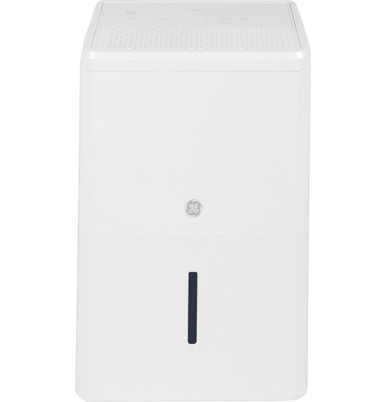
Explore this need in the finder →The GE ADHR22LB is a compact 22-pint/day dehumidifier with an 8.5-pint bucket, a 19.5-inch cabinet and basic Smart Dry humidity controls. Its strongest distinction is the smaller 22-pint rating in the older ADHR family, not a special way to remove water: the manual requires the bucket to stay seated even when a gravity hose is attached. GE now labels the exact model no longer manufactured, so this review is an owner and earlier-model reference rather than a current purchase recommendation.
The assessment uses the exact GE ADHR22LB page, its model support record and the linked ADHR22/35/50 owner manual, 49-5000627 Rev. 0.
A lower-capacity choice with a small cabinet
GE lists 22 pints per day, an 8.5-pint tank, 33.2 pounds net and a 19.5 × 13.5 × 10-inch cabinet. The manual identifies casters for this 22-pint model; install them and let the unit stand upright for an hour before use. Those figures are useful when a height, doorway or moving limit is the first constraint. The 22-pint rating is not a promise that a particular basement will yield that much water each day. Room temperature, humidity, placement and airflow affect the result, and the manual says enclosed rooms work best when outside doors and windows are closed.
The bucket holds only 8.5 pints—about 1.06 gallons—so it is much smaller than the published daily extraction rating. The appliance stops when the tank fills or is not seated properly. If you cannot visit the room to empty it, a bucket-only plan may be a poor match even though the cabinet is easy to place. A separate garden hose can route water down to a floor drain, but it is not supplied, must slope downhill, and the bucket must be reinstalled and securely seated. This is not a bucketless setup and no pump lift is listed for ADHR22LB.
Controls and energy figures need context
The exact page lists a 1.57 L/kWh integrated energy factor, 115 volts, 250 watts, three fan speeds, a washable permanent mesh filter, and 124/100 CFM high/low airflow. GE also lists 48.5 dBA maximum and 45 dBA at low speed. These are manufacturer figures, not independent measurements or a forecast of an electric bill. The lower IEF is a meaningful published distinction from the ADHR35LB’s 1.8, but it should not be turned into a room-level efficiency claim.
The family manual lets you select 35%–80% relative humidity in five-point steps or Nonstop operation. Smart Dry automatically varies the fan based on the selected humidity; High, Medium and Low are the manual speed choices. The display is stated as accurate to ±5%. An auto-shutoff, full-bucket alarm, automatic defrost, power-outage restart and 24-hour delay controls help with routine operation, but none removes the need to keep the rear filter clear. GE calls for checking and washing it at least every 250 operating hours, letting it dry before reinstalling, and cleaning the bucket every few weeks.
Fit the placement and operating conditions
GE specifies indoor residential use, a 41°F–90°F operating range and at least 18 inches of open air space on all sides. That clearance can take more floor area than the cabinet dimensions suggest. Top discharge also needs room, and the front bucket needs a straight path out. The manual says that a dehumidifier in a basement may not dry a closed adjacent closet without air circulation, so do not treat a square-foot marketing statement as proof that air can reach a blocked space.
Who should keep it in the comparison?
This model makes sense to identify an existing ADHR22LB, evaluate a specific older-unit listing, or compare a compact 22-pint class against a 35-pint alternative. It is a poor fit when the essential need is a pump, bucketless operation, proven app control, or a current-manufacture guarantee. The exact page describes the ADHR22LB as no longer manufactured and its support record dates production from March 2022 through January 2025. A clearance page is not proof of local stock, warranty coverage or a seller’s actual condition. Match the suffix on the appliance label and check that the bucket, casters and filter are present. For a current 22-pint comparison, see the Midea MAD22S1AWWT or Frigidaire FHDD2234W1; their exact current assessments address their own controls and drain plans.
Key details at a glance
| Published daily removal rating | 22 pt/day |
|---|---|
| Built-in lift pump | No |
| Published bucket capacity | 1.06 gal |
| ENERGY STAR certified | Yes |
| Published low-fan sound rating | 45 dBA |
| Published high-fan sound rating | 48.5 dBA |
| Published dimensions | 19.5 in H × 13.5 in W × 10.0 in D |
| Bucketless operating mode | No |
| Published product weight | 33.2 lb |
| Controls and settings | Manual specifies 35–80% RH in five-point steps or Nonstop, ±5% humidity-display accuracy, three manual fan speeds plus Smart Dry auto, 24-hour delay, auto restart, auto shutoff and automatic defrost. |
| Water-removal setup | A separate garden hose (not included) runs downhill to a floor drain. The bucket must be reinstalled and securely seated; neither family manual establishes bucketless or pump operation. |
| Care and operating limits | Clean the rear permanent mesh filter at least every 250 hours and let it dry before reinstalling; clean the bucket every few weeks. Indoor residential use only, 41°F–90°F and 18-inch clearance. The manual says 22/35-pint models require caster installation and one hour upright before use. |
| Published integrated energy factor | 1.57 L/kWh |
Use the exact model’s instructions for operating limits, supplied equipment and version differences.
Sources for this assessment
Check the route before the room-size claim.
Match the rated capacity and drainage setup to a real place for the water to go.